After suffering sharp declines in the wake of the Great
Recession more than a decade ago, the Ontario and Hollywood Burbank airports
have re-emerged as significant alternatives for air travelers in and out of the
Los Angeles basin in the past few years.
Their rise has come as the area’s two other secondary
airports, John Wayne and Long Beach, have bumped up against capacity rules.
Meanwhile, vehicular access to LAX has gotten so bad of late that the Los
Angeles Times labeled the airport a “traffic-choked zoo” in an October
editorial.
At Ontario, located in the area dubbed the Inland Empire,
approximately 55 miles northeast of LAX, officials are expecting the full-year
2019 passenger count (arriving and departing passengers) to come in at
approximately 5.5 million, up from 5.1 million in 2018.
Since bottoming out in 2013 at just under 4 million
passengers, Ontario has enjoyed growth of close to 40%. The rise followed a
six-year period during which Ontario’s passenger count plunged 45% from its
2007 peak of 7.2 million.
Ontario currently offers 24 routes, deputy CEO Atif Elkadi said. New in 2019 were flights to San Francisco, Atlanta
and Houston. The previous year saw the launch of China Airlines flights between
Ontario and Taipei, which taps into the Inland Empire’s large Taiwanese and
broader Southeast Asian communities. And this spring, Frontier will launch new
flights to Guatemala City and San Salvador, El Salvador.
The arc has been similar at Hollywood Burbank, which enjoys
a convenient location in Burbank, 30 miles north of LAX and 10 miles from
Hollywood. Burbank’s passenger numbers peaked in 2007 at 5.9 million before
dropping 35% to a low in 2013 of 3.8 million. By 2018 the count was back up to
5.2 million, and the airport had served 4.9 million passengers through October
2019, up 13.5% year over year.
Burbank currently offers 17 routes. New destinations last
year included Dallas/Fort Worth, Atlanta and Nashville, and flights to Boston,
Chicago Midway and Houston Hobby were added in 2018.
As Ontario and Burbank continue their upward arcs, growth is
stunted at Orange County’s John Wayne Airport and in Long Beach.
At Orange County, where airlines flew 2.5% fewer seats in
2019 than in 2016, according to the flight data analytics company OAG, local
provisions cap total annual passengers at 10.8 million through this year before
allowing a jump to 11.8 million through 2025. The airport served 10.7 million
customers in 2018.
In Long Beach, scheduled seats dropped 5.6% in 2019,
according to OAG. A local noise ordinance caps jet operations at the airport at
50 flights daily. Last year’s capacity drop, said Long Beach-based industry
analyst Brett Snyder, who pens the Cranky Flier blog, was due in large part to
Delta taking over a portion of what had been JetBlue’s flight authorizations,
then using them for regional rather than mainline jet operations.
Officials at both Burbank and Ontario said recently that a
strong economy and the ease of accessing their airports are part of why they
are now growing rapidly.
“I think we are benefiting from construction and the
resulting traffic at LAX,” said Nerissa Sugars, Hollywood Burbank’s director of
marketing communications and air service. “We consistently tell people, on an
average you can be dropped off at the curb and get to your gate in 12 minutes.”
But other unique factors are also at play.
Sugars said a major cause of Hollywood Burbank’s growth has
been its 2017 name change from Bob Hope Airport. The move, she said, has
resulted in more people understanding that its location makes it a viable
alternative to LAX.
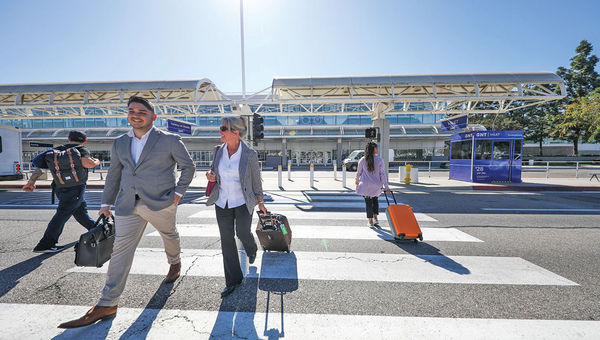
Passengers at Ontario Airport in San Bernardino County, which has space to expand, unlike other area airports.
Burbank is also enticing to airlines because of its
exceptionally low fees of just $2.17 per enplaned passenger. By comparison, the
cost per enplaned passenger at LAX is estimated to be $17.42 for 2020,
according to Los Angeles World Airports, which runs LAX.
Ontario officials said their airport has benefitted strongly
from its 2016 handover by Los Angeles World Airports to an airport authority
run by the city of Ontario and San Bernardino County.
Also, the Inland Empire is the fastest-growing area in the
Los Angeles basin, buoyed by its affordability relative to Los Angeles County.
Ontario Airport spokesman Steve Lambert said the area is projected to grow by
35% in the next 25 years.
Elkadi said he expects Ontario to service 6 million
passengers this year and to grow steadily from there to 10 million or 11
million passengers per year.
Snyder said that over time, Burbank is likely to see growth
suppressed by opposition from surrounding residents. The airport is currently
in the planning stages to build a new terminal. But like the existing facility,
it will have 14 gates. Ontario, on the other hand, is located in a more
industrial area and has space to grow.
“Ontario, sky’s the limit,” he said.