One week after Hurricane Maria battered Puerto Rico on Sept.
20, and with the airport still closed to commercial traffic, Spirit Airlines
flew an Airbus A321 into Aguadilla to offer a free relief flight out.
Because the northwestern Puerto Rico city still lacked
power, Spirit was unable to advertise the unscheduled service, said Barbara
Webster, the airline's director of emergency response. Nevertheless, she said,
all 228 available seats were filled within five hours.
One week later, on Oct. 3, Spirit flew its third Aguadilla
relief flight, this time bringing along from its South Florida base
cardiologist Walter Pinedo and urgent care physician Mario Fernandez. Among the
passengers on the return trip were more than 50 who needed wheelchair
assistance as well as more than 30 over age 80.
"Because Spirit has so many employees and people with
loved ones throughout the Caribbean, I think it really hit us hard,"
Webster said of Maria. "We wanted to do everything we could to assist
them."
In the aftermath of Maria, as well as hurricanes Harvey and
Irma this year, Spirit said it delivered some 200,000 pounds of supplies to
affected communities, flew more than 3,500 people to safety at no charge and
pledged to match up to $150,000 in donations to the Red Cross.
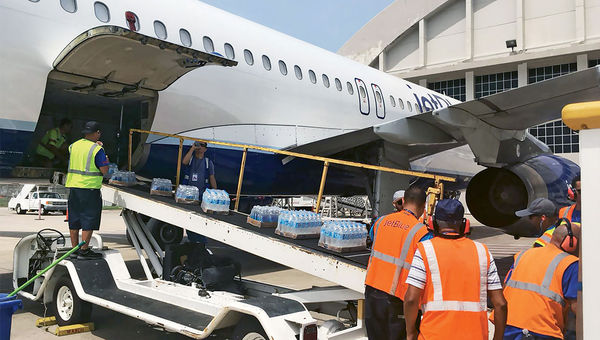
Relief supplies being unloaded from a JetBlue relief flight in Aguadilla after Hurricane Maria.
But Spirit was by no means alone among U.S. airlines in
making extensive efforts to provide relief to communities that were hard-hit
during the extraordinary 2017 hurricane season.
United operated 46 relief flights to assist victims of
hurricanes Harvey, Maria and Irma, in the process flying more than 2,000
evacuees out of affected areas while delivering more than 1.7 million pounds of
supplies to Texas, Florida, Puerto Rico and other Caribbean islands, the
carrier said.
Delta said it operated nine relief flights to the affected
regions, shipped more than 600,000 pounds of relief supplies and made donations
totaling $2.75 million to Red Cross organizations.
American operated nine relief flights for Irma and Maria
victims, transporting more than 2.5 million pounds of supplies and more than
100,000 meals. On return flights with those aircraft, American evacuated 2,700
storm victims, the carrier said. In addition, the airline said it had raised
nearly $2 million for the Red Cross.
Southwest ran 18 humanitarian flights after Maria, carrying
more than 1,100 people out of Puerto Rico free of charge. The carrier also
donated $1.1 million to charitable causes benefitting Houston and Puerto Rico,
and it transported more than 5,000 rubber boots to Houston for rescue teams.
JetBlue, meanwhile, donated $1 million in supplies to Puerto Rico and by Sept. 29, had
airlifted more than 3,000 people on 21 flights from San Juan and Aguadilla. The
carrier, which flies more times per day through San Juan than any other
airline, also made a commitment to provide a broad range of aid to the island
through late December.JetBlue did not provide updated figures on its relief
flights for this report.
Despite the negative impressions that many have of the U.S.
airline industry, such humanitarian efforts in times of disaster are common,
industry experts say.
"This industry, it just does that stuff," said
Holly Hegeman, author of the weekly newsletter PlaneBusiness Banter. "I
don't think its anything unusual. They've got the metal, and they know it's
good in the long term."
Kevin Healy, CEO of Charlottesville, Va.-based Campbell-Hill
Aviation Group and a former planning and marketing director at AirTran, said he
was working at the carrier when it ran relief flights into Gulfport, Miss., and
Shreveport, La., following Hurricane Katrina.
AirTran also offered cheap, last-second flights out of New
Orleans ahead of Katrina, running as many flights as it could.
"Airlines aren't public utilities" Healy said. "It's
tricky. You've got shareholders and boards to be accountable to, but you always
want to help as long as you can."
Indeed, the efforts of airlines this year went far beyond
relief flights and charitable donations. Carriers also used larger aircraft
than usual for flights and added flights ahead of storms while capping ticket
prices both before and after the hurricanes struck.
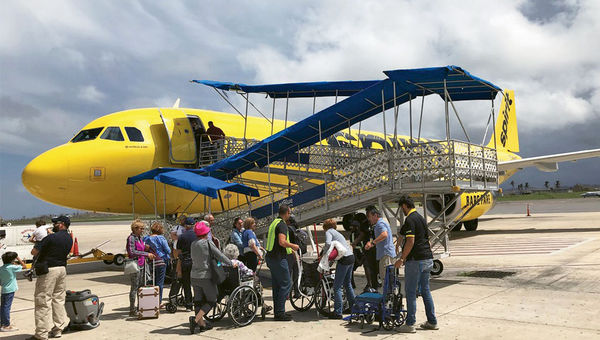
Passengers board one of Spirit's relief flights in Aguadilla, Puerto Rico, on Sept. 29.
United, for example, said it offered 13,600 extra seats to
affected areas this storm season. JetBlue has capped fares to and from Puerto
Rico at $135 through Nov. 15, a fare that includes two checked bags and free
pet carriage.
Other airlines also capped ticket prices ahead of storms,
but the broad move in that direction didn't come until after accusations of
price gouging dominated one of the pre-Irma news cycles as people trying to get
out of Florida encountered four-figure ticket prices.
Experts said those high prices were not price gouging, but
rather the result of the airlines' revenue management programs performing their
usual computerized functions of measuring supply versus demand on typically
expensive close-in bookings. Still, that shot of bad press exemplified the
razor's edge that airlines walk these days in the court of public opinion.
Hegeman said that while airlines have done good deeds in
hurricane zones this year, they have likely been more cognizant of publicizing
those efforts than they have been in storm seasons past.
"What I don't like to see particularly is when airlines
put film crews there," she said.
In the case of Spirit, Webster said, public relations
considerations haven't been a factor in the relief efforts.
"In fact, we didn't allow reporters on our aircraft for
relief flights because we wanted to bring the maximum number of people out,"
she said. "We do it because we think it is the right thing to do."