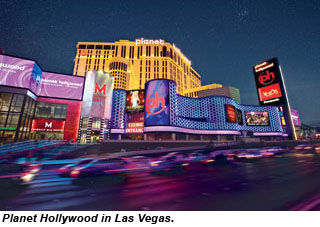
 As travelers increasingly find themselves subjected to hidden fees and surcharges, Harrah's Entertainment is bucking one growing trend by eliminating resort fees at its two newest properties in Las Vegas.
The move makes Harrah's the only major casino operator on the Strip to completely remove what has become an almost standard $20-a-day surcharge at Las Vegas properties as well as at a variety of other resorts around the world.
But don't expect Harrah's move to become an industry movement.
"Once you get hooked on this resort-fee scheme, getting off the train is tough because you are walking away from a lot of money," said Michael Weaver, vice president of marketing for Harrah's Las Vegas properties.
Weaver estimated that resort fees in Vegas last month alone totaled $12 million.
He said Harrah's properties never had resort fees, but the company inherited the fees when it took over Planet Hollywood Resort & Casino and the Westgate Towers earlier this year.
While the company's recent elimination of those fees at the new properties is unique, it does not mean that extras at Planet Hollywood and Westgate Towers are free or that the room rate is cheaper. It just means that guests have control over whether they want to pay extra to use the telephone, gym or high-speed Internet, he said.
In fact, Weaver said, customers might find that Planet Hollywood rates go up a bit "because the rate that you end up being quoted is the actual rate you are going to pay. It is an honest reflection of what you are going to pay."
He added: "It is conceivable that when you call our reservations line and get quoted $100, and the competition is [quoting] $80, it makes it seem like it is more expensive, but it is not."
Still, Harrah's customers will have to pay for the extras they use, and Bjorn Hanson, a professor at New York University's hospitality school, said he expects surcharges for extras will only continue growing across the industry.
"There may be local competitive initiatives like Harrah's, and responses to those, but these will be the exceptions," said Hanson, who has been monitoring the growth of fees and surcharges by hotels.
"In fact, the trend is the opposite," he said. "There are both increases in the fees and increases in the number of hotels charging them."
Fees and surcharges emerged as an industry practice around 1997 with the implementation of resort fees and have increased every year, except for periods following the 9/11 terrorist attacks and the steep decline in travel demand during the 2009 recession, Hanson said.
Hanson said hotel fees peaked in 2008, when they totaled $1.75 billion in the U.S. alone.
Extras, extras!
That number fell to $1.55 billion last year, he said, both because hotel occupancy was down and because properties were reluctant to charge extra fees for fear of further eroding demand.
But with hotel demand back on the rise, Hanson said, so are fees, which he estimates will total $1.7 billion in 2010.
Examples of the extra charges Hanson has been monitoring include resort or amenity fees, early-departure fees, reservation cancellation fees, Internet fees, phone call surcharges, the costs of local calls, business center fees (i.e., charges for sending or receiving faxes and sending or receiving overnight packages), room service delivery surcharges, minibar restocking fees, charges for in-room safes and automatic gratuities and surcharges.
For groups, Hanson said, there have been increased charges for the services of bartenders and other staff at events; charges for the setup and breakdown of meetings rooms; charges for meetings rooms in which meals are served (the common practice has been that there is a charge for meetings rooms but not an additional room charge for rooms in which meals are served); fees for master folio billing; and baggage holding fees for guests leaving baggage with bell staff after checking out of a hotel but before departure.
While there have been many headlines about outrage over the growing number of ancillary fees charged by airlines, Hanson said those reports have in some ways enabled the hotel industry fees to fly under consumers' radar.
"Many people see the airline charges as more troubling," he said, "so, by comparison, the hotel industry looks modest."
Planet Hollywood and Westgate join Caesars Palace, Harrah's Las Vegas, Paris Las Vegas, Rio All-Suites Hotel & Casino, Flamingo Las Vegas, Bally's Las Vegas and Imperial Palace as official "no-resort-fee zones," the company said in a news release.
Weaver said the only other major Las Vegas Strip-area property he knows of that does not charge a resort fee is the Hilton.
This report appeared in the Aug. 16 issue of Travel Weekly.