Whenever Toni Lanotte-Day travels, which is often, she constantly posts to her Facebook account, whether it's photos of what she ate for dinner, unique cultural experiences or quick reviews of places or experiences.
"As soon as I get back from wherever I'm traveling to, my phone is ringing off the hook," said Lanotte-Day, the owner of Levittown, N.Y.-based Toni Tours Inc. "It kind of keeps me in the forefront of people's minds."
What Lanotte-Day is experiencing is not unique. In the last few years, agents have increasingly turned to social media sites like Facebook (by and large the most popular, followed by other sites like Twitter, Instagram and Pinterest) to supplement more traditional branding, marketing and networking efforts.
In turn, they are generating leads from old and new clients alike and have also found a forum where they can connect with other agents instantaneously to help better serve those clients.
Yet, increasingly, they are finding that the rich personal interactions made possible by social media are ultimately effective only if they are part and parcel of larger, more traditional marketing, branding and networking strategies.
Curating a distinctive personal brand
Social media has become key in agents' branding efforts, and brand awareness is key for agents' business, according to Andy Ogg, sales and marketing director for the Ogg Marketing Group.
"You're not selling just a service; you're selling yourself," he said. "You're selling your experiences, you're selling your contacts and you're selling what you have done."
Facebook and other sites that enable users to upload photos and videos have become an ideal space for agents to show clients their personal brand. For many, it's also an easy way to get themselves and their names out there outside of traditional branding efforts.
Yet, Jackie Friedman, president of Nexion, insists, "It's definitely not replacing; it's supplementing. It just reaches a different audience."
Traditional branding techniques are still important, especially to home-based agents, Friedman said.
"We always tell them, 'Don't sit back and wait for the phone to ring, because it's not going to,'" she said.
Increasingly, though, social media is becoming a useful, free outlet when it comes to branding.
Mara Hargarther, a CruiseOne franchisee of Ponte Vedra Beach, Fla., is another agent using social media to build her brand by posting personal photos to her Facebook page.
In September, Hargarther and her husband took a cruise on the Norwegian Getaway for a personal vacation. She went on an excursion to swim with dolphins, and she shared photos from that experience on her Facebook page.
"You have no idea how many people called me after and said, 'I want to do that excursion. Can I do it on my cruise?'" she recalled. Her photos of the ship itself also generated a good deal of likes and comments.
Jason Olson of True Vacation Travel said he wears two hats when it comes to social media: that of an agency and that of an agent.
"At the agent level, each agent as a person needs to establish their own brand, which needs to be consistent with, but not the same as, their agency's," he said.
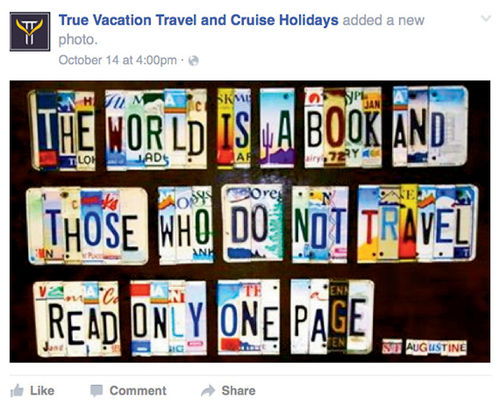
True Vacation Travel’s Facebook page. The company views efforts like TV and print ads as a means of reaching an older demographic, while social media is used to connect with millennials.
For example, True Vacation Travel focuses on luxury travel, so that is the agency's broad, sweeping scope when it comes to social media; think "wanderlust" posts, he said.
But at an agent level, he encourages the staff to identify their niches. He has two Disney specialists whose pages are filled with their own Disney photos as well as photos shared from the corporate Disney account; there is no mistaking their specialty.
Focusing on themselves and their specialties via social media pages is key for agents, according to Emily Peters, business development manager at MTravel, Montrose Travel's host agency. That enables agents to build credibility among their current and prospective clients, she said.
Terrie Hansen, senior vice president of marketing at Virtuoso, said that sharing first-hand experiences via social media is "about interacting with people and having a conversation to establish credibility with prospects as well as strengthen relationships and foster loyalty among existing clients."
Hansen pointed specifically to agents in the millennial generation, who are taking advantage of increased mobility to share their experiences while building up their business "in record time," which she attributed largely to social media.
Margie Jordan, vice president of member services at CCRA Travel Solutions (CCRA), was recently on a fam trip in Italy. She turned the experience into a teachable moment and shared her formidable knowledge of social media with the agents present.
"One of the things I'm encouraging agents to do on social media is not just show how pretty the room is or how beautiful Florence is. I'm asking them to take it one step further and talk about the experience," she said.
"What was it like seeing Michelangelo's 'David' for the first time? How was the authentic bistro or cafe you found down the alley where the locals dine? It's those tips that make us the real deal."
Leveling the marketing playing field
Once agents have established their personal brand, they can turn to social media as a marketing tool. Facebook again was the most popular platform for marketing, though agents could apply marketing techniques on a variety of other sites.
Ann van Leeuwen, president of the National Association of Career Travel Agents, is seeing an uptick in the number of members using social media in addition to their more traditional marketing plans.
"They're sharing a deeper level of marketing than you could otherwise get through a traditional print piece," she said. "Social media is able to provide and supplement the traditional marketing with a more customized approach. And, it's more targeted."
Vanessa McGovern, executive vice president of business development and strategic partnerships at the Gifted Travel Network (GTN), said that years ago, businesses would have had to go to a marketing firm and invested a significant amount of money to reach the targeted audiences Facebook ads can. That changed with the advent of social media, which has "leveled the playing field for marketing," she said.
The GTN primarily supports niche travel specialists, and Facebook has proven successful in marketing their services, McGovern said.
"We've really sunk our teeth into a Facebook ad strategy, and we're really savvy with that," she said.
For example, McGovern said, the GTN has a relationship specialist who can target ads touting honeymoons and destination weddings to anyone in her geographic region who recently changed their Facebook relationship status from single to engaged.
The GTN has another agent whose specialty is "making history come alive through travel," she said. The agent loves British history and the popular TV series "Downton Abbey," so she has created a series of ads that target Facebook users who have liked fan pages devoted to the show.
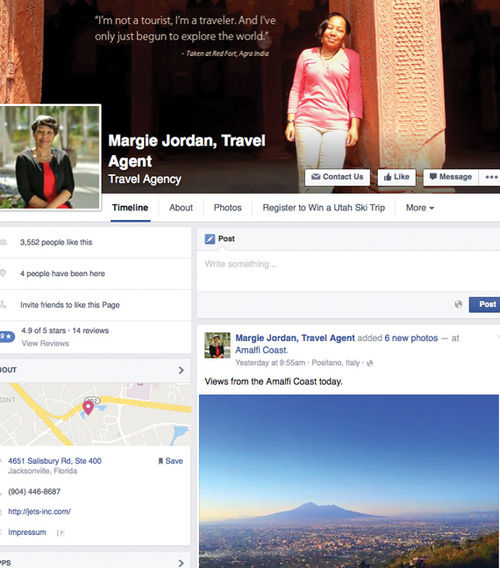
Travel agent Margie Jordan’s Facebook page.
Jordan, too, sees value in Facebook ads, specifically in their ability to target a wide range of people, "from the basics like marital status, location, age and home ownership to things like newly engaged, moms, people actually planning to travel," she said.
Ads can also target people with anniversaries or birthdays on the horizon or who have liked pages like Royal Caribbean.
"Once you know who the target audience is, finding them on Facebook isn't difficult," Jordan said.
One thing agents are cautioned against, however, is relying on Facebook solely.
"It should definitely be part of a broader marketing strategy," Friedman said. She urged agents to "have an integrated strategy; don't rely on any one thing."
Robert Joselyn, president and CEO of the Joselyn Consulting Group and Travel Agency Management Solutions, said that to be successful in using social media as a marketing tool, agents have to know their audience.
"Do I think it can be effective? Yes," he said, but that effectiveness comes from identifying exactly who the target audience is in any given promotion and what the goal in reaching that audience is.
"You have to have a plan," Joselyn said. "You've got to know what you're doing and not just throw stuff at the wall and hope something sticks. I think social media can be extremely profitable and beneficial to an agency as part of its entire marketing strategy. I think they just have to pay attention and work at it and do it right."
Having a solid plan in place is part of the reason Ensemble Travel Group only very recently introduced its Facebook page, according to Georganne Shirk, vice president of marketing. Shirk said it is important to consider an overall plan before executing marketing techniques.
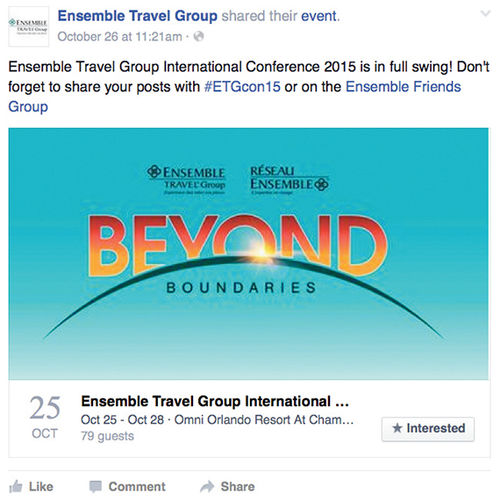
Ensemble Travel Group’s Facebook posts. The company says it is important to consider an overall strategy before executing marketing techniques.
"When it comes to any good marketing strategy, it's about layering your approach, so it's not just print marketing," she said. "It's not just digital marketing. It's also social media. It's also your website and how you reach people and communicate with people on your website."
Ogg Marketing's Andy Ogg agreed.
"Develop a marketing plan, think it all the way from A to Z and go with it," he said. "And be unique. Reach outside that box."
When Olson took over True Vacation Travel in 2013, he invested heavily in advertising via traditional media. He still does, but he now views efforts like TV and print ads as a means of reaching an older demographic. When it comes to social media, it's "just a different tool to reach a different group," he said, mainly millennials.
Peters, too, asserts that it has to be one tactic in a broader strategy.
"I don't know if [social media] will ever completely replace traditional marketing, but I do find that more and more of our agents are realizing that they can't get by with just traditional marketing," Peters said. "They have to have this online presence and not just with a website."
Social media is a "big component" of Chicago-based CRC Travel's strategic plan, according to Patricia Sullivan, director of social media and marketing.
"I definitely think it's here to stay," Sullivan said of using social media as part of an overall strategy.
Marc Kazlauskas, president of leisure sales and U.S. branch operations at Frosch, sees social media and traditional marketing as complementary: "We're still finding that traditional marketing is doing fabulous, especially direct mail, so one will not supplant the other; this will be in addition to."
A natural networking platform
Beyond marketing their personal and agency brands, social media has also given agents a networking platform for connecting with clients and colleagues.
But like marketing efforts, it can't take the place of old-fashioned physical interactions. When it comes to staying connected with other agents, social media fills the gaps between opportunities to network in person.
Kim Urig, who focuses on social media and content creation for the Outside Agent Sales Integration System, or Oasis, cited its sixth sales meeting as an example.
"Our first one had 25 agents," she recalled. "Today, we have 150, because our agents do want that face-to-face follow-up. Everybody is very happy to be here because they have made the introduction or the acquaintance digitally, and now they can put a face, a handshake, eye contact, with that person who has been so helpful to them in the electronic world. The two are very complementary because at some point, you can only surmise so much from a digital conversation."
Rosemarie Reed, vice president of marketing for CruiseOne and Cruises Inc., likened social media to the "old water-cooler conversation" at the office: a more personal relationship involving small talk that enables people to stay connected. Reed says that networking on social media can replace some in-person interaction but not all.
Social media is also offering agents the chance to stay connected with clients they don't see face-to-face often.
Stephanie Serino, a Tzell Travel Group agent based in New York, said clients "don't necessarily come in to see me on a regular basis, so we're staying connected virtually."
Lanotte-Day agreed, saying, "I think that primarily, it gives you another way to touch the client. ... The more times you touch your client, the more you're going to be in their mind to call when they want to book their vacation."
Van Leeuwen said there are also benefits to agents interacting with each other on platforms that are shared with clients. When one agent endorses what other agents have posted, it builds their credibility in full view of their clients. Suppliers, too, get involved sometimes, she said.
"I think that's good networking among each other because they're endorsing what they're posting or adding to it," she said. "That is networking at its best."