Travel Weekly editor in chief Arnie Weissmann is in the Yucatan for the Hokol Vuh feast. His second dispatch follows.
I'm traveling with 18 chefs from throughout the world who have come to Mexico for intensive exposure to Mayan culture, cooking techniques and local food products, in advance of preparing for a banquet dubbed "Hokol Vuh" on Friday night.
The morning of the first full day began with breakfast at Conchita, a loncheria (snack bar) in the market of Izamal, about 42 miles east of Merida. Bright red metal tables were pulled together, and the Coca-Cola logos on their surfaces were soon covered by plates of venison tacos, turkey salbutes and black bean panuchos.
Ben Shewry of the restaurant Attica in Melbourne was on my left, and we talked about the virtue of having fresh eyes on a culture. It strikes me that, often, a first-timer's impression of a destination is more interesting than reading recommendations from an "insider" resident who has, in a sense, ceased to see what is unique about familiar details in his or her hometown.
Shewry remarked that what caught his eye as he entered the market was the presence of slot machines. Regarding the food we would be eating over the next few days, he was looking forward to a deep dive into unfamiliar details of Yucatan cuisine.
A salsa fresca that was on the table was described as "very hot" by a chef from northern Europe. Taking that into account, I took the lid off a wooden jar in front of me on the table, and a green sauce seemed to glow from within.
"What do you think?" I asked Vladimir Mukhin of Moscow's White Rabbit, who was on my right. "I think yes," he answered, and we both spread a thin green line over our panuchos.
The sauce, with a habanero base, made the salsa fresca seem as cool as the center seed of a refrigerated cucumber.
"I think yes" seemed to be the nascent theme of the trip -- although a few chefs passed up the chance to sample some of the fruity concoctions available that morning, I haven't seen any of them decline an offer of food or drink unless it was for a third or fourth (or fifth) helping.

The chef's of Hokol Vuh, representing Mexico, Spain, Denmark, Russia, Slovenia, the United States, Australia and Norway, on the steps of the convent/cathedral of Izamal. Photo Credit: TW photo by Arnie Weissmann
Izamal is called the Yellow City because all the buildings in the town center are painted a clean, bright yellow, trimmed in white. Our guide, Hugo Lizama, whose theatrical nature, sense of humor and deep knowledge made him a riveting narrator, confessed the color had no historical significance whatsoever -- it was a marketing concept promoted by the town's mayor in the 1960s.
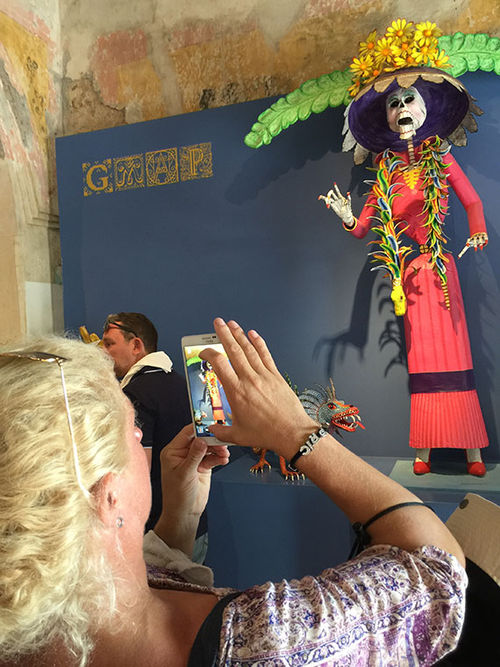
Seeing a giant papier mache "Katrina" in the folklore museum, Slovenian chef Ana Ros of the restaurant Hisa Franko, commented "I feel like her sometimes." Photo Credit: TW photo by Arnie Weissmann
Although Izamal's convent/cathedral complex is the dominant structure seen from the center of town, Mayan history permeates even Yucatan's Catholic sites. Lizama told of the methods used to convert Mayans (while keeping them second-class citizens, relegated to small corner chapels off the courtyard) and how Christian sites were purposefully built over Mayan ones.
And, through the arches of the courtyard, a Mayan pyramid could be seen towering above the tree line.
The day would end with a rain-soaked tour of Chichen Itza to get further immersion in historical Mayan society, but before getting to that magnificent site, the group was exposed to contemporary expressions of Mayan traditions, including a visit to a regional folk art museum (Centro Cultural y Artisanal Izmal) and a visit to a master folk artist, Estaban, who (among other talents) can turn seeds into horse leg earrings.
And then the group literally steeped in one of the geographic pleasures of Yucatan, after plunging into the chilly waters of a beautifully situated cenote.
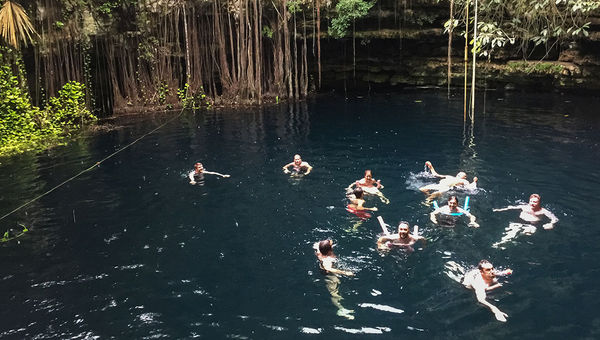
On a steamy day in the Yucatan, the chefs found respite from heat and humidity in a cenote. Photo Credit: TW photo by Arnie Weissmann
A table near this natural pool was set up and spread with locally grown and foraged fruit and seeds, and the chefs, many still deciding what to prepare for the Hokol Vuh feast, sampled them all. Tasting the deep orange-red, slightly sour flesh of mamey for the first time, Mukhin thought that, pureed, it could make a nice bed for venison.
A small fruit, nanche, was identified as tasting like cheese.
Even the Mexican chefs from areas outside Yucatan sampled items they had never seen before.
During a very leisurely lunch that included dzikilpak (a ground pumpkin seed paste that could be to Yucatan what hummus is to the Middle East), roasted pork and fried chaya (a local leafy green), the chefs, many of whom have known each other for years, gossiped, swapped stories and shared ways they have refined their kitchens and restaurants.
David Kinch of Manresa in Los Gatos, Calif., said a former choreographer that ran his front-of-house operation taught waiters how to move gracefully through the dining room, stressing the importance of having all servers moving at the same pace.
After hours at the table eating and drinking wine, beer and tequila, someone suggested a final dip in the cenote before hitting the road again. The consensus? "I think yes."