TROMSO, Norway -- I thought I would suffocate, or maybe lose my nose, when pulling on a dry suit so I could try my hand at kayaking on a cold, snowy October day in Norway.
This was a first-time kayaking experience. The dry suit, and all the layers I stuffed inside it, kept me warm enough. It helped, of course, to be in waters well protected from the open North Sea.
But this adventure was easier than sleeping on reindeer hides spread on the lumpy ground inside a Sami tepee on an even colder October night well above the Arctic Circle.
Both activities were among the pre- and post-meeting itineraries made available to delegates to an Adventure Travel Trade Association summit, held on a Hurtigruten ship as it sailed the Norwegian coastline last fall.
Our host for much of the sightseeing, Fjord Norway, the Bergen-based tourist board for fjord country, was making the point to ATTA members that this Scandinavian country is ideal for travelers who chase adventures in the great outdoors.
Point taken.
Our overnight Sami itinerary illustrated what operators offer. Summit delegates visited the Sami village Manndalen, a 2.5-hour boat ride from Tromso.
Our tepees, or lavvos, were set up on the grounds of the town cultural center, the place that in summer is the site of an annual international indigenous peoples festival called Riddu Riddu.
 Evening events began in a large tepee with a Sami dinner of stewed reindeer meat that smelled like mutton but tasted better; a traditional bread that looks like pita but is more substantial; reindeer broth, tasty but greasy; boiled potatoes, a staple throughout Norway; carrots; and a dessert of lingonberries and cheese.
Candles provided lighting; soon, a corner of my fur hat was in flames, but I tossed it to the ground with minimal damage.
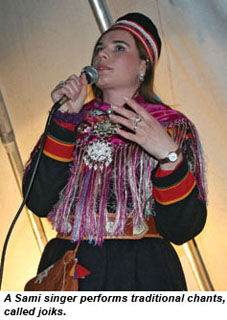
We were regaled by a Sami storyteller and a singer of traditional chants, called joiks. Our singer said all Sami have a personal joik. The songs are viewed as circles and may end abruptly, because they have no beginning or end.
Our storyteller advised that Sami "can't get enough of jewelry" because the sounds keep the bad spirits away and protect children. She said the Sami, aka the Lapps, will "never ask a visitor to leave." She referred to lands to the south as "down in Europe."
Sleeping accommodations included sleeping bags, a fire in the middle of each tepee, bathrooms up the hill in the cultural center and the promise of a gorgeous Northern Lights display. Too bad I slept through it.
Our Sami experience wrapped up the next morning at the Manndalen Husflidslag, or handicrafts center, where we learned to make a few handicraft items. My subgroup made krakesolvs broderi, or glitter embroidery. We poked needles through leather and fingers to produce rustic key chains.
Expeditions can be longer and may involve dogsleds or reindeer sleds for transportation. Local operators such as Radius Kirkenes (www.radius-kirkenes.com) and Via Alta Tours (www.visitalta.no) can provide Sami itineraries, and U.S. operators such as Borton Overseas (www.bortonoverseas.com) offer Sami experiences, too.
We went to sea by kayak off the coast of Smola, an island 85 miles due west of Trondheim. It is right out there in the North Sea, but the coastline is not open because Smola is surrounded by 5,800-plus small islands and even smaller islands called skerries.
The ground operator for our Smola kayaking was Contrast Adventure, which operates tour programs focused on nature and outdoor activities.
Anne Stine Mathisen, general manager, said Contrast Adventure, which shows sample itineraries at its website, www.contrastadventure.com, usually works on a commission basis with overseas agents.
Sea fishing, biking and hiking are other outdoor activities for travelers who wander this far from cities, but another part of the Smola adventure is accommodations. Ours were in the year-old Smola Havstuer, a nine-room hotel comprising two, two-story wooden buildings modeled on traditional fishermen's cabins. Many rooms include floor-to-ceiling windows facing the sea and islands near and far; the same applies to the dining room, where guests eat at a communal table.
Accommodations and public spaces have a rustic style but have modern bathrooms and free wireless broadband. Three "day rooms" enable guests to eat with more privacy.
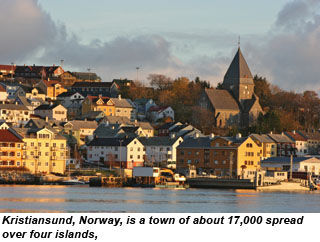
The 83-acre island of Smola, home to about 2,150 people and a large wind farm, is accessible by car ferry and high-speed passenger boat. The latter took us to Kristiansund, a town of about 17,000 spread over four islands, in 40 minutes.
Kristiansund, curiously, is home to one of only two Norwegian opera companies.
 It takes a little more than an hour from Kristiansund via westbound ferry, road and motorboat to get to the tiny Haholmen, once a village where fishermen lived during the cod and herring season. Now it is the Haholmen Havstuer, a member of the Classic Norway group of hotels, offering rustic housing in refurbished or rebuilt cabins. Tourists come for fishing trips, either aboard modern vessels or on a replica of a Viking ship.
The only all-new building is Saga Siglar Hall, a museum of shipping focusing on the work of Ragnar Thorseth, who built replicas of historical ships and sailed them around the world. The interior of one that sank in the Mediterranean provides seating when the hall is used as a meeting site. See www.haholmen.no.
The same westbound ferry out of Kristiansund, plus about 20 minutes driving, takes visitors to the five-mile Atlantic Road. It has eight bridges linking islands and skerries, made dramatic with sweeping turns plus high arches built to enable ships to pass below.
For a short period in February, the Kristiansund area is rich in herring -- and the orca who eat the fish. The adventurous traveler and dedicated lover of so-called "killer whales" can take six-day orca safaris at sea, following the fishing boats in order to watch the large mammals at work. Similar options are available from Svolvaer in November.
More variety
Activities for the outdoor sportsman were a common thread among pre- and post-summit travel for the ATTA delegates, but other types of Norway adventures were highlighted by the delegates, specifically historical re-enactments and Arctic expeditions.
YourWay, based in Oslo, operates a number of multiday, historical re-enactments in which clients are the re-enactors. In one example, clients dress and, as nearly as possible, live a few days like the Vikings. In another, the experience is imitative of Norwegian Roald Amundsen's 1911 South Pole expedition. See www.yourway.no.
U.S.-based operators PolarExplorers and Quark Expeditions sell trips that start and end on Norway's Spitsbergen. PolarExplorers this spring used the Arctic Island as the staging point for flights to the North Pole and offered add-ons with dogsledding itineraries. Quark Expeditions is selling a series of summer cruises from Spitsbergen, aboard ships built to serve as research vessels. More details appear at www.polarexplorers.com and www.quarkexpeditions.com.