The country is at war with neighboring Russia, but there's no
evidence of that in the streets of Kiev -- no soldiers or obvious
security presence. The main boulevard is closed off, but that's to make
space for Father's Day activities. And despite a 65% devaluation of the
hryvnia, Ukraine's currency, over the past few years, there are still
some residents who shop at the Gucci and Ferragamo stores on Kheshchatyk
Passage, the city's answer to Rodeo Drive.
In the evening,
laborers and their bosses sit side by side in $7 seats at the city's
acclaimed philharmonic orchestra or the opera, or perhaps at Olimpiyskiy
Stadium, home to the national soccer club, where the most expensive
ticket costs $16.
"Kiev may be the least-known European capital
other than Tirana [Albania]," said Jean Baptiste Pigeon, the general
manager of the city's InterContinental hotel. A Frenchman born in
Mexico, he has worked in 11 countries, from Portugal to Japan, and said
Ukraine can hold its own against any of them.
"It has
everything," Pigeon continued. "Rich culture, architecture, interesting
landscape, the sea, skiing, historic areas, gastronomy, good rooms,
great service, safe streets."
But as 2017 dawns, its residents
are also going through a period that is trying the soul of Ukraine. It's
a complex soul that has become accustomed to trials, located
culturally, spiritually, intellectually and literally between Russian
and European capitals. Its current challenges began when, having deposed
a pro-Russia president in its 2014 revolution, the Crimea region of
Ukraine was annexed by its superpower next-door neighbor. Ukraine's army
is currently battling to prevent a similar fate in its Donbass region,
more than 400 miles east of Kiev.
The war is costly and has taken
a toll on the economy. Tourism has taken a double hit: Russians used to
make up its largest source market, and Westerners are wary of visiting a
country that has been in the headlines due to conflict, no matter how
far from the capital the conflict is occurring.
But, as is often
the case when a country faces challenges, those who do visit find that
its residents will readily engage in deep conversation with visitors.
Pigeon,
who was present during the revolution, said his bonds with the
Ukrainians immediately became stronger afterward. "We became a family in
the seven days of the revolution," he said.
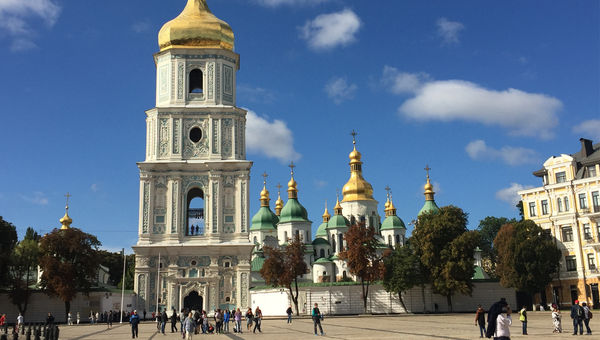
St. Sophia Cathedral, Kiev Photo Credit: Arnie Weissmann
The gastronomic underground
All of the above is not to suggest that
Kievans' focus on historical and current events means that the
atmosphere is somber. Perhaps the best example of Ukrainian esprit de la resistance is found in the restaurant OB.
The
name OB comes from the first letters of the Ukrainian words for "last
barricade." There is no signage for the restaurant, which is located in a
shopping complex beneath centrally located Independence Square, a site
of political protests over the past 25 years. A prospective diner must
first find the one elevator which has a button for OB, then, upon
entering the restaurant lobby, give the password, a Ukrainian phrase
meaning, "You fight, and you will win." (The transliteration: Boree'teesa ee-poboreteh.)
Once
a diner gets this far, he or she faces a wall with 72 silver-colored
hands attached to it (each represents one year when Ukraine was part of
the Soviet Union). The correct one must be pulled to get into the
restaurant proper.
Once inside, the atmosphere is lively. On the
walls of each room hang paraphernalia from a different Ukrainian
revolution. The bar stocks only Ukrainian spirits and 22 varieties of
local beer, including, we noticed, Obama Stout.
Perhaps this is
as good a time as any to insert a word or two about Ukrainian cuisine.
In most city restaurants, one can find borscht (always served warm),
varenyky (a dumpling similar to pierogi) and, yes, chicken Kiev.
Vodka
is ubiquitous, and often flavored in ways that will be unfamiliar to
Western palates. To my surprise, I developed a taste for horseradish
vodka.
There are some unfamiliar traditional dishes I quite
liked, such as chestnut soup with chopped, fried buckwheat kernels, and a
mushroom-based dish called pine bolete.
The chefs at OB bring a
nouvelle touch to traditional ingredients which, regardless of
preparation, might give even Anthony Bourdain pause. On their menu,
listed one after the other, were "brains with greens and hemp sauce,"
"bovine eggs with burnt butter and cranberries" and "internal parts of a
goose."
(Prairie oysters and organ meat aside, the menu is quite
varied, and even a picky American will find something that will
please.)
OB presents one aspect of the Ukrainian soul: cheerful defiance.
But
the Ukrainian ability to both embrace its history and interpret it with
objectivity, rationality and even touches of ironic humor is sorely
tested when presenting a site 60 miles north, one of its -- and the
world's -- greatest catastrophes: Chernobyl. (View a slideshow here.)

German tourists take a group selfie in front of the sign indicating the city limits of Pripyat. Photo Credit: Arnie Weissmann
Welcome to Chernobyl Exclusion Zone
Tourists have been going to Chernobyl, the
site of the worst nuclear accident in history, for 20 years. In 2015
alone, about 25,000 people visited the site. Before signing up for an
eight-hour daytrip there, I gave a thorough read to the website of
Chernobyl Tour, one of the operators offering guided excursions. The
company acknowledges that it cannot guarantee that a visit to the area
is completely risk-free, but made a credible case that unless one breaks
the rules or is very, very unlucky, the typical exposure to radiation
on the tours is well below danger levels.
The rules: No eating,
except in the workers' canteen, where a prebooked lunch is served. Don't
put a camera bag, purse or any item you're carrying on the ground or
any other surface. Don't sit on the ground. Don't touch anything in any
of the buildings that might be entered. Do not take anything with you as
a souvenir. Walk only where your guide tells you to walk and do not
stray from the group.
One can rent a Geiger counter from the tour
operator for about $10 to check radiation levels along the way as well
as check the accumulated exposure at the end of the tour. Visitors will
get off the bus to be checked for possible contamination three times.
Participants
must apply to go at least three days in advance and submit a copy of
the personal-information page from their passports to obtain government
approval. As our guide, Maxim Krygin, explained, "Every tourist is a
possible terrorist."
Before we boarded the bus in Kiev, Krygin, a
former mathematician at the country's National Academy of Science,
turned on his Geiger counter and showed an ambient-radiation reading of
0.11 microsieverts.
Normal readings are in the 0.08-0.12 range,
though they will be closer to the top of the range in cities because
granite and other building material contributes minor levels of
radiation.
Indeed, when we stopped at a convenience store 30
minutes outside the city, the reading had already gone down to
0.09.
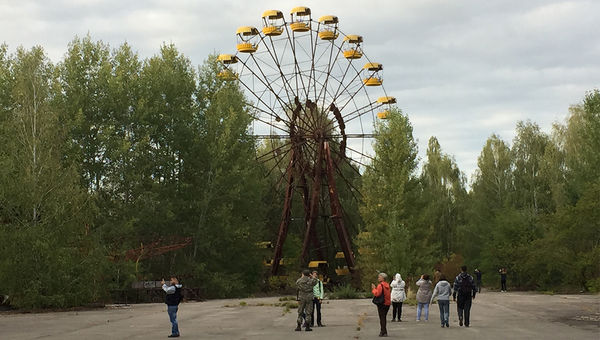
The Ferris wheel in Pripyat on the grounds of an amusement park that was to open on May Day, 1986, four days after Reactor No. 4 exploded. Photo Credit: Arnie Weissmann
During our drive north, we were shown a BBC documentary on the
Chernobyl disaster, and it was depressingly straightforward. My
companion for the day was Gregg Truman, Ukrainian Airlines' general
manager for North America, and his eyes widened as we watched. Just
after the narrator described the deaths from radiation poisoning of
Soviet soldiers who were trying to contain the reactor, Truman raised
his hand and said, "Check, please."
"Welcome to [the] Chernobyl
Exclusion Zone," Krygin said as we pulled up to the entry gate. We got
off the bus and showed our passports. Though we were still in the
countryside, the radiation level had crept back up to 0.11. "It will go
up the closer we get to Reactor No. 4," Krygin said.
"I wonder if they have Uber out here," Truman said.
Visitors
from 16 nations were on our bus, the majority from Germany and the
U.K., but China, Brazil, the Netherlands, Japan, Scandinavia and Eastern
Europe were also represented. Truman and I were the only Americans.
"It's rare for Ukrainians to come," Krygin said.
I asked if Russians ever joined.
"Seldom," he said. "Russians aren't afraid of radiation, but perhaps are afraid of Ukrainians. They aren't very popular."
The
Dutch put on disposable green coveralls more typically used by poultry
farmers, and some of the Germans donned blue Tyvek coveralls.
The
Chernobyl Tour website also promoted visits that included overnight
stays in the exclusion zone. I asked Krygin how safe that could be.
"There are people who work out here," he said. "We'll pass the buildings
where they live, and we'll be eating lunch with some of
them."

Chernobyl Reactor No. 4 Photo Credit: Arnie Weissmann
Habitable? 'Not in a million years'
Our first stop within the
exclusion zone was Zalissya, an abandoned village. Reports that I had
read about visiting the exclusion zone suggested it was like going back
in time and that everything was left exactly as it was on April 26,
1986, when the reactor blew up.
But that wasn't exactly true.
Vegetation and the elements had certainly taken their toll on Zalissya.
In a former health center, the floorboards had rotted through in places.
Certificates hung on walls, the paper yellowed and fragile-looking, and
hospital beds -- one with stirrups attached -- rusted in the
rooms.
The most emotionally moving moments occurred in playgrounds and a
nursery school. The BBC documentary we had seen on the bus ride made it
clear that the population had not been moved out of the area until after
it had been exposed to very high doses of radiation. Thinking of that
and seeing swings and slides with smiley faces, lockers with cheerful
stickers or child-size beds was heartbreaking.
The soil had been
scraped and removed from many of the areas where we walked, but as we
approached the nursery school, Krygin warned, "Please be very careful
here. Follow me exactly. Don't even take one step to the side." He
showed us examples of "hot spots" in front of the school where an area
as small as six inches in diameter could have radiation levels 280 times
higher than the ambient reading.
Back in the bus, we rolled past
a statue of Russian revolutionary Vladimir Lenin beside the road.
"Likely the only one still standing in Kiev region," said Krygin.
We
stopped at a graveyard for robotic machines that had been brought in to
remove highly radioactive fuel rods. The rods posed an extreme danger
of igniting an explosion in an adjacent reactor which, it was feared,
would erupt in an even more powerful explosion, one that would render
Europe uninhabitable. However, the radiation from the rods was so
powerful that it rendered the machines useless, and the rods had to be
removed by soldiers, all of whom died shortly afterward. Thirty years
later, the machines are still too contaminated to approach safely.
I
asked Krygin how long it would be before the area could be settled
again. "Almost every known radiation source is present," he replied.
"Plutonium has a half-life of 24,000 years, so unless technology is
developed to speed that up, it will never be habitable, not in a million
years."
Nonetheless, he said, about 100 residents never left
their homes within the exclusion zone. We later saw an older man walking
toward a still-active 200-year-old Eastern Orthodox church.
The
bus turned left down what was once a secret road so we could see an
enormous military radar installation, a wall of interconnected towers
that is half a mile wide and 500 feet tall. Its retro look of pods and
geometric patterns was unlike anything I'd ever seen. Similar
installations from its era have been disassembled and their materials
reused, but this entire installation is considered too hot to be
salvaged, and stands as an outsize monument to two events that loom
large in Ukraine's history: the Cold War and the tragedy of Chernobyl.
On
our way to see Reactor No. 4, the source of the accident, we stopped
near a cooling pond, and Krygin told us to bring any extra food we might
have to feed some fish. We walked out over the water on a bridge and
saw a school of supersize catfish, some approaching five feet in length,
near the surface. Thinking of "The Simpsons" and Blinky, the three-eyed
fish that lived near Springfield's nuclear power plant, I asked whether
their size had anything to do with mutations due to radioactive
exposure. "No," Krygin said. "No one's fishing, everyone's
feeding."
A visit to Ukraine: Chernobyl
A sarcophagus, with a side of borscht
The reactor itself was much smaller than I had imagined, though what
one sees today is the outside of a concrete sarcophagus that covers the
remains of the reactor. When the covering was completed 30 years ago, it
was thought it would last 30 years. A larger containment unit is being
readied next to it, prepared to encase the one that's about to expire.
The new sarcophagus is built to last 100 years.
We went to the
nearby workers' canteen. Before being brought to the dining room, we had
our first contamination test, standing in a machine with our feet and
palms on sensors. We all passed, were instructed to wash our hands
thoroughly and went up for a lunch of borscht, potato pancakes,
coleslaw, pasta, mashed potatoes and beef, chicken or pork.
"Same as the workers get," Krygin said.
Afterward,
we went to Pripyat, a city built to house plant workers and their
families. At the time of the accident, it was 16 years old and had a
population of around 50,000.
We visited a recreation center,
school and an apartment building. From the roof of the apartments, one
could clearly see just how close the reactor was to the city.
All
the buildings had deteriorated significantly, and what had once been
wide boulevards looked more like narrow side streets. The forest had
encroached from both sides, and signage and lampposts that had once been
on curbs now stood well into vegetation.
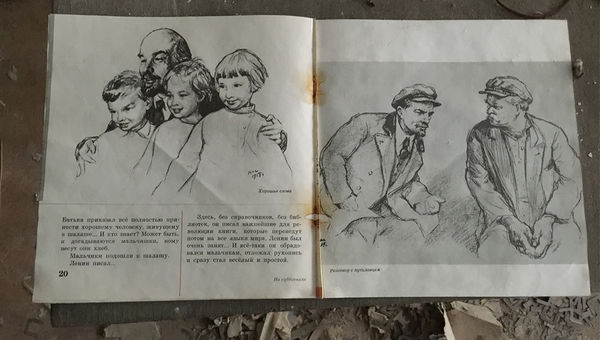
A schoolbook featuring images of Soviet revolutionary Vladimir Lenin, on the floor of the town’s abandoned school. Photo Credit: Arnie Weissmann
The long-abandoned school we toured would have made the perfect
setting for a video of the Alice Cooper song, "School's Out." Forever.
It was completely trashed. Books were strewn over all the floors.
(Krygin said the bookcases had been salvaged, and the books just dumped
out.) Instructional posters still on the walls heralded the glory of
Lenin and other Soviet leaders. Children's art could be found tacked to
bulletin boards or among the papers on the floor.
Back on the
bus, Krygin told us to turn on our Geiger counters as we drove quickly
through the highest levels of radiation we would be exposed to that day,
in the "red forest." Extremely high levels of fallout had turned the
trees in that patch of land red. Our Geiger counters rose quickly to the
level of 7.0 microsieverts, then dropped just as quickly.
Our
final stop was at a large stadium/amusement park complex. The stadium
had begun to host games shortly before the accident, but the amusement
park was scheduled to open on May Day 1986, just four days after the
accident. A Ferris wheel, bumper cars and a spin ride still stand
rusting, never used.
Our final checkpoint, at the border of the
exclusion zone, was calibrated to be more sensitive to radiation than
the others, Krygin said, and there have been visitors who registered as
"contaminated" there. "If contaminated," he said, "it means you broke a
rule."
We all passed the test. As we rode back to Kiev and
checked our Geiger counters one last time, I saw that I had absorbed a
cumulative total of 3.0 microsieverts -- about the same degree of
exposure an airline passenger experiences after one hour of flight at
40,000 feet, according to Krygin.

Deposed pro-Russia president Vladimir Yanukovych’s former living quarters in Mezhyhirya. Photo Credit: Arnie Weissmann
An opulent exhibition of corruption
After the 2014 revolution, it was not a great surprise for
Ukrainians to see evidence that their deposed president, Viktor
Yanukovych, was corrupt. That was a given. But when they discovered the
depth and breadth of his corruption, it went beyond what even typically
cynical Ukrainians suspected.
Their president had used citizens'
money to build Mezhyhirya, a 500-acre playground for himself and his
family, complete with a zoo, restaurants, a golf course, idyllic ponds
stocked with black swans, a luxe guest house where he entertained
Russian president Vladimir Putin, a museum of antique cars and extensive
gardens -- among other touches.
He had a fitness center that
included a bowling alley, a boxing ring, a tennis bubble and a spa with a
salt room as well as a vertical tanning bed that monitored skin tone to
achieve the perfect tan.
That was connected by underground
tunnels to his mansion, which featured Lalique crystal chandeliers in
the bathrooms, a private movie theater with massaging/vibrating leather
armchairs, intricate parquet floors and, in the living area, one of 25
limited edition white Steinway grand pianos signed by John Lennon.
In stained glass in a private chapel, his face was featured as God Himself.
Yet
his staff said he had become a prisoner of the house, trusting no one
and fearing that the day would come that he would be ousted or
assassinated.

Petro Oliynyk brought this vandalized painting of Yanukovych and Viktor Pshonka, former prosecutor general of Ukraine, from Pshonka’s residence. Photo Credit: Arnie Weissmann
As it became clear in February 2014 that the revolution had succeeded
and Yanukovych had fled to Russia, Ukrainians smashed down the gates of
the compound and rushed to the mansion. But one man in the crowd made
it to the doorway first and turned to face the rest. Petro Oliynyk, 34, a
grocer from Lviv, stopped the crowd from entering, arguing that the
contents belonged to the Ukrainian people and should not be vandalized
or looted. He went inside, locked the doors and for two years never
left, standing guard over the house, ultimately with a few trusted
assistants.
The new government turned Mezhyhirya into a national
park and has taken responsibility for maintaining the expansive grounds.
The entrance fee is about $2, and there is an additional fee for guided
tours via golf cart. Concessionaires also rent out bicycles and Segways
for those who want to explore on their own.
But to see the
inside of the mansion -- popularly called the Museum of Corruption --
one must make an appointment with the mercurial Oliynyk. Although he now
leaves the house at night, he comes back to give tours, by appointment,
if you're referred by a source he trusts.
A visit to Ukraine: Museum of Corruption
He charges about $7 for the tour and, he said, uses the money for
upkeep. (After almost three years, there does not appear to be even a
speck of dust in the place.) In an interview after the tour, he said the
government will not provide maintenance funds and has even turned off
utilities in the mansion in an effort to get him out. (He figured out
how to turn on the auxiliary power.)
He greets visitors wearing a
flag of national resistance as a cape, and in our interview freely
criticized the current government as being as corrupt as the previous
one, the only difference being that the people's standard of living has
eroded since the revolution.
Oliynyk said he will not leave until
provisions have been made to turn the house into an official museum,
with the proviso that absolutely nothing be removed. He fears that
anything taken for government storage will somehow disappear before it
makes it to a warehouse. Although Oliynyk is a walking encyclopedia of
conspiracy theories, some of them seemingly outlandish, one suspects he
is right to worry about the fate of the contents that might be removed.
The
two main characters in the story of Mezhyhirya, Yanukovych and Oliynyk,
reveal two more sides of the Ukrainian soul, one cynical and corrupt,
one idealistic and patriotic, but both extraordinarily suspicious and
justifiably paranoid.
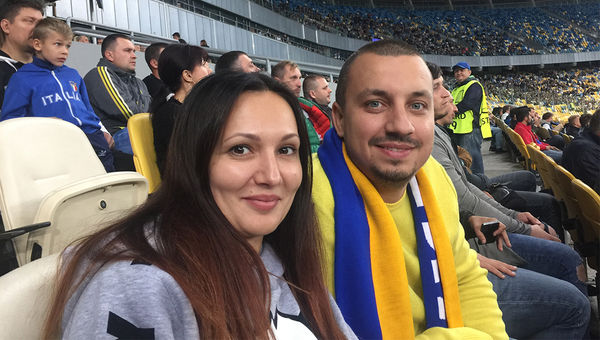
Julia Kulik and Aleksandr Skrypka, owners of receptive operator JC Travel, at a Kiev FC Dynamo soccer game. Photo Credit: Arnie Weissmann
Jump-starting tourism
Accompanying me to Mezhyhirya
and on a tour of Kiev were Julia Kulik and Aleksandr Skrypka, the young
couple who owns JC Travel,
a receptive operator. I found them to be enterprising and enthusiastic,
arranging my visits to both Chernobyl and Mezhyhirya and coaching me on
the correct pronunciation of the password to gain entrance to OB. They
scored great tickets to see the local soccer team, FC Dynamo, and
ziplined with me across the Dnieper River in central Kiev.
They and one of their guides, Olga Karpenko, walked me through
onion-domed churches and beautiful city parks and provided the narration
for a fascinating architectural tour.
The couple's upbeat
outlook and cheery professionalism seemed a reflection of the hopeful
energy and new-dawn vibe of OB. Despite challenges the country is facing
and the looming presence of Russia, these young entrepreneurs see a way
to marshal the country's identity and considerable cultural assets and
resources to boost both tourism and national self-esteem.
While
in Kiev, I had dinner with Frank Ludwig, a German who serves as the
senior inspector for tourism for Kiev, and he is working with the
private sector in support of raising arrival numbers. Given the
competing priorities for government resources in the country at the
moment, he relies heavily on working with the private sector to
formulate strategies to promote visitation.
He is linked to what seems to be a burgeoning informal network of
private-sector players who are cooperating in and coordinating tourism
promotion. Ukraine Airline's Truman is a driving force in trying to
increase traffic from the U.S.; he had met Kulik and Skrypka of JC
Travel at the New York Times Travel Show last year (they're returning
this year, as well), and together they connected me with the
InterContinental's Pigeon and also Dejan Djordjevic, the managing
director of hospitality business for Esta Holding, whose properties
include Kiev's Opera Hotel. (My trip was fully hosted, thanks to
Truman's efforts.)

The facade of the 7-year-old InterContinental Kiev evokes an earlier era. Photo Credit: Arnie Weissmann
My overnights at the InterContinental and
Opera reflected properties with a full understanding of international
luxury standards. The InterContinental was recognized within its parent
company as being the European hotel of the year and having the best
hotel service in Europe. For five years running, it has been rewarded as
having the best breakfast in the hotel group within Europe.
When
I first saw the property, I thought it was a very well-maintained grand
hotel built in the first quarter of the 20th century. It turned out
that it, like much of the architecture in Kiev, is of more recent
vintage but designed to be consistent with the aesthetic of that earlier
era. The InterContinental is just 7 years old, and occupies an enviable
location, within easy walking distance of major tourist sites and
Independence Square.

The Egyptian suite in Kiev’s Opera Hotel.
The Opera Hotel does have an older
pedigree, and is said to have once been the residence of composer Franz
Liszt. It's on a quieter street near the Opera House. Djordjevic said
they are positioning the hotel, which is a member of Leading Hotels of
the World, as an intimate, boutique-style property with a focus on
personalized service.
"We're not trying to compete with the big boys, the InterContinental, Hyatt or Hilton," he said.
A
feature of the property is seven suites decorated in the style of opera
locales: France, Russia, Italy, the U.S., Japan, Egypt and Morocco.
My
overall impression is that Ukraine is an undervalued, barely known
destination that will appeal not only to the adventurous who like
exploring off-the-beaten-path locales, but would also suit anyone with
an appreciation for classical culture. Truman envisions tours focused on
opera and classical music; both the philharmonic and opera have a wide
and varied repertoire, each featuring several different shows in any
given week.
With high service levels, one-of-a-kind-attractions,
quality performing arts and outstanding value, Ukraine seems primed to
appear on some "best-kept-secret" lists. It certainly made mine. Ukraine
Airline flies daily to Kiev from New York JFK March through October,
and five days a week in low season. (The U.S. is crucial to its strategic plan to serve as a low-cost, global-network carrier.)
And
no small part of its attractiveness lies in its people, their souls
forged in centuries-old traditions, yet continually redefined by current
events.