
Paul Szydelko
Whether clients are approaching Las Vegas for the first time or the 20th time, they are met by one of the world's most recognizable skylines. The Strip has changed constantly through the decades but retains an unmistakable grip on the imagination thanks to architecture that alternates between chaotic and wondrous, kitsch and classic.
What are the most memorable elements in the tourist corridor right now? Having lived in southern Nevada for 40 years is my only qualification to select, so I asked Glenn Nowak, an associate professor of architecture at the University of Nevada, Las Vegas, to add his perspective. Here are my choices for the top five structures that grab my attention and don't let go:
• Sphere (opened in 2023). Sphere has brought an indelible presence to the skyline. To call the $2.3 billion, 18,600-seat structure a state-of-the-art performance venue would be an understatement. Its 580,000-square-foot "exosphere" pops into vision when you least expect; it sometimes appears larger and closer than it is. About 1.2 million LED lights (each the size of a hockey puck) spaced eight inches apart create vivid displays.
"There are stories of people just sitting in their hotel room with room service, a glass of wine and watching Sphere for an hour. That's an almost an-unheard-of form of entertainment. It's one of the few buildings in the world where people are happy to just contemplate," said Nowak, who called it the "quintessential Las Vegas building."
Sold-out concerts and an enhanced version of "The Wizard of Oz" have brought global renown to the structure, which will soon be replicated in Abu Dhabi.
"It's inviting conversations about concepts of everything from social media to storytelling to history," Nowak said. "It's changed how performing arts are approached. … It actually invites these world leaders in performing arts to rethink their medium and go, 'What are we going to do in a way that your standard venue doesn't do it?'"
• Strat (1996). It was called "Stupak's Folly" when Vegas World owner Bob Stupak was building it more than three decades ago -- at 1,149 feet, the tallest freestanding observation tower in the U.S. Back in the day, I thought it was gimmicky and regrettable. But it has become an audacious landmark, provides a stunning vantage point to see the city and preserves Stupak's place in city lore. The Strat Hotel, Casino & Tower is throwing a party next month to celebrate its 30th anniversary.
"The Stratosphere invites people to go check it out because it is so tall," Nowak said. "You can see it from everywhere. I've heard people use it as a reference for orienting themselves in the city. It serves as that beacon."
• Luxor (1993). You can't think about Las Vegas without thinking about Luxor, the 30-story, pyramid-shaped resort with unique inclinator elevators and a massive indoor atrium. It's "something that resembles the pyramids of Egypt, but out of glass and a light that you can see from outer space. It's architecture that kind of only happens in Vegas," Nowak said.
• High Roller at the Linq (2014). Amid all the massives boxes, this 550-foot-tall High Roller observation wheel from Caesars Entertainment adds a touch that's more delicate, graceful and playful. It's an attraction and part of the hospitality landscape, but not a building, Nowak reminds me. It wasn't on his radar for this list, but he admits its allure.
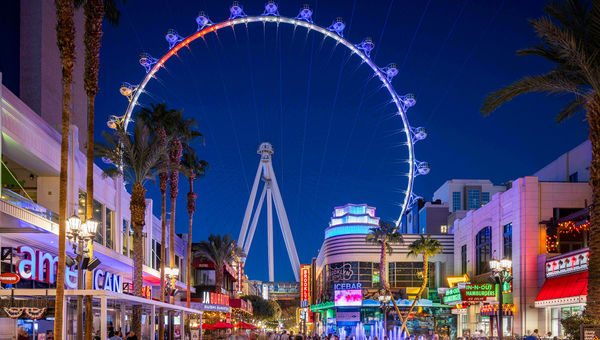
The 550-foot-tall High Roller at the Linc adds a touch that's more delicate, graceful and playful than other Vegas landmarks. Photo Credit: Caesars Entertainment
"The way it's set up within the urban design of the Strip makes it have that much more appeal," he said.
• Bellagio (1998). Maybe it's not readily apparent from far off the Strip like the others on this list, but up close, the Italy-inspired resort is elegant and inviting -- an instant classic not only because of its architecture, lighting and landscape but because of its fountains.
"Similar to the High Roller, the real attraction for me is the fountains in front, which are not a building. But the effectiveness of the fountains is really amplified by the backdrop of the building. If it didn't have that setting, it might not be as spectacular," Nowak said.
Other landmark buildings
Nowak said 1972's book "Learning from Las Vegas" (which coined the terms "ducks" and "decorated sheds" to classify buildings) is still his go-to framework to evaluate the city's architecture. He called my attention to several other landmark buildings in the tourist corridor.
Famed Black architect Paul Revere Williams designed the shell-like lobby of the La Concha Motel (1961), which was saved from destruction and moved to its present location at the Neon Museum, where it serves as the visitors center. Williams also designed Guardian Angel Cathedral on the Strip just north of Wynn/Encore.
Nowak said he also appreciates the Cosmopolitan for its emphasis on vertical design. "I gravitate toward that as noteworthy property to visit because it fits so much into a comparatively small footprint: stacking the restaurants on top of the casino, the shopping between those two, the pool on top of that. It just does what everybody else does in a slightly more efficient space planning." Cosmopolitan's design might foreshadow how future Strip properties are built with real estate so expensive, he said.
Meanwhile, two buildings under construction are changing Vegas' skyline a little every day.
The blue-tinted Hard Rock's guitar-shaped room tower is rising where The Mirage's faux volcano once stood; it's expected to debut in 2027. And work is progressing on the A's $2 billion baseball stadium at the former Tropicana site. First pitch at the enclosed 33,000-seat structure, described by its designer as a "spherical armadillo," is slated for 2028.