Many families heading for Arizona immediately think of focusing on the Grand Canyon, the Phoenix/Scottsdale area or mystical Sedona. But they'd be remiss if they overlooked Tucson.
The state's second-largest city is where visitors are likely to meet the sort of eclectic and artistic personalities that you might expect in Austin, Texas, or Portland, Ore., but it's the lovely Sonoran Desert vibe that makes this city of more than half a million people stand on its own.
One thing that can't be overlooked: Tucson can get hot, especially in the summer months, when triple-digit temperatures are not uncommon. It is a dry heat, so visitors will find it toasty but not unbearably muggy like Houston or Orlando can be. The good news is that the remainder of the year sees pleasantly warm weather across the valley, perfect for hiking opportunities (of which Tucson has plenty).
My family loves the Broadway Trailhead on the east side of town, which leads into the Cactus Forest Trail system. The hikes here don't gain too much in elevation, so they're suitable for smaller children. But even for teens, there's plenty to see, with typical desert vegetation, the occasional roadrunner and constant views of the nearby Rincon Mountains.
If you have older kids and they're feeling up to it, the broader series of trails here do head up through the eastern portion of Saguaro National Park, offering more challenging hikes.

Tucson's Saguaro National Park provides plenty of stunning views of its namesake cacti along with dramatic mountainous terrain. Photo Credit: Paul J. Heney
Speaking of Saguaro National Park, this Tucson treasure is one of the few U.S. national parks split into two noncontiguous sections, with one located to the west and the other to the east of downtown. For younger children, the Scenic Bajada Loop Drive (a graded dirt road) in the West District is a great introduction to these iconic cacti.
Saguaro are found only in the Sonoran Desert, which stretches across parts of Arizona, California and Mexico. Indigenous peoples have long used them for food, hydration and shelter, and they're also of critical importance to mammals, birds and insects in the region.
The drive allows for multiple stops with short, easy trails, including the Valley View Overlook Trail and the Desert Discovery Nature Trail with some educational interpretive signs.

Displays at one of the Pima Air & Space Museum's hangars. Photo Credit: Paul J. Heney
Look to the skies
A favorite local attraction is the Pima Air & Space Museum, located close to Tucson Airport. The museum grounds include roughly 400 aircraft spread across 80 acres and feature everything from a Boeing 747 and 787 to an extensive collection of military aircraft, such as a B-17 Flying Fortress.
Children will be fascinated with the variety of aircraft here, large and small, with a few that visitors can get in, walk through or even walk underneath. There are a handful of hangars to wander in as well as an extensive outside area that includes a Douglas VC118-A once used as Air Force One by presidents John F. Kennedy and Lyndon B. Johnson.
A bit farther afield, Kitt Peak National Observatory is located atop 7,000-foot Kitt Peak, about an hour's drive southwest of the city. There is a visitor center and various daytime public tours offered of the telescopes (I loved the McMath-Pierce Solar Telescope).
You can also reserve a nighttime Dark Sky Discovery Program (for $99 per person) ahead of time or attend nightly observing programs. Note that the drive to the top is fairly windy and temperatures near the summit can be 20 degrees colder than on the desert floor, so make sure to bring layers for the little ones.

Tucson boasts more than 500 murals across the city, painted by some 200 different artists. Photo Credit: Paul J. Heney
Who doesn't love a trolley? Tucson Trolley Tours (OK, it's actually more of a shuttle bus but very comfortable -- and air conditioned!) offers a fascinating tour of this very artistic city, including more than 50 murals, some more than 10 stories high.
The tour is better suited for older kids, as it's just short of three hours long. For us, the time passed quickly, as our driver/guide was a delight; he kept us laughing with local stories, Tucson history and details about the various murals. Also included was a huge game of Where's Waldo.
For teens, a visit to the Tucson Museum of Art can make a nice counterpoint to the mural scene. There is an impressive collection of art of the American West, along with contemporary art, Indigenous art and Latin American art. The upcoming Arizona Biennial 2026 will focus on contemporary art by Arizona artists and runs from May 22 to Sept. 27.
Younger children will enjoy the museum's Creative Space area, an interactive gallery where kids can draw, read or simply take a break and relax.
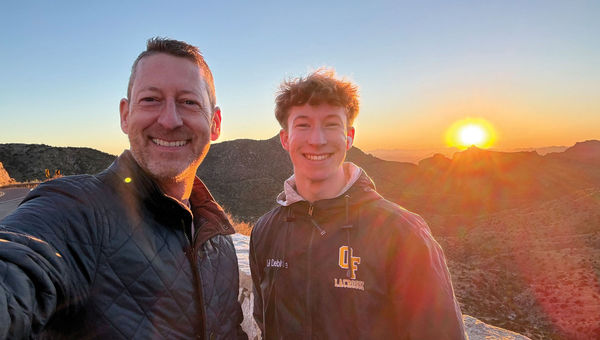
The author and his son enjoyed a sunset during their drive down the Mount Lemmon Scenic Byway. At more than 9,000 feet, it's the highest peak in the Santa Catalina Mountains. Photo Credit: Paul J. Heney
To top it all off ...
A Tucson family getaway wouldn't be complete without going straight to the top. Located to the northeast, Mount Lemmon presides over the Tucson Valley, a commanding presence from most anywhere in the city. The highest point in the Santa Catalina Mountains at more than 9,000 feet, you'll often see snow at the top, and there's actually a ski area near the summit.
The twisty, 27-mile drive from the base to the top takes about an hour, but the views are magnificent. It's fascinating to note the different types of plants and trees as you move through multiple climactic zones on the way up.
Activities on the mountain include hiking, biking, rock climbing, bird watching and even stargazing. My family and I love to head back down right around sunset. The twilight colors from different elevations are so striking, with the lights of the city below just starting to shine, that it's hard not to feel that they are beckoning us back for more adventure.