Three decades of interviewing, working with, and consulting for the CEOs of some of the world’s largest companies has given Joel Kurtzman a broad-based, up-close opportunity to examine why and how some businesses succeed while others fail. His most recent book,Common Purpose: How Great Leaders Get Organizations to Achieve the Extraordinary (Jossey-Bass, 2010), examines those dynamics from the vantage of a leader’s role.
Common Purpose is one of 25 business books written by Kurtzman, who is currently chairman of the Kurtzman  Group business research and consulting firm and a senior fellow at the nonprofit, nonpartisan Milken Institute think tank. Kurtzman is also an economist whose previous positions include editor in chief of the Harvard Business Review, business editor for The New York Times, and a consultant with PricewaterhouseCoopers.
Most of Kurtzman’s books as well as hundreds of articles were based on interviews he conducted with CEOs and other business leaders. “From that standpoint, I've been able to see many business leaders in action, to observe how they lead and to determine what's responsible for their successes and failures,” Kurtzman said.
This is the first excerpt from a dialogue between Kurtzman and Diane Merlino about business leadership.
Merlino: Let’s start with your definition of common purpose in the business world.
Kurtzman: It’s that feeling among people in an organization that the we is more important than the I or the me and that there's pleasure in contributing to that we with as much enthusiasm as possible. The rewards are in the group effort rather than in the individual effort.
A common purpose is elusive, and it’s very difficult to maintain over the long haul. I’ve seen a number of companies achieve it sporadically. Many companies don't achieve it at all.
Merlino: You say that common purpose is the core question of leadership. Why is that?
Kurtzman: When I was editor of the Harvard Business Review and before and after that a consultant with PricewaterhouseCoopers, I got the opportunity to walk into companies of all kinds and see what was working and what wasn't. When I delved deeper into why some companies failed and some succeeded, when on paper they had the same objectives and in some cases the same strategy, I found that leadership plays an extremely important part in success and failure. It’s not just that leadership is important and interesting and we should study it; it's that leadership is really vital to success and failure.
Merlino: Isn’t it obvious that leadership is crucial to success or failure in business?
Kurtzman: It may be obvious to a lot of people, but the amount of time that CEOs in particular spend honing their leadership skills is painfully small. One problem is that it's very, very difficult to define leadership. There are so many books and articles about it, and almost every book and every article has a different approach to what leadership is and what determines success. I tried to identify the essentials beginning with a very, very simple definition of an organization.
Merlino: And what is your definition?
Kurtzman: An organization is simply when a group of people get together to do something that they can't do on their own. I can sit by the pool and read the newspaper or a book on my own, I don't need an organization to do that. But if I want to build a pool or publish a book, I need an organization, and that's when we start getting into the human side of business.
Merlino: Many companies emphasize a healthy bottom line as the primary measure of success. What’s the primary measure of success in a common-purpose company?
Kurtzman: There is always the bottom line, and there's always the top line, and companies have to make sure that both are healthy and growing. Revenue and profits are both extremely important and have to grow under all circumstances.
But what I've seen is that in common-purpose companies, people work long hours by choice, they contribute new ideas, they're listened to by their peers, and together they achieve remarkable things. The greatest common purpose companies are able to weather the storms and are successful because they have everybody aligned around goals that they want to achieve.
Merlino: Give us an example of a great common-purpose company.
Kurtzman: FM Global is a case study I have in my book. This is an insurance company in Rhode Island that is more than 150 years old. Most people haven’t heard of them, but travel industry companies might know them because they insure hotels, among other things. FM Global is so strong on common purpose it not only weathers recessions and depressions, it weathered the Civil War.
This is a company that has withstood the test of time. The firm does not rely on statistics in terms of how it assesses and writes insurance for a client. Instead, almost everyone there who's a decision maker is an engineer. They send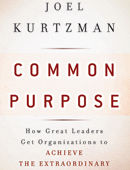 the engineer out to look at a hotel or a warehouse or an airport, assess it, and then determine whether or not it’s up to the engineering standards for earthquake or storms or fire. They use a common language to do this that’s been in place for more than 100 years. They have a common set of skills in engineering, and they have respect for each other.
Merlino: Did anything in particular surprise you about FM Global?
Kurtzman: The longevity at this company was really surprising to me. Part of their parking lot is reserved for people who have been with the company 20 years or more, and you can't believe how many cars there are in that lot. The 20-plus-years employees are the majority. That’s really, really unusual. People love that company, and they stay their entire careers.
The company doesn’t seek publicity; it's not out there with a big PR firm behind it. It just does its job. People are happy and self-disciplined, which is absolutely essential. I interviewed a number of people who worked at the company and almost all of them were doing initiatives they had come up with on their own in order to save the company money. Most of them were traveling much more frugally, not because of a corporate policy but because they wanted to protect their company. That’s a great example of we instead of me.
Merlino: You've said FM Global’s CEO, Shivan Subramaniam, sees his role as to guide, advise, and recommend. Is that approach important in common-purpose leadership?
Kurtzman: Yes. The important thing in a common-purpose organization is that people arrive at ideas to contribute as much as they can to the group on their own. They need autonomy to do that because they need to decide on their own whether to come in early and work harder or bring work home and work later during a tough time. They can’t be told; when people are told to do things like that, they push back.
Leaders need to have enough respect and belief in the people working in their company to give them the autonomy they require to make the right decisions. FM Global does that.
Merlino: Why should a business leader care about creating a common-purpose organization?
Kurtzman: First of all, people are happier in common-purpose organizations. And when they’re happy, they perform better, so the bottom and top lines are healthier. Growth is healthier when people are happy. We all know this. It’s common sense that happy people working together achieve more, but there are studies that indicate it’s true as well. That’s a really important thing to take into account. Happiness counts.
Click here TO ACCESS A VIDEO of Joel Kurtzman's presentation at Stanford University.