 "You," the instructor says, motioning to me. "You're with me." He looks to be around 30 and in shape, which I figure is a good thing. After all, when you're about to put your life into the hands of a complete stranger, you want him to be fit.
"When I say run, you run," says the instructor, who hails from the Altazor Sky-sports paragliding school, as he straps me tightly into a tandem harness. "And whatever you do, don't stop." Yikes.
Stretched out behind us is a parachute-like canopy and complex set of cords and pulleys that, once airborne, will suspend us high above the desert city of Iquique, Chile. Or, at least, that's what he tells me.
"Ready?" he asks.
And with that, we're off, sprinting headlong toward the precipice. Suddenly, a gust of air fills the huge canopy, and moments later we are floating high above the swirling dunes and crystal coastline of Iquique.
"Great, huh?" he says, with a laugh.
Really great. In fact, there's no better way to see a place than with your legs dangling above it, especially a place like Iquique.
A bustling coastal city improbably ensconced in the Atacama, the driest desert on Earth, Iquique is as surprising as it is exhilarating. Originally built to transport the riches of Chile's once-thriving nitrates industry, Iquique has morphed from a stark outpost into a surprisingly cosmopolitan center.
Paragliders from around the world flock here for the flying conditions -- the area gets less than a millimeter of rain each year -- but now, it seems, ordinary tourists are following suit. And one of the first things they encounter is Iquique's bustling culinary scene.
On the menu
 "You have to try these," said Cristina Burchard, offering me a mouthwatering bake of Parmesan-crusted mussels. We were at Burchard's restaurant, El Tercer Ojito, one of the best-known eateries in town. And that's no small compliment in Iquique. The region's vast coastline yields some of the freshest seafood in Latin America, while the area's Asian immigrant and indigenous Indian roots -- it was forcibly annexed from Peru in the late 1800s -- yields a spicy, exotic cuisine not usually seen farther south in Chile.
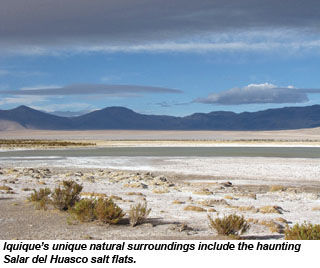
While cuisine is Iquique's hidden treasure, the region's topography is its most obvious calling card. The city, which bears both Spanish colonial and 20th century industrial influences, gives way to vast deserts, windswept dunes and magnificent salt flats such as the stunning Salar del Huasco.
Pre-Columbian geoglyphs -- outsized, ancient figures marked with stones -- dot craggy hillsides. Its more recent past, on the other hand, is on full display in Humberstone, an eerily well-preserved ghost town that was once home to many of the region's mining families. The place is now a Unesco World Heritage site.
Camping it in Chile
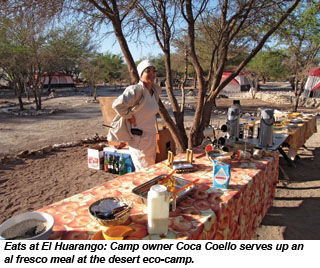
While Iquique boasts several comfortable hotels, there's no better way to experience the region than under the desert stars. And that's what visitors can do at El Huarango, an upscale eco-campsite just a few hours outside of town.
There, husband and wife Marco Fernandez-Concha and Coca Coello set up for their guests large, comfortable tents with ample cots and plush, down sleeping bags (temperatures in the Atacama drop precipitously at night).
Hot showers are mercifully just a few steps away. In the clear, cold evening, fallen branches from tamarugos, the only trees that grow in this climate, fuel a large and cozy bonfire. And while the setting may be rustic, mealtime is anything but.
"We provide a real outdoor experience, but with restaurant-quality food," Coello told me as she ladled out a delicious stew, care of a solar-powered oven. "And we serve it on real china, with real wine glasses."
The result feels both wildly adventurous and utterly cosmopolitan. Just like Iquique.
Visit Chile's tourism promotion arm, Sernatur, online at www.sernatur.cl. For Altazor, go to www.altazor.cl; for El Tercer Ojito, visit www.eltercerojito.cl; and for El Huarango, visit www.ecocampamentoelhuarango.cl.