Del Rio, Texas, on the Mexican border 150 miles west of
San Antonio, has been without commercial air service since mid-2013.
Last August, when Public Charters agreed to provide daily
flights from Del Rio to Austin, which would set up a connection to Dallas, it
appeared that getting in and out of the town of approximately 40,000 would
become easier.
Yet five months later, Del Rio still doesn’t have air
service, in large part due to a Nov. 20 decision by the Transportation Security
Administration (TSA) to not provide security for the airport.
“We could offer [the Austin flight] without the TSA, but
we would be losing half of our customers,” airport manager Juan Onofre said.
Del Rio is one of at least three small U.S. airports to
encounter these kinds of problems since late 2014. The situation led
congressional representatives of the affected districts to submit companion
House and Senate bills last week requiring the TSA to return to airports that
have lost commercial air service since the beginning of 2013, as long as the
airports have a commitment from a carrier. A bipartisan group of 10 legislators
from Oregon, Wyoming, Utah, Texas and Washington introduced the TSA Fairness
Act on Feb. 11.
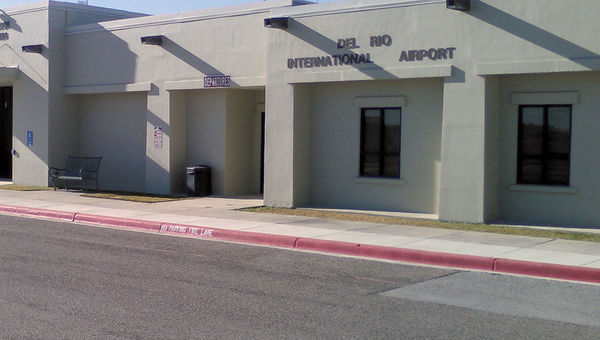
Del Rio Airport in Texas is one of at least three U.S. airports where the TSA decided not to provide security.
“The Crater Lake-Klamath Regional Airport is a critical
transportation link for the region, and it’s unacceptable for bureaucrats 3,000
miles away in D.C. to stand in the way of restoring commercial service,” Sen.
Jeff Merkley (D-Ore.) said in announcing the bill.
Like Del Rio, Crater Lake-Klamath Airport wants to resume
air service but had its security request turned down by the TSA.
The refusals come as small airports around the country
are faced with service cuts and closures as a result of the shrinking regional
airline industry.
Since the second quarter of 2013, 29 small airports in
the continental U.S. have lost commercial service, according to the trade group
American Association of Airport Executives.
The closures are partially driven by a pilot shortage
plaguing regional airlines. But small airports are also hurt by a shift by
Delta, American and United to larger planes in their regional networks to
increase efficiency.
As 30-seat propeller planes continue to be replaced by
70- to 90-seat jets, more small airports unable to fill the larger planes could
lose their service, analysts say.
At the Klamath Falls airport, Peninsula Airways is
planning to offer 12 flights a week to Portland, Ore.
At Sheridan County Airport in Sheridan, Wyo., Denver Air
began offering twice-daily flights on Nov. 19 to Denver, despite the TSA’s
refusal to move back into Sheridan after it briefly lost commercial service
last March.
Passengers on the Denver Air flights travel unscreened to
Denver Airport, then are taken with their luggage on a bus to the front of the
airport, where they check in as if they were starting their trip there,
Sheridan County Airport Director John Stopka said.
The TSA sent nearly identical letters to the Del Rio,
Klamath Falls and Sheridan airports saying that the agency had carefully
considered their requests for federal screening services, stating, “The
unpredictability of air service in the region and the inability to maintain
consistent passenger loads does not provide a solid foundation for the
expenditure of the funds required.”
The agency noted that the airports and their carriers
could provide the type of unsecured flights that Denver Air ultimately began
out of Sheridan.
The TSA declined an interview request; in an emailed
response to questions, the agency did not provide specifics about how many
airports it has declined to serve in recent years.
“Over the past five years, the majority of requests for
deployment of federal resources have been approved,” the agency wrote. “To
determine if a small airport should be refederalized, TSA appropriately
balances resources against risk and economic considerations for the deployment
of federal screeners.”
Andrew Malcolm, spokesman for Rep. Greg Walden, a
Republican who represents Klamath Falls, said the TSA Fairness Act has been
well received by leaders of the House Committee on Homeland Security.