SEVILLE, Spain -- Speaking to an adoring crowd at the World
Travel & Tourism Council summit here, former President Barack Obama told
the travel industry it needs to make its case to world leaders about tourism's
economic benefits.
"There's no government and no leader on the planet that
is not thinking, 'How do I make sure the economy is growing and that people are
gainfully employed?'" Obama said. "That's obviously the way to get
their attention."
Interviewed on stage by Hilton CEO and WTTC chairman Chris
Nassetta, Obama said the industry must be "concrete and specific"
about what governments can do not only to help tourism, but to not hurt it.
Citing an example from his own administration, he said he
was made aware of the difficulty that nationals in places like Brazil and China
had getting visas to visit the U.S., which was hurting the U.S. economy.
"We saw huge growth in people in Brazil with disposable
income that wanted to travel and go to Disney and other places," he said. "But
they could only get a visa in Sao Paulo or Rio. Brazil is a massive country.
That was going to cap how well we were going to do."
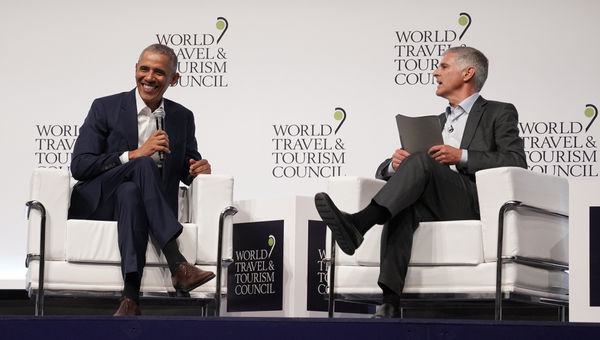
Hilton CEO Chris Nassetta praised Obama for being a "a huge advocate of travel and tourism over many years." Photo Credit: James Abarke/WTTC
As president, Obama ended up easing and expediting U.S. visa
practices in China and Brazil and easing travel restrictions to Cuba. Nassetta
praised Obama for being a "a huge advocate of travel and tourism over many
years."
Obama stressed the importance of being aware of the balance
between growing tourism and protecting national resources and assuring local
communities not only benefit, but do not become resentful.
Without naming his successor, Obama cited "dangerous"
trends, both in the U.S. and abroad, such as wanting to put up "genuine or
metaphoric walls" and the surge in nationalism and xenophobia."
"If we try to reassert these very hard, fixed borders
at a time when technology and information are borderless, not only will we fail
but we'll see greater conflict and clashes between people," he said.
The good news for both the world and the travel industry, he
said, is that the younger generation does not hold such views.
"The generations behind us are more sophisticated,
worldly, cosmopolitan and appreciative of cultures than the old people are,"
he said. "They are not afraid of difference, change, things that are
unusual or unfamiliar. That's the world they've grown up in. The politics of
looking backward and erecting walls is a politics that is going to not appeal
to young people. It's one that they fundamentally reject."
Obama also warned that climate change poses a real and
growing threat to the industry.
"Some of the most beautiful places on this planet that
we most want to visit and share with our children and spend time in are at
risk," he said, adding that climate change "is the defining issue of
our time, even if people don't realize it yet. ... It's here."
As president, Obama said, he not only promoted inbound
travel, but made a point to visit cultural sites when traveling abroad.
"What I understood is that part of diplomacy is letting
other people know that you recognize them," he said. "That you
recognize and appreciate their cultures and stories and history and memories.
When people feel as if they're known and understood and seen, then they're more
open to your perspectives as well. It's true in individuals and nations."
Obama praised travel and the travel industry for bringing
the world together.
"One of the benefits of the travel industry is to
remind people both of the incredible value of the diversity of this planet and
the differences we have," he said. "Because that's what makes food in
Seville different than food in Bangkok -- and they're both really good. But
travel also reminds us of what we share and what we have in common. And the
ability for us to recognize ourselves in each other. So that if you're
wandering through some small village in Kenya and see a mother and child
playing and laughing, that's not different from a mother and child back in
Virginia or in Hawaii."