 When real estate developers speak of challenges in getting the local community to approve a project, they often refer to the term Nimby, an acronym for "not in my backyard." When it comes to states and gambling legislation, though, it might be more of a case of "Imby." Increasingly, gambling is being embraced with open arms by politicians and residents alike.
"There's lots of gambling being done by Massachusetts residents in other states," said Stephen Crosby, chair of the Massachusetts Gaming Commission, explaining the commonwealth's decision in November to pass a gaming bill. "There are a lot of people who enjoy it."
Massachusetts is one of a handful of states that have either legalized or considered legalizing gaming facilities as a way to rebuild their coffers in the wake of the Great Recession. Gaming supporters say casinos help the local economy by creating jobs both during their construction and after opening and by generating tax revenue from both local residents and visitors from neighboring states.
Ohio passed a bill legalizing casinos in 2009 and will welcome its first three casinos this year. Penn National Gaming's Hollywood Casino Toledo and the Horseshoe Casino Cleveland, to be developed by a joint venture of Rock Gaming and Caesars Entertainment, will open this spring, while Penn National Gaming's Hollywood Casino Columbus will open later this year. The Horseshoe Casino Cincinnati is slated to open next spring.
In nearby Kentucky, state leaders regularly debate the prospect of legalizing gambling facilities that might help the fortunes of the state's horse-racing tracks.
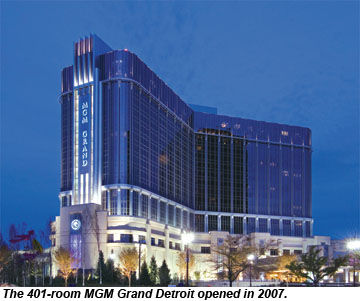
Ohio is following the example of fellow Rust Belt state Michigan, where a bill was passed in 1996 that allowed for gambling in Detroit. That led to the 2007 debuts of the $820 million, 401-room MGM Grand Detroit and the 400-room MotorCity Casino Hotel as well as the 400-room Greektown Casino Hotel, which opened in 2009.
Meanwhile, Massachusetts in late November signed a bill allowing three gaming licenses for casino resorts -- one each in western Massachusetts, southeastern Massachusetts and the Boston area -- and one license for a slots-only facility yet to be issued.
 Since then, MGM Resorts International, Ameristar Casinos and Hard Rock International have unofficially proposed luxury hotel-casino developments for the western part of the state. Additionally, Caesars Entertainment and Wynn Resorts might propose hotel-casino developments in the Boston area, while the Mashpee Wampanoag Tribe is working on a development in the southeastern part of the state, according to the Boston Globe.
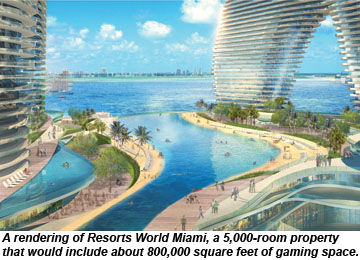
Finally, South Florida legislators haggled over a bill that would have legalized casino operations in the Miami area, where Malaysia's Genting Corp. is proposing the 30-acre Resorts World Miami. The project would include more than 5,000 hotel rooms, more than 50 restaurants and bars and about 800,000 square feet of gaming space.
Legislators last month postponed voting on that bill amid opposition from entities such as the Florida Chamber of Commerce, whose board chairman is Walt Disney executive Anthony Connelly.
"It's definitely a contentious issue," said Holly Wetzel, spokeswoman for the Washington-based American Gaming Association (AGA). "I think there's a strong feeling among the state legislature that it's a good thing to do. It's every expectation for those following the industry that the discussions in Florida aren't over."
Such states might be looking at Las Vegas as a harbinger for gambling's potential. Last month, the Las Vegas Convention and Visitors Authority reported that the city boosted its number of visitors by 4.3% in 2011, making last year's total its second best on record. Gaming revenue in Las Vegas' Clark County rose 3.5% from 2010, to $9.22 billion, according to the visitors authority.
Overall, the AGA estimates that U.S. casinos annually generate about $125 billion in spending when factoring in "direct" (consumer spending on gambling, food, beverage and hotel stays), "indirect" (what's spent by the casinos to run the businesses) and "induced" (i.e., the trickle-down effect of spending by casino and casino-supplier workers).
About $36 billion of that comes from Nevada, $9 billion from New Jersey and $9 billion combined from the Gulf Coast states of Louisiana and Mississippi, according to the AGA. (Connecticut is not factored in because its resorts are owned by Indian tribes.)
Meanwhile, U.S. gambling revenue and resulting tax dollars have paralleled other tourist industries over the past decade or so. U.S. gaming revenue, which totaled $28.1 billion in 2002, plunged in 2008 because of the recession before rebounding. Last year, gross gaming revenue in the 22 states that allow commercial gambling rose 2.7%, to $35.5 billion, with states such as New York and Pennsylvania garnering increases of more than 15%, according to the AGA's preliminary, unaudited numbers (the association will release final 2011 figures in May).
Ultimately, gaming operations generate about $25 billion in federal, state and local taxes, an enticement for remaining states to consider legalization. The developers of Ohio's Horseshoe casinos, whose majority owner Rock Gaming is chaired by Cleveland Cavaliers owner Dan Gilbert, say that, combined, the two projects will generate about $200 million a year in gaming-tax revenue.
 As for Massachusetts, each resort developer will have to pay an $85 million license fee, invest at least $500 million in its projects and fork over 25% of gross gaming revenue to the commonwealth. As a result, Crosby estimated that casinos might ultimately generate as much as $350 million a year in annual gaming taxes.
However, Crosby cautioned that ultimate approval would be on the local level, where communities could decide that all bets are off.
While asserting that "everyone's very interested in the construction and permanent jobs" created by the new resorts, he added: "It's not going to be an issue for [the state commission] to decide."
Still, how much casinos contribute to a net increase in consumer spending and, as a result, taxable revenue, is widely debated. Casino opponents and some analysts have argued that casinos that depend on a local clientele might be merely shifting dollars away from other local businesses.
"The question is whether gambling legalization is doing anything for tourism, or are you merely taking money from your own people," said Jan Freitag, senior vice president at Smith Travel Research. Freitag added that Las Vegas' success can't be applied to most localities because of that city's big meetings business and its pull of tourists from overseas. "Is it just another form of taxation?"
It is that very issue that's been so hotly debated in South Florida, where one anti-casino group, No Casinos, has been lobbying against the Genting project. No Casinos warns that sales taxes from restaurants, theaters and amusement parks could fall if spending gets redirected to casinos. The group also argues that casinos lead to more crime.
Regardless, since Genting reportedly paid $500 million for the Miami Herald building as well as the land around it, the debate over legalized gambling there will likely continue.
 Jessica Hoppe, senior vice president of government affairs and general counsel for Resorts World Miami, said in a statement that the company was encouraged by the casino bill's progress through the state legislature and touted the company's "transparent approach to educating the public about our plans and galvanizing public support."
On the other side of the debate, Andrea Finger, spokeswoman for Walt Disney Co., which operates Walt Disney World in Florida, said, "We are pleased the expansion of casino gambling in Florida died in the state legislature. Voters have rejected gambling time and again over the years, and we have long agreed with that position. Gambling runs counter to Florida's family-friendly tourism brand, and it would hurt efforts to diversify Florida's economy."
Moreover, the ultimate economic impact of legalized gambling is murky. In Michigan, gaming revenue was up 3.4% last year, to $1.42 billion, while revenue per available room at Detroit hotels rose 13%, compared with the overall U.S. increase of 8.2%. Still, that improvement likely stemmed more from the resurgent auto industry and general economy than from contributions from casinos.
Meanwhile, in Connecticut, the Foxwoods and Mohegan Sun casino resorts contributed about $360 million to the state's general fund for the year ended June 2011. That said, demand isn't guaranteed. The Foxwoods Resort Casino, which is owned by the Mashantucket Pequot Tribal Nation, has been struggling financially since opening its 800-room MGM Grand at Foxwoods in 2008 and now has $2.3 billion in debt, according to the New York Times. That would indicate that any new casino resorts proposed in Massachusetts might result in a zero-sum gain of sorts because the new projects would pull from the same New England and New York drive markets served in Connecticut. And, if that's the case, the increased competition could result in competing casinos adjusting their payout odds in order to tilt demand in their favor -- what Freitag called "a race to the bottom."
"I'm not discounting the fact that it's a good idea," Freitag said. "It's a question of how do you sell that to the local constituents?" The key, he said is that "everyone's clear on the impact on the local community."
For hotel and hospitality news, follow Danny King on Twitter @dktravelweekly.