Despite the California coast's reputation as an iconic
travel destination, rampant high-end real estate development and rising hotel
rates have put overnight stays near the shoreline out of reach for many
travelers.
"The cost of staying on the California coast has
increased dramatically in recent years, and that cost is particularly impacting
the ability of young people, people of color and low-income families to come
visit," said Amy Hutzel, deputy executive officer for the California State
Coastal Conservancy.
When the conservancy undertook a statewide poll of 1,200
people a few years back and asked, "Do you ever stay overnight when you
visit the California coast?" she said the only group from which a majority
said yes were those with $200,000 a year in household income, "55 and over
and white."
California's coast is far from the only hot destination to
draw a well-heeled demographic. But its rapid transformation from egalitarian
parkland to luxury playground has put it directly at odds with the California
Coastal Act, which was enacted in 1976 and ensures that virtually all
California beaches remain open and welcoming to the public.
Jon Christensen, an adjunct assistant professor at the
Institute of the Environment and Sustainability at UCLA, said the Coastal Act
has two goals. One is to protect the coastal environment, the other is to
preserve public access to the coast.
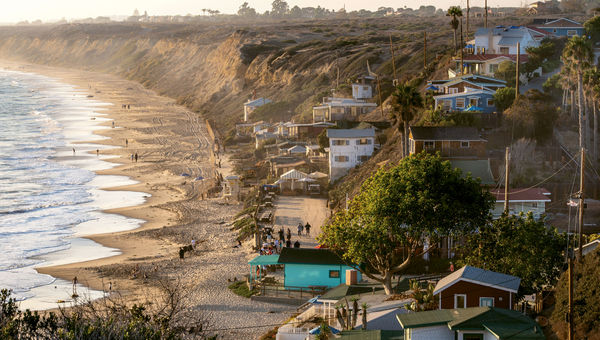
The Crystal Cove Historic District in Newport Beach, Calif., where cottages are open to the public for overnight stays. It is one of the few lower-cost accommodation options on the California coast. Photo Credit: J. Christopher Launi
"In the last few years, however, there's been a real
focus on what the barriers to coastal access actually look like," he said.
"Important challenges include developers and billionaires closing off
public access and the fact that for about half of Californians, the cost of
visiting the coast, particularly staying overnight, just doesn't make economic
sense."
At the front lines of enforcing the Coastal Act is the
California Coastal Commission, which appears to have ramped up its scrutiny of
the hospitality sector, levying major fines against upscale hotels in recent
months.
In May, the commission fined developer Sunshine Enterprises
a record $15.6 million after the company opened a Santa Monica hotel. Sunshine
was originally approved to construct lower-cost accommodations on the site,
which had previously been home to a Travelodge and the Pacific Sands motel.
Instead, the commission said, the group abandoned those plans entirely, opening
the boutique Shore Hotel in 2012. As of this month, room rates there started at
$350 to $430 per night.
Meanwhile, this past June, news broke that the commission
had fined the Ritz-Carlton Half Moon Bay, located less than an hour south of
San Francisco, $1.6 million, accusing the property, which often charges $1,000
per night for king rooms, of impeding public access to the beach.
Jennifer Savage, California policy manager for the global
ocean and beach preservation nonprofit Surfrider Foundation, said, "The
way that the Ritz-Carlton is built, adjacent to the beach path, it looks like
the beach belongs to the hotel."
The foundation testified at commission hearings involving
both the Ritz-Carlton Half Moon Bay and the Shore Hotel.
"As part of the conditions for allowing the hotel to be
built where they built it," Savage said, the developers of the
Ritz-Carlton Half Moon Bay were required "to provide a certain number of
public parking spaces and clear signage saying that there's public parking and
a public beach. They didn't do that. If you're a casual visitor to the coast
and you don't know the law, you'd likely feel pretty intimidated. ... You
shouldn't have to be versed in California law just to visit the beach."
While the commission's recent efforts have served as a stern
warning to coastal developers, real estate owners and hoteliers, most experts
agree that the issue isn't likely be solved by regulatory crackdowns alone.
For the conservancy, expansion of lower-cost overnight
options -- including campgrounds, hostels and more accessibly priced hotels and
motels -- plays an integral role in keeping the coast open and within reach.
In October 2017, the state passed a law instructing the
conservancy to assess the availability of lower-cost coastal accommodations in
California. The resulting study found a severe lack of diverse price points.
The conservancy's Hutzel said, "There are just under
65,000 coastal accommodations that are on or very near the coast, and
approximately just over 13,000 were qualified as lower-cost when we did our
assessment. And most of that 13,000 were campsites, so there's just not a lot
out there." Hutzel estimated that most campground accommodations start at
around $25 to $50 per night.
Following the study, California voters in June 2018 passed
Proposition 68, authorizing a state resources bond that allocates $60 million
to finance lower-cost coastal accommodations. The conservancy is to receive $30
million to invest in additional overnight options. Another $30 million goes to
California's state parks system, which owns about a third of the coastal
region, to expand and build new campgrounds and other accommodations. The
conservancy put out a request for proposals this summer.

The view from one of the cottages in the Crystal Cove Historic District in Newport Beach, Calif. Photo Credit: Rodrigo Garcia
"With these public funds, we can work with a wide array
of entities, including public agencies and nonprofits like Hostelling
International or Crystal Cove Conservancy, which provide lower-cost offerings
on the coast," Hutzel said. "A likely scenario for new developments
could be some number of rooms that are at market rate and some number that are
lower cost."
UCLA's Christensen said that both nonprofits and government
agencies will have to work creatively with the private sector and with local
communities if any meaningful changes are to happen.
"I think there is great progress being made, but if the
private sector and coastal communities don't also embrace this movement and
figure out how to make it work, it's going to be very difficult,"
Christensen said.
"It's discouraging when you see private investors
flouting the law. They're benefiting tremendously from more than 40 years of
public dedication to protecting the coast," he said.
"And the same goes for communities that want to
maintain some kind of exclusivity. It's discouraging that they would want to
take something that belongs to all Californians and just make it exclusively
available to them."