Although the hospitality sector has sometimes been slow out
of the gate on sustainability improvements, hotels are proving to be ahead of
the curve when it comes to curbing food waste.
"The hotel segment isn't necessarily the segment of the food
and beverage industry that one always looks to for leadership in culinary
trends," said Ned Barker, founder and CEO of the consulting firm Grill Ventures
International and a consultant for the American Hotel and Lodging Association's
(AHLA) food and beverage committee. "However, in the case of food waste, as far
as the U.S. is concerned, I think our part of the industry is very much leading
the way."
By any measure, the amount of food waste that ends up in
landfills is staggering. According to data supplied by the AHLA, roughly 63
million tons of food are wasted each year in the U.S. alone, with some 40% of
that volume coming from consumer-facing businesses, including hotels.
The environmental impact of that waste is also substantial.
Caitrin O'Brien, senior manager for corporate sustainability
at Hilton, said, "Food production is the single biggest contributor to global
deforestation, biodiversity loss and water extraction. And with one-third of
food globally wasted, that means that we’ve wasted a significant amount of land
and resources."
Meanwhile, with composting difficult to achieve at scale, the vast majority of food waste ends up in
landfills, where it causes further environmental harm.
Marc Zornes, co-founder of artificial intelligence-based
food management tech firm Winnow, said, "When you throw food into a landfill,
it decomposes and creates methane, which is a very strong greenhouse gas. It
doesn't really become reusable, and food waste is tied to about 8% to 10% of
global greenhouse gas emissions."
Founded in 2013, Winnow is one of several new innovators
seeking to tackle food waste. The company's latest technology, Winnow Vision,
uses cameras and artificial intelligence to evaluate discarded food, then
analyzes and attaches a cost to the food that was wasted, enabling chefs to
better plan ahead.
An entry-level Winnow
system typically costs a couple thousand dollars to install, though pricing is
determined on a case by case basis. According to Zornes, the tech can deliver
anywhere between a 200% and 1,000% return on investment within the first year.
"We're saving each site thousands of dollars a year in food
costs," Zornes said.
He estimates that Winnow is deployed in some 1,300 kitchens
globally, including at select Accor, InterContinental Hotels Group and Hilton
properties.
"It's something that makes economic and environmental sense,"
he said. "We’re seeing a growing number of large organizations say they're
going to have a target for food waste reduction as a business."
Among the industry heavyweights that have made such pledges
is Marriott International, which has set a goal of cutting its food waste by
50% by 2025. The company has begun implementing various food waste-reducing
procedures, including the utilization of the food waste-tracking technology
Leanpath, as well as partnerships with organizations that are able to donate
unconsumed food to those in need or turn food scraps into animal feed.
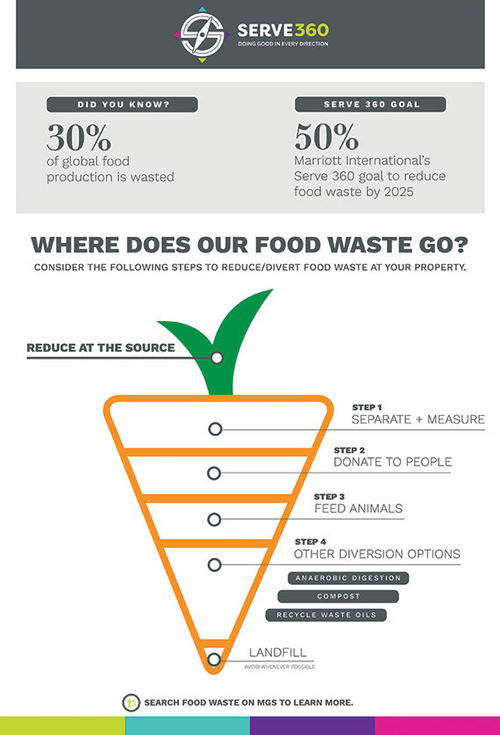
An internal Marriott International poster outlines the company's approach to food waste management.
Denise Naguib, vice president of sustainability and supplier
diversity at Marriott International, said, "No one really wants to throw away
perfectly good food, but we've been seeing particular interest in the issue
from corporate customers who are hosting meetings and events. There's
definitely corporate demand for this on the consumer side, and it's that
consumer demand that will really help us as an industry move forward."
Also making notable strides on the food waste front is
Accor. According to Amir Nahai, Accor's CEO for food and beverage and
lifestyle, the company managed to reduce food waste by 52% in 92 hotels in 2017
and by 31% across 282 hotels in 2018.
This year, Accor debuted an internal Love Food Not Waste
initiative, offering Accor properties individually tailored food
waste-management recommendations. The group also has a partnership with Too
Good to Go, an app designed to help kitchens save food that would otherwise be
thrown away.
"Many owners are aware of this major challenge and recognize
the role that the hotel industry has to play in addressing it," Nahai said. "We
also involve our guests in our food waste-reduction initiatives with positive
messages about portion size, such as the launch of our 'Clear Your Plate'
campaign in Asia."
Further supporting hotelier efforts to cut food waste is the
AHLA, which in 2017 collaborated with the World Wildlife Fund and the
Rockefeller Foundation to launch the Hotel Kitchen program, a toolkit offering
hotels a roadmap for food waste reduction.
One of the biggest issues the Hotel Kitchen platform
addresses is food waste generated by buffets.
"Hotel buffets have been in the habit of using these big,
beautiful dishes and filling everything up so you don't have to replenish it,"
said Grill Ventures International's Barker. "But then you end up overstocking
and over-prepping."
Instead, Hotel Kitchen recommends using smaller vessels on
the buffet line and replenishing as needed. For traditional dining venues, the
toolkit recommends offering more variety in portion size by providing guests
options for a smaller version of an entree or a selection of sharable plates.
Other opportunities to cut waste include nixing the complimentary bread basket
or charging guests a nominal fee for bread.
Hilton's O'Brien said, "Hotel Kitchen is really comprehensive
and walks hotels through all the steps."
She added that the toolkit has been implemented across all
250 of Hilton's managed properties in the Americas as part of the company’s
goal to halve its food waste by 2030.
"Yes, food waste is a big challenge in the hospitality
industry, but it's also something that the industry is really coming together
to focus on, and that has been incredible to see," O'Brien said.