On the top floor of the 55-story W Times Square, visitors
will find one of the brand's original Wow suites, a sprawling one-bedroom
apartment-sized hotel room with silver couches, a hanging basket-style chair
and a round bed complete with ceiling mirrors and lights, a nod to the crystal
ball that drops each New Year's Eve just outside the window.
The large dining room is decorated with drink glasses
featuring male and female strippers. And the amenities are all classic W, with
clever little sayings like "bare all" on the shaving kit, "fresh
mouth" for the toothbrush envelope, "quick fix" on the sewing
kit and a "Two faced bright 'n tight masque, for when you literally can't
even."
Such features have long defined the fun-loving W brand,
which launched the lifestyle hotel trend that sent competitors of Starwood
Hotels & Resorts, including Marriott, Hyatt, Hilton and InterContinental,
scrambling to create their own hip, unique hotels. The goal was to attract
travelers looking for something beyond the cookie-cutter styles that had
previously defined luxury and branded properties in general.
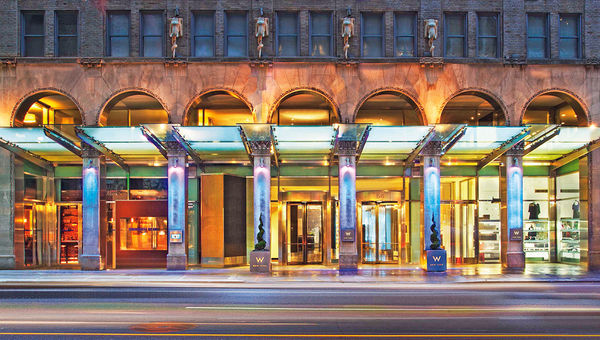
The W New York opened in 1998 and was converted into a Maxwell this year. Photo Credit: W Hotels Worldwide
Today, STR counts 67 brands under its classification of
boutique or lifestyle properties. The company didn't even have such a category
when the first W opened on Lexington Avenue in New York in 1998.
But as the brand celebrates its 20th birthday, consumer
expectations have evolved, and the 17-year-old Times Square property as well as
some of the other early North American Ws may soon go the way of the original,
which earlier this year was converted into a Maxwell.
At issue, said W Hotels global brand leader Anthony Ingham,
are the evolving consumer demands and brand standards, which he says have
become increasingly luxurious as more W hotels have been developed around the
globe. The Times Square property, like the Lexington Avenue property and a few
of the other early Ws that have already exited the brand, were conversions,
meaning they were developed in buildings with traditional hotel architecture
that limits what can be done in renovations.
Indeed, across from the Times Square location stands a
symbol of one of W's new competitors, the Edition, which was launched by
Marriott in partnership with boutique hotel legend Ian Schrager in 2008. The
Edition, still under construction, and the W now share a parent company,
following the 2016 acquisition of Starwood by Marriott.
But the planned opening of that property really has nothing
to do with what Ingham expects will be W Hotels' eventual exit from the Times
Square property. The W Times Square is simply past its time, Ingham said, but
it will remain in the brand until a site can be found in New York.
What happened, Ingham said, is that after the original
opened, there was a "very fast expansion," with 12 to 15 properties
opening in North America within three years.
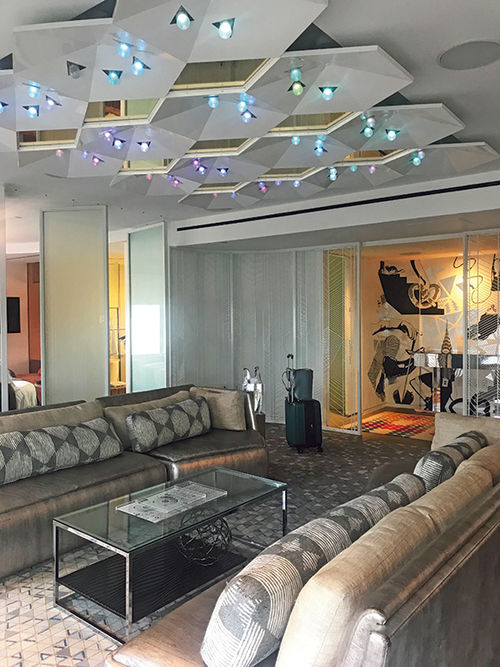
The Wow suite at the W Times Square features silver couches and ceiling mirrors and lights that give a nod to the New Year's Eve ball drop. Photo Credit: Jeri Clausing
"But that original business model was not a luxury
business model," he said. "Those were conversions of existing assets
that Starwood owned. They had clever interior design, a great chef, a hot bar.
It was a brilliant concept that was never intended to be a luxury concept."
The experience, however, was so unique that the company was
able to start charging more and more, and "real estate developers started
coming to us after the first five years saying, 'I want a piece of this hot new
brand. I have lots of money, and I want to build something new and spectacular.'"
As development turned global, he said, "this model has
played out where we have an entirely newbuild pipeline of hotels that are
firmly in the luxury space but have this spirit of our original DNA, of the
original disrupter, of the lifestyle hotel. So we can be really quite
adventurous and quite bold and create luxury hotels unlike any seen before."
From city hotels in major global gateways to beach resorts,
each new W is unique. But each, Ingham said, also has requirements now for an
entrance floor that holds all the public spaces, including the lobby, or "living
room," a bar, restaurant and indoor and outdoor "hubs."
They are also unique in their locations. In Punta de Mita,
Mexico, for example, the W was developed on one of the most popular surf breaks
north of Puerto Vallarta. The hotel, according to general manager Brian
Segrave, was built along the beach and into the natural forest of the nearby
hillside, a design inspired by a forest cave.
The hotel has a bohemian surfing culture, along with a
strong focus on wellness, all of which, Segrave said, is combined "with
the DNA of the W brand, a strong focus on design and doing something that hasn't
been done before. Something new, better, special."
There are 54 W hotels around the globe, with 40 more in the
pipeline. But after putting much of its focus on international development,
Ingham said, there is now a concerted strategy focused on North America, where
the properties in recent years have seen a drop in guest satisfaction scores.
"What you'll see is selected exits, a lot of big
renovations in North America and some more newbuilds," he said.
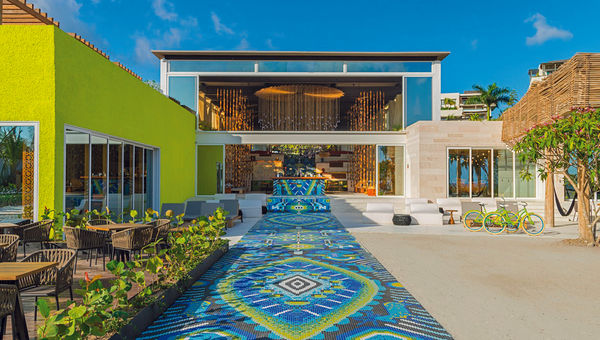
The W Punta de Mita in Mexico pairs the brand's focus on design with a unique location. Photo Credit: Jeri Clausing
Ingham said there are 10 renovations underway, including $50
million-plus upgrades to the Fort Lauderdale, Miami Beach, Boston and San
Francisco properties. On Monday, W announced a $50 million upgrade for the W Washington
DC, which is scheduled to be completed in 2019.
As for the W Times Square, "This hotel is old bones,"
he said. "Guests love it because it's a favorite location."
Renovations have been done to its living room, restaurants
and bars, and the rooms have had "soft touch-ups." But Ingham said, "It
doesn't really live up to the new brand direction."
For that reason, the W Times Square "cannot be our
flagship," he said. "We have to build something from scratch. So we
are in the process of looking for that New York flagship."
Asked if the new W will also be the global flagship, he
responded, "We would like to say that, but that would be a very high bar."
_______
Correction: Brian Segrave is general manager of the W Punta de Mita. An incorrect spelling of his last name appeared in a previous version of this article.