The U.S. Tour Operators Association wants agents to be very clear about something: The group has two levels of membership -- active members and associate members -- and only active members are covered by the association's $1 million travelers assistance program.
The reason for the clarification is concern that travel sellers might be mistakenly booking with USTOA associate members assuming that the transaction is protected by the $1 million bond required of active members, when in fact it isn't.
Such was the case with one agent who booked with an associate member and has since waged a better than two-year battle to recoup what she says is the $66,400 owed her for bookings that an operator never delivered.
"There continues to be confusion about who is covered under the $1 million travelers assistance program and who is not," said USTOA President Terry Dale. "So through this process it was important to us to define who is an active member and who is not."
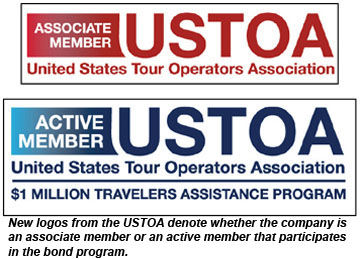 Last Wednesday, the association rolled out new logos -- blue for active members and red for associate members -- to clearly identify which participate in the $1 million travelers assistance program. In addition to the different colors, the blue logo bears a tagline identifying the member as being covered by the $1 million bond.
Unfortunately for Patricia Hazen of Bonita Springs, Fla.-based Pelican Landing Travel, that clarification comes a few years too late. Hazen said she called the USTOA in December 2009 to ask if Steps of Paul Coastal Cruises, a division of Cruise Club Holidays, was indeed a USTOA member. Hazen said the operator displayed a USTOA logo on its website and when she checked with the association, she was told that Cruise Club Holidays was indeed a member.
In fact, Cruise Club Holidays was listed as a supplier member (membership nomenclature has changed since then) in the 2010 USTOA directory, which was released in December 2009. The operator is no longer a member of the USTOA at any level.
Hazen insists that she booked with the Athens-based Steps of Paul in large part because she believed that the company was endorsed by the USTOA. She initially booked a church group of 60 people, but after the company canceled and rescheduled numerous times, the group was whittled down to 41.
The pared-down group made the trip this past April, nearly two-and-a-half years after the original booking, but Hazen said she is still waiting for a $66,400 refund for the deposits that were paid by the remaining 19 group members who ultimately canceled amid all the rescheduling.
Hazen has contacted the USTOA about her situation and said she personally reached out to Dale but has not heard back. She said she feels that the USTOA is in part liable for misinforming her about the type of membership, and consequently the type of coverage and protection for her clients, Steps of Paul had within the organization.
For his part, Dale insisted last week that the USTOA had properly advised Hazen.
"We never want to see, whether it's Pelican Travel or any agent, suffer a loss," he said. "This association was built around integrity to travel." Even so, he added: "We did not drop the ball in this process."
The USTOA, Dale said, informed Hazen "that this entity was an associate member and not covered under the travelers assistance program. Regrettably that doesn't necessarily guarantee that everyone is clear about the difference between an associate and an active member. We recognize that we need to continually go out and say 'These are who are active members.' "
Along with the new logos that differentiate active members from associate members, the USTOA has rolled out what Dale described as "enhanced" guidelines for the more than 700 associate members of the USTOA.
Those guidelines state that associate members who have an office in the U.S. and sell tours to the North American travel market are prohibited from using the associate member logo on any material or websites "because of the increased risk of consumer confusion."
Most of the hundreds of associate members fall into other, non-tour operator, supplier categories such as hotels, airlines and cruise lines. But Dale said there are eight that have a U.S. office and sell tours to the North American market. There are also dozens of associate-member tour operators that are foreign-based companies.
As for why the USTOA grants membership to operators that do not satisfy the requirements of active membership -- most crucially, posting $1 million in security in the form of a bond, letter of credit or U.S. Treasury Bill and having been in business for three years -- Dale said that the organization is "always looking to develop a pool of potential active members."
"We recognize that securing a bond or a letter or a treasury bill in the amount of a million dollars is a big ask for a small business," he said. "So if we can start bringing them into the fold through the associate member category, so they can then secure that million dollars, they can become an active member."
Travel lawyer Alexander Anolik applauded USTOA's new emphasis on differentiating the two levels of membership. The problem, he said, is that the effort is past due.
Until now, Anolik said, "you saw the USTOA symbol on the brochure ... but you didn't know there were these two types" of members. "USTOA has to give a disclosure, has to have transparency, [has to] make sure that agents know all USTOA members aren't created equal."
Hazen, who originally retained Anolik to pursue legal action against the USTOA, said last week she has given up on the idea because the legal costs are too high.
The USTOA has frequently made tweaks in the way it classifies affiliated companies that are not active members. There used to be two separate groups. One, called "allied members," consisted of advertising and public relations companies, local airlines, attractions, cruise operators, ground operators, insurance companies and legal services, among others. The other, "associate members," consisted of global airlines, car rental companies, cruise lines, hotel/resort/restaurant groups, tourist boards and trade associations.
Under Dale's leadership, the two have been merged under the umbrella category known as associate members.
Pam Young, vice president of industry relations at Travel Leaders Group, applauded the USTOA's new initiative to better clarify the distinction. At the same time, she said confusion has not been an issue among Travel Leaders agents.
Young also noted that the USTOA remains a strong industry brand and that active members of the USTOA are well regarded by retailers. "Our members absolutely do look to that," she said.
For news on tour operations, wholesalers and river cruising, follow Michelle Baran on Twitter @mbtravelweekly.
CORRECTION: This report was updated to correct the location of Pelican Landing Travel. It is based in Bonita Springs, Fla., not Naples, Fla.