
Yeoh Siew Hoon
I suppose it is fitting that I write my first postcard for you from Bhutan, Land of the Thunder Dragon. It is, after all, the least visited destination in Asia (only 100,000 visitors in 2013) and possibly the most aspired to by the growing legions of travelers in my part of the world.
I was told that Americans are one of Bhutan's biggest customers, as are Europeans (Germans, French, Swiss), and it's now beginning to see more visitors from Asia, particularly from countries with Buddhist populations. While I was there, I saw tourists from Malaysia, Singapore, Indonesia, Thailand and, increasingly, China.
Because it's a little landlocked place between India and China, you'd expect that Bhutan might feel a bit lost between its two giant neighbors. I live in Singapore, and that's a little place sandwiched between two big neighbors, Malaysia and Indonesia, so I know what that can feel like.
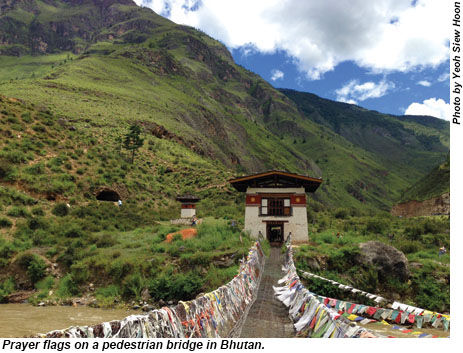 But I have to say that in all my travels, I have not come across a place that has as strong an identity, and that, I think, is the root of why Bhutan is how it is today: a place of grace, dignity and -- let's not forget -- happiness.
This is the place, after all, that gave the world the concept of Gross National Happiness, the notion that a country's development should not just be measured in terms of economic growth but should take into consideration four factors: governance, culture, socioeconomic development and the environment.
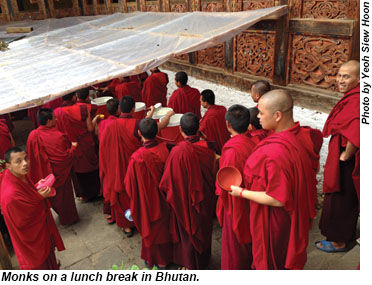
Bhutan certainly scores high in culture. When you visit villages and monasteries, nothing is put on for the sake of tourism. You see monks going about their daily rituals, meditating, taking music classes, breaking for lunch, reciting their chants. And you can move freely among them as long as you respect the boundaries. For example, once you remove your shoes, no more photos. And you should be dressed appropriately.
It also rates well for environment, scoring among the top 10% of highest species density in the world. About 26% of the land is designated as national parks. This has very strong appeal for those of us who live in an increasingly urbanized Asia, where people are being moved, in one generation, from villages to high-rise building blocks.
 You see and feel the nature as your plane approaches Paro Airport. That tight squeeze between the mountains, the green valleys spread out below you, and that landing in Paro Valley, which sits at 7,382 feet. Wow!
The air is fresh and thin. It can take some adjusting to. You definitely feel breathless the first couple of days, and walking up monastery steps can be a bit of a challenge. But in Bhutan, life is lived at a slow pace, so no need to hurry, just take your time and go at your own pace.
As someone who's used to living life at a fast pace -- I lived in Hong Kong for a decade, and let me tell you, Hong Kong can make New York seem slow by comparison -- I constantly had to remind myself to slow down. Breathe. Wait. Relax.
If anything, Bhutan reminds you to do all that.
And, oh yes, eat!
 Food is a big part of our culture in Asia -- if we are not eating, we're talking about food -- and as I was traveling with a group of Malaysians and Singaporeans, that subject was a constant.
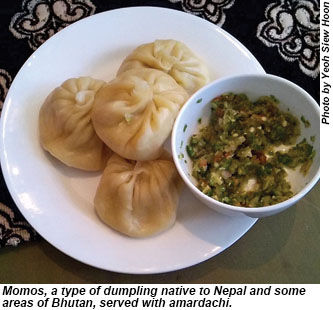
The food visitors are served in Bhutan is generally bland, but there's one thing I learned: In Southeast Asia, we eat everything with chilies; in Bhutan, they eat chilies with everything -- that is, chilies are their main ingredient. So if you want spicy, ask for their side dishes. A chili cheese dish called amardachi can get your taste buds soaring to Everest and back.
And here's something else I learned in Bhutan: They have the world's highest virgin mountain -- virgin because a few years ago, the king decreed that no one should climb their mountains because once, a long time ago, a team of Japanese scaled a Bhutanese peak and so much bad luck happened to the team and the villagers that they believed the spirits were disturbed.
So, if you like stories of spirits, love nature and meeting people with "good attitude" (I give their people top marks for sincerity, hospitality and sense of humor), head to Bhutan. This is a place the world has much to learn from, and who knows? You may even find the secret to happiness.
Yeoh Siew Hoon, editorial director of Northstar Travel Media Asia, is the founder and editor of Web in Travel, a content and community platform for online travel professionals in the Asia-Pacific region. At heart a traveler and writer, her blog on www.webintravel.com is a popular aggregation of her experiences on the road and issues facing the travel business. She will write a monthly column for Travel Weekly.