It had been a while since anyone found my being an American exotic. I certainly didn't expect it to happen in Nanjing, a city just two hours from Shanghai by bullet train.
Nanjing is a hugely popular destination among Chinese travelers, but it is not as well known among Western tourists. Known in China as the "southern capital," Nanjing served as the nation's capital during part of the Ming dynasty (1368-1644) as well as 10 other periods of Chinese history.
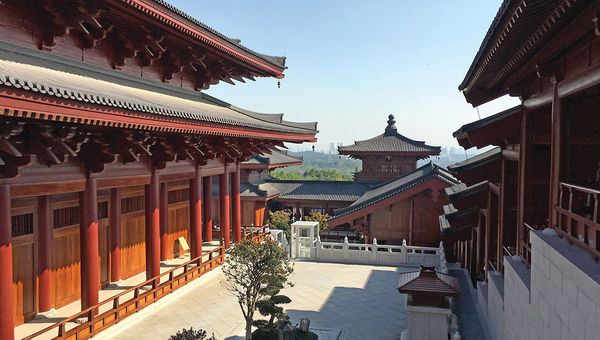
The Usnisa Temple is a sprawling hillside monastery complex just outside of the city. Photo Credit: TW photo by Johanna Jainchill
Today, the city offers some of China's most important Buddhist sites, a wealth of Ming dynasty artifacts, one of the country's most significant war museums and the street life of a second city where locals still find Westerners rare enough to ask for their photograph. At least three times in as many days there, friendly locals asked members of our press group if they could take pictures with us. On another occasion, a young girl studying English at school simply wanted to practice speaking with us.
This was particularly surprising given that Nanjing is also a large, cosmopolitan city of 8 million people with well-known hotel brands such as the InterContinental, Four Seasons and Shangri-La, where we were hosted. They regularly host business and leisure travelers from around Asia.
At night, all of those tourists seem to congregate around the city's Qinhuai River and the Confucius Temple. This busy area is full of food vendors and tea and craft shops as well as temples and historical buildings.
The temple itself, built along the river in 1034, has been destroyed and rebuilt a few times since then. It has the largest Confucius figure in China and a collection of ornate panels made of jade, gold and silver that chronicle his life.
Evening cruises on the Qinhuai are popular, taking visitors in slow, antique-style boats while they eat salty snacks, sip tea and watch performers play traditional Chinese music along the banks.
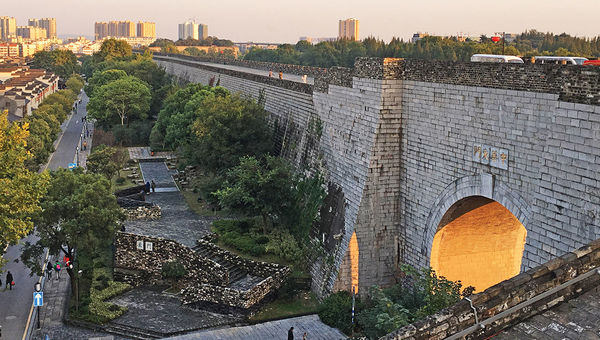
The Nanjing City Wall was built in the 14th century by the founder of the Ming Dynasty. Photo Credit: TW photo by Johanna Jainchill
Also nice for a visit around sunset is the Nanjing City Wall. Built in the 14th century, the original wall was almost 22 miles long, making it one of the longest city walls in the world. Today, there are about 15 miles of the wall left, and six sections are open to the public.
Nanjing has several important historical sites, but one not to be missed is the Nanjing Massacre Memorial Hall.
Built in 1985, it tells the story of World War II's 1937 Nanjing Massacre, in which the Japanese killed 350,000 people, and memorializes the victims. The impressive exhibits include historical documents, artifacts, photos and videos, many of which are disturbing but worth seeing.
China's vastness seems to have given it countless cuisines, but I had never heard of Nanjing's before getting there. A local meal seems to invariably include duck, the local specialty, in all forms — one favorite is duck blood soup. Nanjing also draws people from around China to enjoy hairy crabs, which are pulled from nearby Gucheng Lake and served hot or cold. Each fall, the city hosts a hairy crab festival.
And beer lovers will be interested to know that Nanjing is also home to China's first craft brewery, Master Gao, which also features a popular bar with 16 taps. Founded in 2008 by Gao Yan, who had lived in the U.S. and fell in love with craft beer, the bar serves up some decidedly local brews like Jasmine Tea Lager, which Gao said combines China's three top-selling beverages: water, tea and beer.
Outside the city
Several of Nanjing's top attractions can be found just outside the city in its parks and hills. The mausoleum of the Ming dynasty's founding emperor, Zhu Yuanzhang, and his wife is a 600-year-old Unesco World Heritage Site and one of China's largest imperial tomb complexes. Its half-mile-long Sacred Path has large stone statues of warriors and mythical creatures that are meant to guard the emperor.
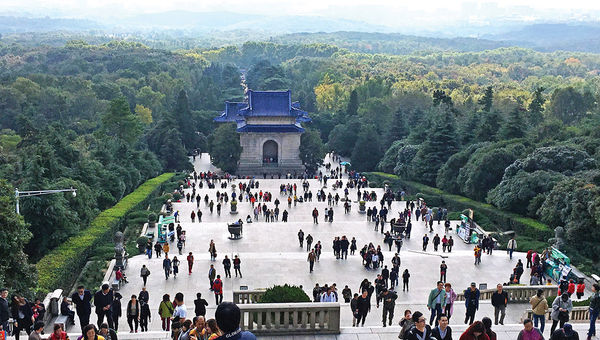
The view from the top of the 392 steps to the mausoleum of Sun Yat-sen. Photo Credit: TW photo by Johanna Jainchill
The mausoleum of Sun Yat-sen, who died in 1925 and is considered the father of the Republic of China, draws people from around the country to its 20 acres in the Zhongshan Scenic Area of Purple Mountain. Visitors climb 392 steps to reach the mausoleum, which offers panoramic views of the surrounding countryside. Qixia Mountain has several Buddhist temples and pagodas, and passing by one, we were treated to an unexpected chanting ceremony from the local monks.
One of China's most important Buddhist sites is a complex that attracts pilgrims the world over and cost around $600 million to build.
The Nanjing Niushoushan Cultural Park, opened in 2015, is home to a huge, opulent Buddhist palace built into the side of a mountain that goes six stories underground, housing centuries-old Buddhist relics as well as a 25-foot-long, rotating Buddha sculpture and the 10,000 Buddha Corridor, which seems to be literal.
The beautiful grounds are also home to some Tang dynasty-era (618-906) pagodas and a sprawling hillside monastery complex where monks can be seen wandering the property, which has beautiful views of Nanjing and the countryside.