Since U.S. immigration authorities began targeting cruise ship crew for visa revocations and deportations this summer, the cruise industry has stayed largely quiet about the actions, which law experts say are difficult to challenge.
U.S. Customs and Border Protection (CBP) removed crew members from ships sailing the Great Lakes in July. Victory Cruise Lines acknowledged the actions, while a source close to Pearl Seas Cruises said they had taken place, and crew members from the Viking Octantis confirmed the removals. News outlets in Norfolk, Va., reported that 21 Carnival Cruise Line crew members were removed from the Carnival Sunshine while it was docked there.
Foreign crew members hold visas that the Department of Homeland Security or the State Department can revoke for alleged criminal activity without pending charges or investigations, said Georgetown Law faculty member Sophia Genovese. When revocations occur, they are not subject to review in federal courts, she said.
Authorities have alleged that the recently deported Carnival crew members possessed child pornography, according to coverage of a rally organized by activists from the Pilipino Workers Center, a California-based group that advocates for better working and living conditions for Filipinos in the U.S.
Genovese said she is suspicious of the enforcement actions and that authorities do not appear to be investigating the allegations or identifying potential victims, the standard approach for such cases.

Sophia Genovese
"I think that invoking something so abhorrent, like child pornography and child sex crimes, may be cover for the department to avoid scrutiny over the situation, to try and manipulate the situation so there isn't much pushback," she said.
It is unclear how widespread the enforcement activity is and whether it is ongoing. Norwegian Cruise Line Holdings said it is not aware of any crew removals on any of its ships. Carnival said it is cooperating with authorities, and Royal Caribbean Group did not respond to a request for comment. CLIA only said that "cruise lines cooperate fully with authorities. Crew may be asked to disembark at their request, and we do not speculate on the reason."
Cruise lines have not publicly commented on CBP's actions beyond saying that they are cooperating with authorities.
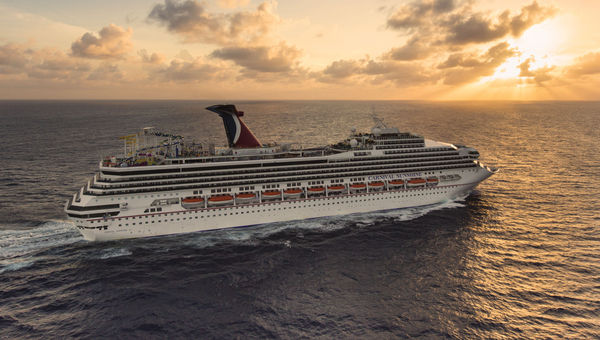
The Carnival Sunshine. More than 20 crew members were reportedly removed from the ship by CBP while it was docked in Norfolk, Va. Photo Credit: Courtesy of Carnival Cruise Line
Elected officials representing the ports where the removals took place, Detroit and Norfolk, have spoken up.
Rep. Shri Thanedar (D-Mich.), whose district includes part of Detroit, said, "President Trump campaigned on protecting people and removing illegal immigrants who are 'the worst of the worst.' Instead, we see incidents like the one at the Port of Detroit, where immigrants who are here to work and make a better life for themselves are detained and deported with no due process."
Rep. Robert Scott (D-Va.) also decried the lack of due process and said the crew held "valid" work visas. He said that it was "unclear" why the seafarers were targeted or "whether for each individual detained, if there was probable cause that they had committed a crime. ... Our nation was founded on the fundamental principles of due process. Under our Constitution, everyone is entitled to due process regardless of citizenship or immigration status."
Cruise industry silence
There are various reasons the cruise industry would choose to stay mum about the issue, said Cori Alonso-Yoder, director of the Immigration Clinic at the University of Maryland law school.

Cori Alonso-Yoder
One, the industry is in the business of selling vacations, and publicly fighting immigration enforcement would clash with efforts to market the concept of escape. Bringing attention to the issue could also potentially make it more challenging to attract new employees, she added, although workers often accept those risks when the opportunities abroad are more lucrative than what they would find at home.
William Terry, a Clemson University professor with expertise in tourism industry labor, said the industry's silence might inspire a larger operation against other types of visa holders, saying that the administration might calculate, "'If we know that no one's going to fight this, if we know that [the visa holders] don't really have a means of fighting it, maybe we can push this a little further next time.'"
Meanwhile, some cruise lines may try to avoid CBP if they can. According to a passenger sailing on the Victory I the week of July 28, the ship skipped Detroit, the port where CBP had removed members of its crew in early July and instead called in Toledo, Ohio. Passengers were told the swap was due to "docking issues" in Detroit.