 TIRANA, Albania -- We arrived at the small, simple airport here, the kind with no conveyor belts for baggage, and met an excited young guide named Fatmir. There were Americans among a group of mostly Dutch tourists, and Fatmir had never before encountered any of our breed. As we drove into town, we spotted military bunkers all over the place.
That was Albania, 1990.
Twenty years later, almost to the day, I returned to this Balkan nation. Tirana's Mother Teresa Airport is a smart, modern affair, opened in 2005. Our guide, Rudenc Ruka, an archaeologist and historian, had not only met Americans before; he had studied at a university in Florida. (View a slideshow of Nadine Godwin's recent visit here.) As for the bunkers, they're still all over the place because, well, just try bulldozing one of those things.
Albania is hardly noticed by most travel professionals on our side of the Atlantic, but while no one was looking, it managed to transform itself into a destination with considerably more appeal for American tourists.
Lonely Planet's editors tapped Albania as their No. 1 destination choice for 2011, marking the first time they had put Albania on any list of best destinations.
In reality, not everyone who has seen France will choose Albania next, but the country does have much to offer:
• Gorgeous shoreline and mountain scenery.
• Sites associated with a fascinating history spanning thousands of years.
• The chance to observe a country still recovering from Europe's most oppressive communist regime.
• A number of reliable, private, incoming tour operators.
• Restaurants serving tasty traditional meals.
• Hotels that in some cities are catching up with the West.
While the quality of roads varies, the infrastructure now includes a four-lane highway from Kosovo through the Albanian Alps in the north to Tirana and on to Durres on the coast.
Albanians tend to love Americans for two reasons, Ruka said. First, they are grateful for the U.S. role in the NATO intervention to halt Serbian aggression against Kosovo's majority ethnic Albanians in 1999. In addition, he said, Albanians credit President Woodrow Wilson with preserving much of the country from partition after World War I.
This was not apparent back in 1990, when a congenial but loyal Fatmir described why Albanians admired Stalin for "saving the people" after World War II.
How things have changed: Albania joined NATO in 2009.
My first foray into Albania was a seven-day packaged tour operated by a Dutch firm, which at the time was the only way to get into the country. In fact, 1990 was the first year since before World War II that tourists from the U.S. were even allowed in. (View box below for information on tours to the country.)
At that time, there were only 6,000 phones in the country and roughly 600 cars. Until autumn 1990, individuals were not allowed to own cars. The lack of phones and cars helped explain why Tirana's central and huge Skanderbeg Square was full of strollers, all part of a nightly "slipper parade." It was a way to have a social life, and there was not much else to do at night in the city.
Fatmir, who was an English teacher with part-time guide duties, believed he would never own a refrigerator.
He was wrong about the refrigerator. I don't know about phones, but I'm sure more than 600 cars whizzed through Skanderbeg Square each hour in my two evenings in the capital on this visit.
 There was no slipper parade, but strollers will have a second chance. Much of the square is a construction site now. It will be converted into a pedestrian-only, "tranquil area," Ruka said.
I could see the action in the square on both visits because I stayed in the same hotel, a socialist-era high-rise shaped like a cereal box and overlooking the square. But the once-dreary Tirana Hotel International has benefited from a makeover.
Although still a box, the hotel's more stylish exterior harmonizes with the high-rises that have sprouted in the area. The gleaming interior is unrecognizable, the elevators work now and the maids are more sophisticated; 20 years ago, they were flushing wastebasket contents down the toilet.
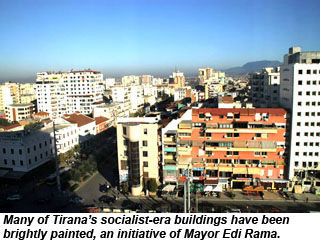
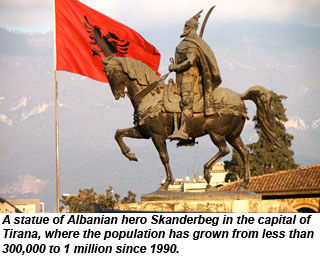
The city has grown from less than 300,000 to 1 million and, having dumped communism, it blossoms with modern architecture that is both creative and attractive. City leaders have bulldozed unauthorized structures of shoddy construction.
They are also painting the town, literally. In the last few years, Tirana has been brightening its legacy drab, socialist-era apartment blocks with colorful geometric designs. One building is even covered with leaves. Ruka told us that Mayor Edi Rama, an arts professor, created some of the designs himself. This makes for one eye-popping city tour.
Skanderbeg Square is still lined with an eclectic collection of buildings: Besides the hotel, they include the socialist-style National Museum and Palace of Culture, plus a small, 19th century mosque and a collection of lovely gold- and rose-colored government buildings dating from 1929 to 1931. The architects were Italian fascists, Ruka observed. Nevertheless, they had more taste than the communists who came later.
A pleasant, tree-lined boulevard reaches south from Skanderbeg Square, leading to parks, attractive new construction, a faux McDonald's and, eventually, Mother Teresa Square, named for the holy woman, who was ethnic Albanian.
It also leads past the ugly, pyramid-shaped Enver Hoxha Museum, named after the former dictator. But that won't be the case for long: Ruka told us Albania meant to knock the building down, beginning on Feb. 20, the 20th anniversary of the day a huge Hoxha statue was pulled down in Skanderbeg Square.
However, Admira Jorgji, counselor at the Albanian mission to the U.N., said later that the date is now less certain, as construction contracts have not been awarded. The aim, she said, is to knock down the pyramid sometime in 2011, 20 years after the fall of communism in Albania. The government then plans to construct a Parliament building, to open next year, the centennial of Albania's independence from the Ottoman Turks.
 My recent Albania sojourn also included a second visit to Kruja, about 20 miles north of Tirana. A town of 30,000 hanging off the side of a mountain 2,000 feet above sea level, Kruja was headquarters for Skanderbeg, the chieftain who became Albania's 15th century hero in the fight against the Ottomans.
His fortress sat on a steep promontory backed by a near-vertical mountainside. Today, the 1980s Skanderbeg Museum sits high within the remains of the centuries-old citadel walls. Modeled on a medieval castle, the museum looks as handsome now as it did when I first glimpsed it 20 years ago. It was designed by Hoxha's daughter, Pranvera, who is an architect still living in Tirana.
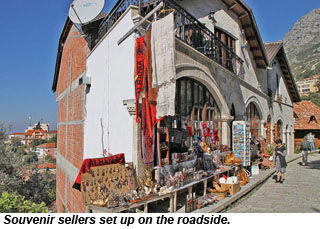
The citadel grounds also include a beautifully restored Ottoman house, serving as the ethnographic museum, plus the remains of long-gone buildings. In 1990, sheep grazed among those ruins; today, there is a small souvenir market at the base of the museum.
In addition, 20 years ago, Kruja's restored Ottoman bazaar, with its steep mountain and a slender minaret as evocative backdrops, was attractive but had been shut down. On my last visit, the shops and their environment were no less appealing, but the street had become a fully stocked market for tourists, and shopkeepers accepted euros and dollars.
For that matter, real estate and cars are priced and paid for in euros nowadays, Ruka said, although Albania's aspirations to become a full European Union member won't be realized for a decade or more.
About 70% of Albania's population is at least nominally Muslim, and the remainder Christian. Because Albania was declared an atheist nation in 1967, most citizens grew up without a religion. Many churches and mosques are open again, but Ruka said, "A man may call himself a Muslim [based on family history] without ever having been inside a mosque."
Albania was "the North Korea of Europe," Ruka continued, and an estimated 1 million departed after the communist regime fell.
Albania, which is smaller than Maryland, still has 3 million people, and some emigrants have returned because they now see a future here.
Ruka's family are among those who stayed. "It is exciting to live in the time of revolution and the time of a changing social system," he observed.
It also is exciting to visit.