Fish for breakfast? After hearing about the menu that awaited me at the Fish Auction Hall in the St. Pauli district of Hamburg, Germany, I thought maybe it was a mistranslation.
But at 9 a.m. Sunday I was happily loading my plate with raw salmon and pickled herring and navigating past servers delivering hot cocoa and Duckstein's red beer while a cover band blasted "Come Together" and "House of the Rising Sun" beneath the Fishmarkt Brunch's loft. It was part of the itinerary during my recent visit to Hamburg at the invitation of the city's tourism organization, Hamburg Tourismus.
Outside, near the edge of the Elbe River, locals bid on smoked eel and tropical fruit, devoured fillet-wrapped pickle slices known as rollmops and continued the bustle of trade that has established Hamburg as the wealthiest city in Germany over the past 1,000 years.
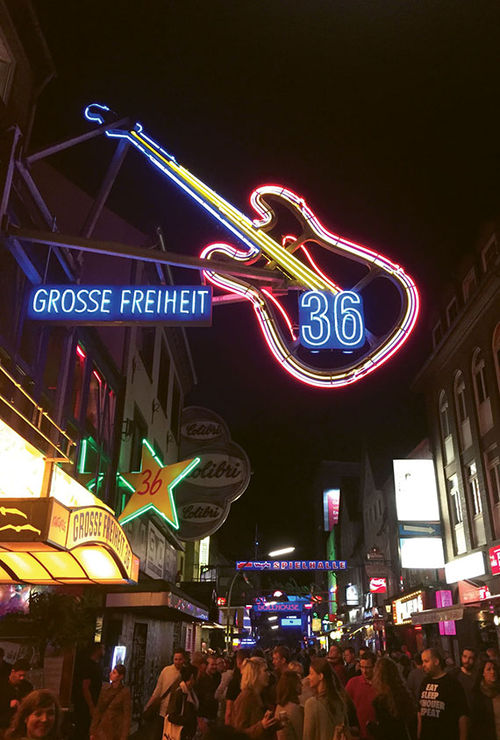
Grosse Freiheit 36, a Reeperbahn music venue where the young Beatles performed regular shows. Photo Credit: Dan Peel
I appreciated the 350-year-old fish-auction tradition for two reasons beyond its stimulating atmosphere: It put the city's motto, Grosse Freiheit (Great Freedom), into action by amending the Catholic church's ban against the sale of fish on Sundays. Also, Hamburg functions as a compartmentalized city, and I had discovered a cultural estuary where partygoers, plaice-haggler millionaire families and music lovers intermeshed.
A post-brunch bike ride gave me a chance to admire Germany's greenest city, its steeple-defined skyline and its 120 parks that fill a quarter of its topography.
I crossed over myriad waterways, which had forced city planners to construct more bridges than Venice, London and Amsterdam combined.
Later I embarked on an hour-long cruise up the Alster, an 800-year-old, man-made lake that houses Hamburg's swans and transforms into a public ice-skating rink in the winter.
During my cruise I saw many lakefront estates and learned that 1.8 million people, including 1,500 millionaires and six billionaires, live in Hamburg, making it Germany's second most populated city after Berlin.
The ports in Hamburg have historically imported salt, wine, tea and rock stars. In 1960, four teenagers arrived with a 45-minute set list, an untrained drummer to replace their wash-bucket percussionist and a recently revised name: the Beatles.
Little did they know Hamburg ran its music clubs from 7 p.m. to 5 a.m. and expected four- to eight-hour shows. I stopped by the Indra Musikclub, where the young Beatles sweated through their first show by stretching each song to close to 20 minutes in length. Over the next two years they played 300 concerts on four main stages, including Kaiserkeller and the Indra, which fans can visit.
The Beatles' influence flits through Hamburg's music culture in the forms of old clubs such as Grosse Freiheit 36, where the Beatles met Ringo Starr; newer venues such as John Lemon; and through the annual Reeperbahn Festival, where 450 bands perform down the street from Beatles' Platz, a record-shaped piazza featuring the band members' silhouettes.
I spent my next two nights in HafenCity, a red-bricked, Gothic architecture district that functioned as a shipyard until 2005, when it became the largest urban-development project in Europe. One of HafenCity's new buildings, the 25hours Hotel, provided me with a retro yet upscale reflection of Hamburg's maritime culture, using navy blue carpets, cruise ship-style inset closets, nautical imagery and freight-style elevators to create a seafaring atmosphere.
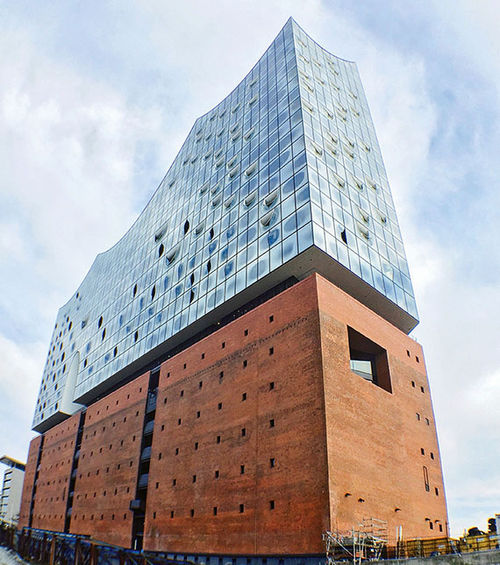
The Elbphilharmonie Concert Hall. Photo Credit: Dan Peel
After enjoying brunch at the 25hours, I took part in the 150th annual Elbfest boat parade.
Amid a fleet of historical, steam-spouting vessels, a 500-foot-high cobalt-silver structure caught my eye, appearing to ripple as I circumvented it. The $900 million Elbphilharmonie was created by the Swiss firm Herzog & de Meuron to rival the world's top concert halls.
Though ongoing construction demanded I wear a hardhat, I was permitted to tour its 2,100-seat main hall, which gave the impression of a magnificent colony of coral. The designers had formed sound-dispersing plaster into geometric shapes to reflect and balance the sounds of baroque and contemporary classical music. Resident orchestras, ensembles and touring groups began performing at the hall on Jan. 11.
My nights in Hamburg involved live music, selections of beer from local breweries such as Ratsherrn — which tasted delicious, as Hamburg's tap water contains fewer impurities than bottled water — and several barbecues, including one at StrandPauli, a beach club where MSC Cruises celebrated its 100th cruise liner docking in Hamburg with fireworks, music, torches and a bonfire.
The next day I took a 40-minute train ride to Lubeck, a city renowned for its marzipan production. Though an 1842 fire decimated Hamburg's old town, Lubeck's Holsten Gate and its seven old-town towers gratified my traveler's desire to steep myself in history. I also visited Schiffergesellschaft, one of the world's oldest pubs, which opened during the Renaissance era and continues to front boat decorations and murals from different eras.
I spent my final night in Hamburg at the Reichshof, an attractive cherrywood and marble-lobbied hotel from 1910 that hosts live rock music on Saturdays and sets its tables with silverware from the early 1900s. The following morning I greeted the sunrise along the Elbe, where I witnessed an 80-foot sailboat raise its sails and catch the region's unending breeze. The majestic sight reinforced the impression that Hamburg's aesthetic as a city makes it a symbol of circulation not only for water, trade and music but for prosperity.