This year marks the official centennial of the U.S. entry into World War I, the grueling four-year battle that gained so little and cost so many millions of lives.
During a recent tour of France's Western Front, I was able to relive — at least a little — the horrors of the trench warfare, hear the fallen soldiers' stories and learn about the combination of disastrous mistakes and unselfish bravery that characterized the war.
It's important to note that a Western Front tour, which in our case encompassed the important battle sights of Verdun and Somme, is not for history buffs alone. Our itinerary also included Champagne, Reims and Amiens, for example, charming cities that are also known for beautiful architecture, world-class tipple and stunning art.
Our tour began in Meuse, which we reached from Paris via France Rail in under two hours after an overnight flight on Air France. On our way to the Chateau des Monthairons, where we spent our first night, we drove along the Voie Sacree, or Sacred Route, that was used to transport troops and supplies during the war.
To get a sense of the staggering numbers of casualties in the famous battle of Verdun, we visited the Verdun battlefield Ossuary, which contains the bones of 130,000 unknown soldiers and offers a 20-minute documentary about the battle every half-hour.
The recently expanded Verdun Memorial nearby features 2,000 artifacts as well as photos and interactive displays that re-create some of the noisy, claustrophobic conditions of the battle.
Because World War I represented a different kind of warfare, relying predominantly on artillery, the French army learned quickly that traditional methods of defense were no longer effective. The fall of Fort Douaumont to the Germans on day three of the Battle of Verdun was a game changer, and today's visitors can explore the fort, its observation terrace and gun turrets, which now overlook a serene countryside.
As with all wars, soldiers were not the only victims in this region. There are nine so-called Destroyed Villages in the region — Beaumont, Bezonvaux, Cumieres, Douaumont, Fleury, Haumont, Louvemont, Ornes and Vaux — that were never rebuilt. Our guides told us that the casualties were so heavy that the land was too contaminated to be used for farming after the war.
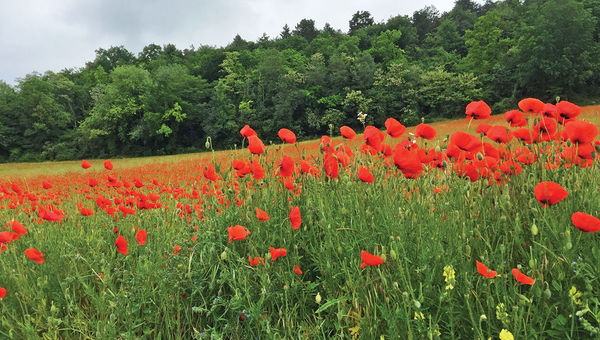
Poppies grace the Western Front countryside. Photo Credit: Felicity Long
One of the most evocative sites of our visit was the underground Citadel in Verdun, a former logistical center, where we boarded a tiny train to traverse the dark, chilly galleries that use audiovisuals and animatronics to offer a glimpse into the frightening daily lives of the French soldiers.
While in Verdun, it would be a shame to miss some of the more cheerful attractions of the city, which include shopping for dragees (candied almonds that date from the 13th century) and admiring the Notre Dame cathedral in all its Baroque glory.
We overnighted at Les Jardins du Mess on the Quai de la Republique, whose location was perfect for enjoying an alfresco sunset cocktail or shopping in one-of-a-kind boutiques.
We also took in the American Monument at Montfaucon d'Argonne, which offers a viewing platform of the former battlefields and the Meuse-Argonne American Cemetery, which features a new interpretation center and is the largest cemetery of American soldiers in Europe. Both sites are cared for by the American Battle Monuments Commission, a U.S. government agency.
Our visit to the nearby Champagne region included walking the Main de Massiges trenches to get a sense of the horrors of life in the foxholes, followed by a more cheerful tasting at the Taittinger House of Champagne, whose vast network of cellars hid soldiers during the war.
A highlight of any summer visit to Reims is the Reve de Couleurs sound and light show displayed on Reims Cathedral. It runs nightly June through August and weekends in September.
For fun, we participated in a cooking workshop with chef Eric Geoffroy at Au Piano des Chefs next to Reims Cathedral, which can be tailored to individuals or small groups.
In the Aisne region we overnighted at the Hotel des Francs in Soissons and toured the Caverne du Dragon, a massive underground quarry that served as barracks for both French and German soldiers during the war, located at Chemin des Dames, a frontline position that also includes a number of other significant World War I sites.
Other highlights included guided visits to the Bois Belleau cemetery, where U.S. troops stopped the German offensive in 1918, and another Champagne break at Champagne Cellar Pannier in Chateau-Thierry, with its 12th century cellars.
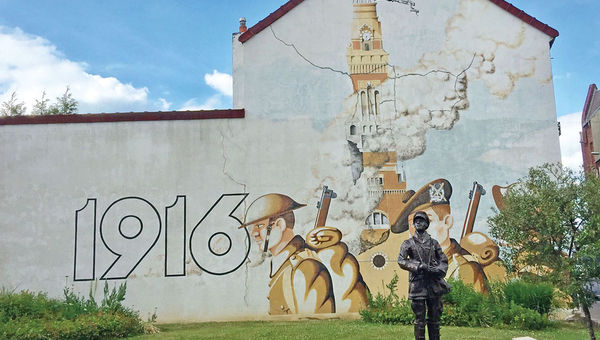
Outside the Somme 1916 Museum in Albert. Photo Credit: Felicity Long
We embarked on a guided visit of the Chateau of Blerancourt, a French national monument that was transformed by American heiress Anne Morgan in 1917 into a medical and social services facility staffed by female volunteers. A new museum dedicated to Morgan and her works, containing some 15,000 works of art and artifacts, opened this spring.
The Historial of the Great War in Peronne gives a glimpse into the lives of the soldiers and of the occupied civilians during the war through inventive displays of uniforms, personal memorabilia and colorful propaganda posters. The Memorial to the Missing at Thiepval features a massive British war memorial as well as a 200-foot-long mural illustrated by Joe Sacco of the battle of the Somme, a modern take on the famous Bayeux tapestries in Normandy.
Fighters from Newfoundland were key players in this region in 1916, and young Canadian tour guides at the Memorial of Beaumont-Hamel bring to life the tragic mistakes that led to massive casualties in the Somme offensive.
We also toured the Somme 1916 Museum in Albert, comprising a 13th century, 800-foot-long tunnel that morphed into an air raid shelter during the war and now houses dioramas illustrating events of the conflict.
We finished our grand tour with a serene flat-bottom boat ride in Amiens, amid the floating Hortillonnages gardens on the branches of the river Somme, and a gourmet feast at Les Marissons, reminders of the beauty that transcends the tragic history of this region.