Like some magician's assistant feigning teleportation, Britney Spears arrives in a puff of smoke on the Axis theater stage.
One minute there is just an empty pedestal and a corps of dancers lit by strobes. The next, there is Britney, glittering in a green leotard, knee-high boots and ample hair extensions, telling us to "Work, bitch."
For a moment, the crowd seems to lose its collective mind.
Then she's off, strutting down the stairs and launching into a full-scale sensory assault of pop theater. The bass line thumps, the dancers bounce and the stage erupts with a video display that flashes across the entire front wall of the theater. At the nexus of all that light and sound is the petite, blond diva, hips shaking and hair flipping, following her own demanding directive while the audience stands on their feet in a full-scream salute.

Britney Spears headlines at the Axis theater at Planet Hollywood. Photo Credit: Denise Truscello
"You want a hot body? You want a Bugatti? You want a Maserati?" Spears sings. "You better work, bitch!"
Welcome to Las Vegas entertainment, circa 2016.
Spears' "Piece of Me" show won't go on the road tomorrow or play in a city near you this summer. The production, which debuted at Planet Hollywood in 2013 and was renewed for two more years last fall, is a resident show at the Axis. That means the only place you can see Spears ride an oversize guitar like a mechanical bull or leap from a giant faux tree to the tune of "Toxic" is on the Las Vegas Strip.
It also means that Spears is part of a growing trend in Vegas entertainment that's replacing eye-popping ensemble productions and musical theater with mega-headliners putting on mega-spectacles.
"Piece of Me" has all the markers of the Strip's new model: big-name star in a tricked-out theater, elaborate production for a relatively intimate crowd, regular dates over multiple years and, if all goes well, a fat paycheck for all parties involved.
Up and down Las Vegas Boulevard, billboards broadcasting famous faces proclaim a fresh paradigm: Las Vegas has entered the age of the resident headliner.
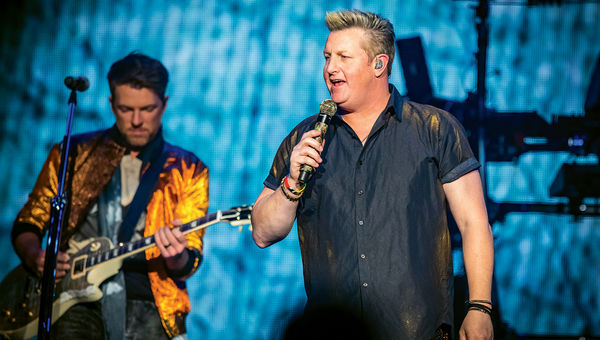
Rascal Flatts' "Rhythm & Roots" at the Joint at Hard Rock Hotel & Casino on Feb. 17. Photo Credit: Erik Kabik/Kabik Photo Group
A laundry list of top stars
In January, Jennifer Lopez unveiled her first Vegas residency in the same theater that Spears calls home. Titled "All I Have" and booked by Live Nation, the show puts the multithreat celebrity through her paces with seven acts, each devoted to a different genre and each with a unique set and costume change, including a dress that doubled as a projection screen with almost 260,000 Swarovski crystals.
Lopez might be the only performer on the Strip who imported salsa instructors from Colombia to prep for her opening night, but she's certainly in good company as a resident headliner.
In recent years, a laundry list of notable artists have signed on to play Vegas, transforming casino showrooms into their personal performance playgrounds, where both the restrictions of more traditional tours and the demands of massive arenas are moot.
Santana headlined the Hard Rock's first residency in 2009. Garth Brooks ditched retirement that year for a guy-and-his-guitar headlining gig at Wynn. After eight years away from the touring spotlight, Shania Twain showed up in 2012 in a sparkling jumpsuit and a live horse on stage for a multiyear run at Caesars Palace and Bruno Mars brought his uptown funk to the Cosmopolitan in 2013.
And that's just the first act: Motley Crue turned the Hard Rock into their own three-ring circus. Mariah Carey hit the high notes at the Colosseum at Caesars. Pitbull did his signature fist pump at Planet Hollywood. In between, there have been residencies from Journey, Guns N' Roses, Elton John and country music royal couple Faith Hill and Tim McGraw, who put on a cozy show at the Venetian, then added 10 more weekends after the initial run's success.
That seems to happen a lot these days: Massive star dips a toe into the Strip waters, likes the temperature and stays for more.
It happened with rocker John Fogerty, who sold out an eight-date residency at the Venetian in January, then tacked on eight more shows for this fall. Country band Rascal Flatts returned for their second residency at the Hard Rock's Joint concert hall, and Spears followed up her contract extension announcement by revealing a revamped "Piece of Me" in front of shrieking fans in February.
And more artists are signing up to play the Strip, too. Later this year, Planet Hollywood will add Lionel Richie to the lineup. Even British punk Billy Idol has a Vegas residency, which opens March 16 at the House of Blues in Mandalay Bay. Idol has dates in May, as well, and has already extended his run to include shows in August, September and October.
"That is the new trend," said Adam Steck, the CEO and founder of SPI Entertainment, which promotes and produces shows such as Boyz II Men, boy band quartet Human Nature and male revue Thunder From Down Under. "Vegas, now it's the cool, hip place to be."
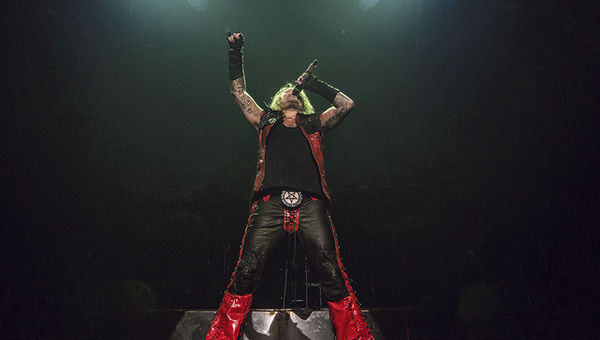
Vince Neil, lead singer of Motley Crue, which played at the Joint at Hard Rock Hotel & Casino. Photo Credit: Fab Fernandez
Big names, big bucks
It's also a lucrative place to be.
Entertainment is a big business in Las Vegas. In 2014, 65% of the city's 41 million visitors attended a show during their stay.
The majority of those guests watched a lounge act, still a staple after all these years, but the percentage of those who took in a big-name entertainer or headliner has climbed during the past 10 years.
In 2005, just 5% of guests who saw shows reported shelling out for a big-name entertainer. Five years later, that number had leapt to 18% and in 2014 (the last year data was available), the figure was at 17%. Among visitors who watched any form of entertainment in Las Vegas in 2014, the average cash spent on performances was $138, a five-year high.
However, Las Vegas wasn't always a destination for A-list artists. Not so long ago, the city had a reputation as a haven for has-beens, a place where the formerly famous came for one last gasp and a paycheck.
"That was Vegas for some time, where artists came to die," said Bobby Reynolds, the vice president of booking for AEG Live Las Vegas, which has exclusive booking rights for the Joint, the Colosseum, the Brooklyn Bowl (in the Linq) and the Venetian Theater.
While forgotten acts crooned in casino lounges, showrooms and theaters were dedicated to other forms of glorious distraction: glittering showgirl revues, magicians in tight pants and even Broadway musicals.
"Vegas goes in cycles," Steck said.
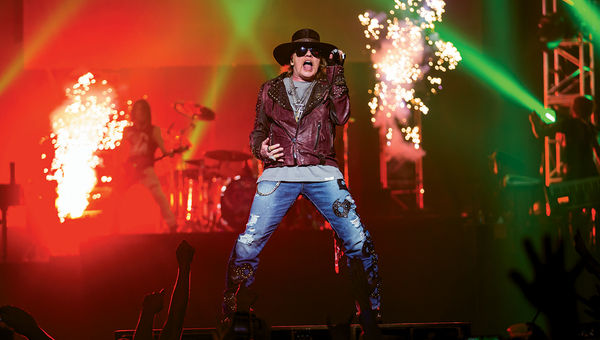
Axl Rose, lead singer of Guns N' Roses, during the band's residency at the Joint in Las Vegas. Photo Credit: Erik Kabik/Kabik Photo Group
This is hardly the city's first headliner cycle. The current wave of resident artists can look back on icons such as Liberace, Frank Sinatra and the Rat Pack who ruled the Strip during the 1960s, holding court at the Sands, Caesars Palace and the Riviera. In 1969, Elvis Presley kicked off a four-week engagement at the International Hotel that would last for years and break attendance records. In the years since, artists such as Wayne Newton and Barry Manilow and comedians including Don Rickles and Rodney Dangerfield had kept the headlining tradition alive on the Strip, even while the resorts' attention began to focus elsewhere.
As for why the Strip drifted from the star-performer standard, it's because Las Vegas has always been a city that survived on evolution and reinvention, luring guests back with fresh attractions, promotions and entertainment that built on the familiar draws of gaming and a good time.
"People want something new," Steck said. "There's always some innovator in town who shifts the paradigm."
One such paradigm shift was the arrival of Cirque du Soleil. The Canadian circus company opened its first resident Vegas show, "Mystere," at Treasure Island in 1993, launching the city into Cirquemania. Next up was aquatic spectacle "O," which debuted at Bellagio in 1998, followed by "Zumanity" (New York New York, 2003)," "Ka" (MGM Grand, 2004), "The Beatles Love" (Mirage, 2006), "Criss Angel Believe" (Luxor, 2008), "Viva Elvis" (Aria, 2010), "Zarkana" (Aria, 2012) and "Michael Jackson: One" (Mandalay Bay, 2013).
Even the Wynn got into the act with "Le Reve" in 2004, a watery show in the same style as Cirque, created by Franco Dragone, the director of "Mystere" and "O."
Cirque still has a strong presence on the Strip, with eight resident productions in as many casinos. However, "Viva Elvis" closed after just two years, and "Zarkana," its replacement at Aria, is shuttering this April to make way for convention space.
The early 2000s saw resorts experimenting with musicals. Resident productions, some trimmed to the Vegas standard 90 minutes, filled casino theaters, assembling a sort of Broadway West between the slot machines and table games. "Avenue Q," "Spamalot," "Phantom! The Las Vegas Spectacular," "Mamma Mia," "The Lion King," "Jersey Boys" and "Rock of Ages" all played the Strip starting around 2003.
But only a handful of musicals remain. Instead, it's headliners who have achieved top billing, their names in massive letters on casino marquees and video boards. While the current era of the resident headliner has grown and developed gradually, it can be traced to a single performer known in Vegas by a single name: Celine.
Canadian crooner Celine Dion's Vegas residency, "A New Day ...," launched inside the freshly built Colosseum in 2003 and was immediately a success. In the show's first year, it earned $80.5 million according to Pollstar, making it the second highest-grossing North American tour. In its second year, it grossed $80.4 million, once again placing second. The only tour to earn more that year was Prince.
By the time Dion's only-in-Vegas spectacular closed in 2007, it had brought in a stunning $385 million and profoundly changed the way the Strip saw the resident headliner.
"She sold almost 3 million tickets at the Colosseum, and then she went out and did a worldwide tour and sold out stadiums," Reynolds recalled. "Celine disproved the misnomer that once you come to Vegas, your career is pretty much over."
The singer proved that a headlining show could be relevant and profitable, and in doing so, she established a new model of Vegas entertainment that more than a decade later is reflected everywhere on the Strip.
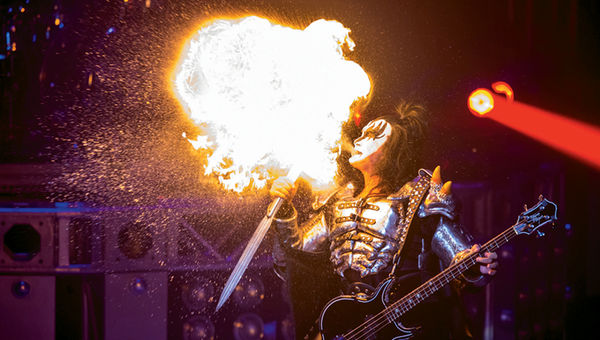
Gene Simmons and Kiss had a residency at the Joint at Hard Rock Hotel & Casino. Photo Credit: Erik Kabik/Kabik Photo Group
A one-two punch
Why does the resident headliner model work in Las Vegas?
Reynolds pointed to its benefits for both the venue and the entertainer, a one-two punch that appeals to all parties involved.
Instead of dealing with one-off concerts every night, residencies enable venues to cut a deal that encompasses a number of shows and moves bodies through the door. Longer residencies mean less time courting other acts, while shorter bookings, like Motley Crue's nine-show run, create an urgency that is lacking in productions playing twice a night, six days a week.
Residencies also relieve some of the logistical pressures and expenses that come with the average tour.
"The artists don't have to travel. They don't have to pay the expense of lugging their gear from city to city," Reynolds said. Performers can also design shows specifically for the venue they'll be playing. "It's the closest thing an artist can have to home-field advantage."
Instead of crisscrossing the country or the globe, visiting fans in Cleveland and Kansas City, Mo., a Vegas residency reads like an open invitation for an intimate performance. On "The Ellen DeGeneres Show" last May, Lopez acknowledged that she had not performed live often during her lengthy career. Then she turned to the camera and spoke directly to her fans: "So I'll be in Vegas. You can come see me."
Residencies can also contribute to a resort's branding. Planet Hollywood, for example, books "iconic headliners that appeal to the younger-skewing market," according to Caesars Palace Senior Vice President of Marketing and Entertainment Jason Gastwirth. Think Pitbull, J. Lo, Britney.
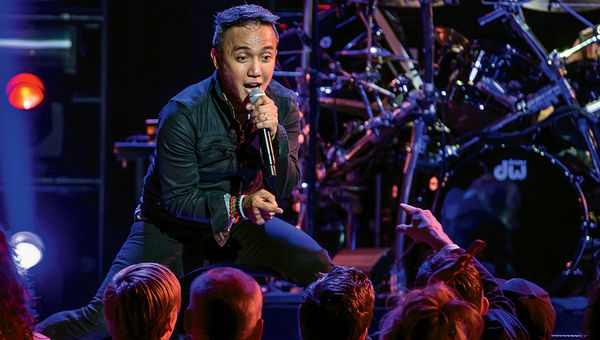
Arnel Pineda, lead singer of Journey, which also had a residency at the Joint at Hard Rock Hotel & Casino. Photo Credit: Erik Kabik/Kabik Photo Group
At the Hard Rock, Reynolds focuses on arena-rock artists such as Kiss, Journey and Guns N' Roses. "A lot of it is gut," he said. "A lot of it is knowing that these artists have devout fan bases. We do our homework. We look at artists' historical data, not only in our market but in our feeder markets."
Even the most relevant artist won't work if the residency doesn't offer something unique: an exclusive appearance in the country or region; a bigger, bolder show; a fresh concept.
"For these shows to work, you have to give the fans something they can't get anywhere else," Reynolds said.
That can mean developing an outlandish production, such as Lopez's seven-act dance party or playing an entire album, such as Def Leppard playing its entire 1987 album, "Hysteria," at the Hard Rock.
"Def Leppard has been touring forever, but you've never seen this show, and that's a real compelling argument for a real fan," Reynolds said.
That can also mean creating an exclusive experience, such as when country king George Strait announced that he would no longer tour but had booked a series of dates at the T-Mobile Arena.
"Anyone on the planet who wants to see George Strait must come to Las Vegas and see him at the T-Mobile Arena," Reynolds said. "Our tickets flew off the shelves."
That truly is the goal of the resident headliner model: give visitors the chance to see an artist they love doing something special.
Headliners won't replace other entertainment in Las Vegas. Cirque du Soleil still stuns with the sheer magnificence of human strength and engineering. Magician David Copperfield still makes 'em gasp in their seats. Thunder From Down Under dancers still rip their shirts off, and the ladies still shriek at the sight of all that tanned, taut beefcake. Diversity is important on the Strip, part of the something-for-everyone ethos by which Las Vegas lives.
But from Spears and Pitbull to Fogerty and Rascal Flatts, headliners are certainly having their moment.
"I really do think this business model is here to stay," Reynolds said. "I know the level of success that we're having at all of our venues. I see these types of things continuing."
Still, there's room for evolution, for tomorrow's residencies to include younger and more current stars, span a wider array of genres and offer more variety within artist-driven entertainment.
Ten years ago, a punk-rock residency would have been unthinkable on the Strip. Now, Idol is playing exclusively at the House of Blues for multiple runs this year. Catch him while you can.
Only in Las Vegas.