Industry Examination Relies on Research, Interviews
Journalist Elizabeth Becker has taken on a huge topic: the good and bad impacts of the booming global travel and tourism industry. Editor in Chief Diane Merlino asked Becker how she settled on her approach to covering the topic, which combines elements of a first-person travelogue with human-interest stories, in-depth interviews, and extensive research.
Becker: This is not my first book, and I find that with each book I write, the approach is different. I did not want to write a book that was all numbers, all droning seriousness. And I have a really great editor who was my editor for my history of Cambodia and the Khmer Rouge — totally different subject! I was struggling 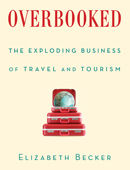 along, and she said, “Elizabeth, why don’t you just write about that trip?”
So that’s the way I went. It mixes a travelogue with reporting on the seriousness of the industry. That’s the formula that finally clicked and made it possible to tell these stories that explain the industry better than anything else I could have done.
Merlino: You clearly brought the skills and experience you have as an investigative reporter to the material.
Becker: I wanted to show as many sides of the industry as possible. On the investigative side, that’s required for fairness. The cruise ship chapter probably shows that best of all, where I talked to the wait staff who earn $50 a month and then I went and separately interviewed the CEO of the line. That’s really what’s required for an honest report.
The thing that is both essential but frustrating in writing about the travel and tourism industry is that people feel it intimately, so it’s challenging to talk about it as an industry. I kept that sense of intimacy while I described it as the industry.
Merlino: What do you mean by people having a sense of intimacy about travel and tourism?
Becker: Intimacy — like when someone says, “My life changed because I went to Italy.” I start out the book in the introduction with my mother. She had lived a wonderful but rather small life, and after my father died, she sold the house and took the profits and travelled the world. Before she died, she had visited every continent but Antarctica. I think that really made that “third age” of hers a wonderful thing.
I started out the book that way to show this intimate relationship we have with travel and tourism.
Tourism has given Bordeaux a new life, but it’s loving Venice to death. A detailed examination of the impact of tourism on both cities, and on many other destinations, is featured in Elizabeth Becker’s Overbooked. The Exploding Business of Travel and Tourism (Simon & Schuster, 2013).
Overbooked is an eyes-wide-open examination of both the positive and negative impacts of the booming global travel industry. The book is informed by Becker’s many years of experience as an investigative journalist, including work as a war correspondent in Cambodia for The Washington Post, senior foreign editor for National Public Radio, and assistant Washington Editor and various foreign affairs editorial positions with The New York Times.
“On my last beat, I was The New York Times’ international economics correspondent, and it was in that capacity that I really began to see the explosion of tourism,” Becker said.
She began to examine the phenomenon, drawing on research and data from the United Nations World Tourism Organization, the World Travel and Tourism Council, local tourism ministries and agencies, and a wide range of tourism associations.  Becker also interviewed scores of people involved in travel and tourism on all levels, from executives of global cruise lines and hotel chains to the employees working in hotels and on cruise ships.
Becker spoke with Travel Weekly PLUS Editor in Chief Diane Merlino about dimensions of travel and tourism the industry does not often consider. This is the first of two excerpts from the conversation, edited for clarity and length.
Merlino: Your book makes the case that modern travel and tourism is exerting a significant impact on economies, culture, human rights, climate change, the environment — the very fabric of life worldwide. Did you set out with that premise?
Becker: No, not at all. I started out knowing it had an economic component, and because of green tourism, I knew it had some sort of environmental component, but the spectrum was shocking to me. It makes sense because the numbers are so big; the record was broken last year, and we now have one billion foreign trips per year.
The least regulated of those trips are having a degrading impact on the environment and on societies. And various communities are now questioning the value of tourism because they are literally being loved to death. I did not set out to find all this, and I was surprised at what I found.
Merlino: Let’s talk about some of the numbers, which are collectively striking. Give us an overview of the economic scope and impact of travel and tourism worldwide.
Becker: The latest figures are $6.4 trillion for the global economy and one billion trips every year. One out of every 11 or 12 employees worldwide works in some aspect of travel and tourism. The ILO, the International Labor Organization in Geneva, a United Nations organization, puts the employee number at one out of 12, but the World Travel and Tourism Council has updated that to one out of every 11 workers.
I was amazed at how many countries depend on tourism in a way I couldn’t have imagined. In the developing world, travel and tourism is second only to the oil industry as the main economic engine to come out of poverty. In the developed world, I couldn’t find a country that didn’t depend in some way on travel and tourism.
Merlino: In terms of gross economic power, you say that travel and tourism is in the same league as oil, energy, finance, and agriculture.
Becker: I call it an octopus industry. It has tentacles everywhere, and people don’t realize how much they depend on tourism until they lose it or until it becomes overwhelming.
During the recession, travel and tourism bounced back faster than any other sector except energy. It easily outpaced manufacturing and financials. Maybe they spent less money or they didn’t go as far, but people did not want to give up their vacation. It was astonishing.
Merlino: You mentioned that travel and tourism is loving some locations to death. In your book, you cite Venice as an example of that.
Becker: Venice is a city that is truly being loved to death. It has only 60,000 people, and it gets 24 million visitors. Local butchers and grocery stores and bakeries are being pushed out. There’s phony synthetic Venetian glass, phony synthetic Venetian paper and phony Venetian masks. Boutiques that you can find anywhere in the world are taking over prime spots just off of St. Mark’s [Basilica].
They’re ruining it for the locals, and that’s what’s going to ruin Venice in the end. That’s what you don’t want to have happen. Local authorities are letting it get rolled over. And the industry is not innocent.
Merlino: You’re saying that local government and some players in the travel industry itself are playing a role in the demise of Venice?
Becker: The industry can’t just say, “We got permission to do this.” Every city has zoning, with commercial areas and residential areas. And too often tourism will push those boundaries, and industry will go under the table to get more of an inroad. Venice is what you’re going to end up with. You don’t want this to happen.
The United Nations — and the U.N. is not the most radical organization in the world — essentially said that putting a halt to the rising water is less of problem now in Venice than tourism. I’ll quote the U.N.: “Tourism could lead Venice to its watery grave.”
Merlino: On the flip side, you also cover destinations where tourism has had a positive economic and social impact.
Becker: Costa Rica is the model you should look at. They started out with almost nothing. The Spanish went elsewhere to look for mineral wealth and to establish plantations and pastures; Costa Rica was considered the last place to go in Central America. But that meant their wilderness was saved, and when the time came for development, they realized they could monetize their wilderness.
They were one of the pioneers of ecotourism, and it works there. They have thoughtful ecotourism, and you can see how it’s helped build a middle class. It’s not superhighway perfect, but it’s gorgeous and it reflects the personality of the country.
Merlino: The industry is very familiar with Costa Rica’s accomplishments and challenges in tourism. You also include France as an example of a country that has taken a measured and successful approach to tourism development.
Becker: France is using tourism to protect its culture and its wildlife, and it’s everywhere. I use Bordeaux as an example in the book. That’s a city that used to be one of the most beautiful in Europe in the late 18th century, and then it feel into disrepair. It was surrounded by the great vineyards of Bordeaux, but the city itself was ugly, and the waterfront was a mess. It had lost who it was.
Then the mayor — Alain Juppé, a very gifted politician — created a 10-year project to recover the glory of Bordeaux. He hit it with a sort of French tourism philosophy: If we make Bordeaux wonderful for the locals, nurturing and protecting what is the essential “Bordeaux-ness” of this place, then we’ll have tourists. If we try to turn it into “anywhere anyplace,” it’s not going to be so important as a tourism spot. His idea was you have to retain who you are and then you’ll get tourists. It’s their philosophy, and it works.
The people of Bordeaux are thrilled with what’s happened. They’ve cleaned up the city. They’ve made pedestrian areas and gotten rid of the automobiles there. The waterfront has been cleared of the mess and it’s a beautiful park area. And the city of Bordeaux is now as beautiful as the vineyard area, and the tourism economy is climbing up next to the wine economy.
That is sort of a perfect example of what tourism can do. In Costa Rica, it’s saving the wildness. In France, it’s saving the essential French culture.
NEXT ISSUE: Elizabeth Becker on the cruise industry and the rising tide of Chinese tourism.