NEW YORK -- They say one man's trash is another man's treasure.
At a SoHo gallery here on April 3, it was one particular type of trash on display -- the humble airplane "barf bag." For Texas collector and self-proclaimed "nausivatologist" Eli Cox, it is treasure.
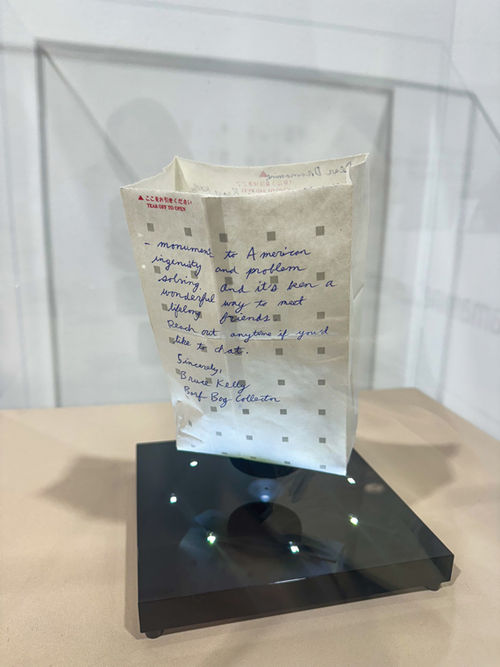
A bag with a handwritten letter from Alaska-based barf bag collector Bruce Kelly helped spawn the idea for "The Last Barf Bag" exhibition. Photo Credit: Christina Jelski
For one day only, a portion of Cox's 370-plus sickness bags were exhibited as part of a pop-up event hosted by Dramamine, the maker of over-the-counter medication used to treat motion sickness and nausea.
The exhibition also included preview screenings of a short documentary by Dramamine titled "The Last Barf Bag: A Tribute to a Cultural Icon."
Those prone to airsickness and other travel-induced nausea are likely familiar with Dramamine, which was introduced in 1949. Coincidentally, the plastic-lined airsickness bag was also invented in 1949.
It's a parallel that caught the attention of a senior marketing director at Dramamine's headquarters in Tarrytown, New York, after an unusual handwritten letter landed on his desk. The message, written on an unused airsickness bag, was from Alaska-based barf bag collector Bruce Kelly, sent on behalf of "the barf bag community."
"We've noticed that quality barf bags are getting harder to find," complained Kelly, owner of a vast collection spanning more than 7,000 bags. "People don't use them anymore and they certainly don't appreciate them. Your product works well, but we wonder if maybe it works a little too well?"
It was in that moment that the idea for The Last Barf Bag exhibition took root.
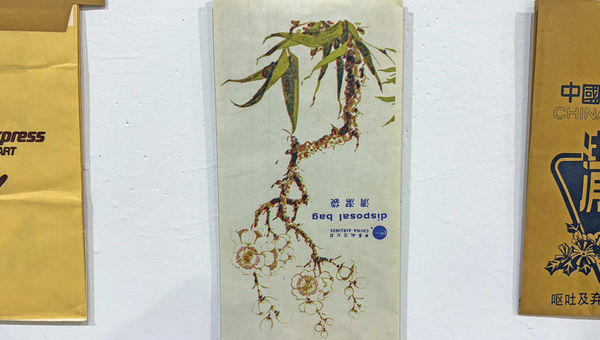
A barf bag from China Airlines with a floral image that appears right side up to anyone using the bag for its intended purpose. Photo Credit: Christina Jelski
An absurd idea turned serious
I visited the pop-up exhibit during an early morning media preview, wandering around the loft-like gallery space with a mimosa in hand. Neat rows of unframed airsickness bags lined the white walls, with a few bags of particular importance -- including the one bearing Kelly's letter to Dramamine headquarters -- presented in a frame or encased in freestanding glass displays.
In total, a selection of bags from four collectors, including Kelly and Cox, were on display. Theirs were joined by bags from California-based collector Bob Grove and Steve "Upheave Steve" Silberberg, a Massachusetts-based collector who is also curator of the Air Sickness Bag Virtual Museum.
All four men were featured prominently in the 20-minute documentary, and after catching one of multiple screenings, I found myself a little star-struck as I was introduced to Cox, the sole collector in attendance.
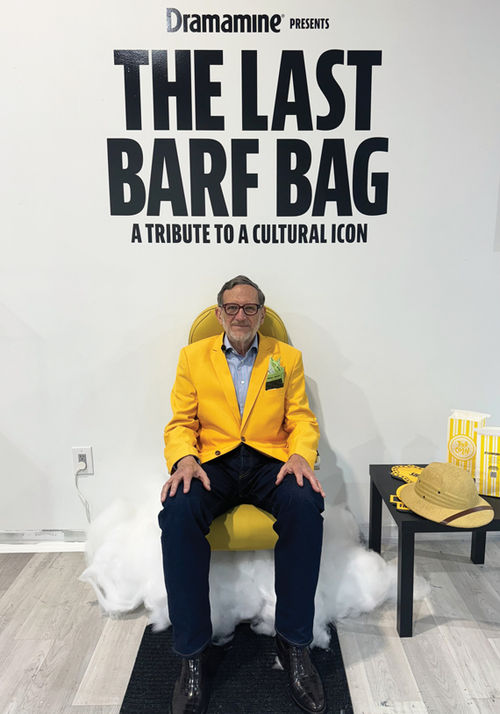
Self-proclaimed "nausivatologist" Eli Cox. Photo Credit: Christina Jelski
A retired University of Texas at Austin professor, Cox began collecting airsickness bags in the late 1960s, after abandoning the pursuit of a world-class stamp collection. About half of his collection has been sourced on his own, while the other half were gifts from colleagues or friends.
What was it about barf bags that captured his interest?
"The answer I come up with is just the absurdity of it," said Cox. "It's a great icebreaker, and it's fun."
When asked whether he has a few favorites in his collection, Cox pointed to a China Airlines bag adorned with a delicate flowering plant emerging from the soil. Though a clever design trick, the plant, which appears upside down, is viewed right side up to anyone facing toward the floor and using the bag for its intended purpose.
But while Cox embraces the absurdity of collecting airsickness bags, he also hopes to bring some level of prestige to the hobby. He enlisted the help of an English professor with expertise in Latin to help him come up with a more refined moniker for the bags, aiming to elevate them above terms like "barf bag" or "spew sack."
The English professor came up with the term "nausivat." Subsequently, Cox coined the designation "nausivatologist."
"There is a degree of seriousness," said Cox. "And because they're often disparaged, I thought, they deserve to be treated with some dignity."