Airport security experts last week cited a combination
of robust intelligence gathering, advantageous geography and plain
old-fashioned luck as key reasons why the U.S. hasn’t experienced a major
airport or aviation-related terrorist attack since 9/11.
“What we’re doing right is engaging in intelligence
collection and analysis to identify people way before they get to an airport,”
said Richard Bloom, the director of Terrorism, Intelligence and Security
Studies at Embry-Riddle Aeronautical University in Arizona.
U.S. intelligence agencies, he said, work globally to
determine where potentially threatening people are, what they might do and how
they might do it.
“I think we do that more comprehensively and more
seriously than many other countries,” Bloom said.
Last month’s bombing attack, claimed by ISIS, on the
Brussels airport and a nearby metro station has led to renewed questions about
the security of airports, especially in areas outside the checkpoints that in
the U.S. are operated by the Transit Security Administration (TSA).
But with
the exception of two lone gunman incidents at Los Angeles International Airport
— the most recent in 2013 resulted in one fatality and the other in 2002
resulted in two fatalities — the vast network of U.S. airports has been
unscathed by violent attacks, including terrorism, in the post-9/11 era.
In addition to the long tentacles of the U.S.
intelligence network, analysts, including Gordon Longton of the Minnesota-based
consulting firm James L. Johnson Associates, emphasized that increased police
vigilance has been a key factor in maintaining the relative security during the
past 15 years. As an example, Longton cited Minneapolis/St. Paul Airport, where
he headed security in the 1990s. Police staffing there has increased by a third
since 9/11, he said.
But Longton also argued that intensified security
efforts, both on-site and through intelligence gathering, are just part of why
the U.S. aviation network has thus far avoided a major attack. The country, he
noted, is also the beneficiary of being far from most of the terrorist bases.
“We have an ocean separating us, which makes us so
much different than Europe, where they have lots of people crossing borders,”
Longton said.
Analysts also cited simple luck as a third major
factor in U.S. airports having largely steered clear of successful terrorist
attacks.
“You’re just lucky when you break up something,” said
Duane McGray, executive director of the Airport Law Enforcement Agencies
Network, which comprises industry professionals. “The reality is we’ve been
very fortunate, but we’re also very vulnerable.”
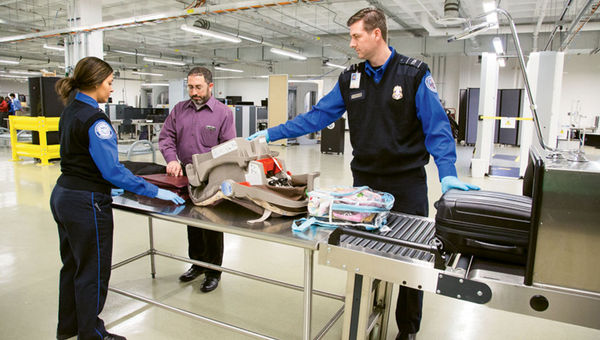
The Airport Law Enforcement Agencies Network says behavior recognition is a primary tool.
McGray said airport security teams have just two
primary tools at their disposal: behavior recognition and explosives detection
with dogs. But those techniques, while important, can’t remove the possibility
that an airport will be targeted.
“There’s no way to know who’s driving on those roads
coming to your airport,” he said.
He added that it’s wrong to view check-in terminals
and other unsecured portions of airports as different from soft targets such as
malls, churches, movie theaters or New York’s Times Square, where a car bomb
attack was foiled by two street vendors in May 2010.
“Any place where the public gathers is vulnerable,”
McGray said.
But, like other security experts, McGray said that
pushing checkpoints back behind areas that are now public sections of airports
would not be effective. The reason, he said, is that terrorists like choke
points where people gather. Moving the checkpoints, or adding new ones, would
merely create a new choke point and therefore a new target-rich location.
Indeed, said Philip Baum, the U.K.-based editor of the
magazine Aviation Security International and author of the recently released
book, “Violence in the Skies: A History of Aircraft Hijacking and Bombing,” the
crowds at existing TSA checkpoints are already a deep concern.
“I am appalled when I go through the United States by
the overt levels of security that one witnesses,” he said. “It is, to me, so
tick-box focused — just following guidelines. The huge queues of people waiting
to go through security lines is not a good form of security.”
Baum said while it is true that U.S. airports have avoided
successful terrorist attacks since 9/11, Europe is not far behind.
The Brussels airport attack, coupled with the November
attacks on the Stade de France as well as cafes, restaurants and a concert hall
in Paris, have heightened the sense that Europe has come under heavy
terrorist-network assaults. But prior to Brussels, the most recent attack on a
European airport was the unsuccessful 2007 assault on Glasgow Airport in which
two assailants drove a Jeep Cherokee filled with propane canisters through the
terminal’s glass doors in an attempt to set the facility ablaze. Five people
were injured, but the only fatality was one of the suicide bombers.
Like many security experts, Baum lauded the security
network that protects Tel Aviv’s Ben Gurion Airport as a model for airports
everywhere, and he touted Israel’s controversial tactic of profiling airline
passengers.
“I am not talking about racial profiling,” he said. “I
am talking about observing people. Observing their behavior. Inspecting travel
documents when we need to.”
Like McGray, Baum noted that U.S. airport security
teams already engage in behavioral recognition. But he said that deployment
should be broader, with undercover officers monitoring taxi stands, airport
entrances and even train stations that lead to airports. That way, plotters
can’t prepare to evade screeners at predictable locations.
Still, Baum said, at some point the U.S.’s run of luck
will end.
“It would be foolish for us to believe that American
aviation is not going to be targeted again,” he said.