Four Seasons Hotels & Resorts opened a
research-and-development studio in late October to give its managers and
designers opportunities to experience the proverbial dry run, but its expansion
push is absolutely real.
The Toronto-based luxury hotel operator, which oversees more
than 100 properties globally, is poised to finish 2016 with nine new
properties, the most it has opened in a single year in its 55-year history. In
addition, it has about 50 more hotels in its development pipeline. Since
September, the company has debuted hotels in lower Manhattan; Kyoto, Japan; and
Anguilla, West Indies.
Four Seasons and its development partners are investing in a
luxury-accommodations sector whose U.S. room rate average of some $280 a night
is more than double the overall average, and whose RevPAR increase of 20% over
the past three years is about even with the U.S. accommodations industry,
according to hospitality-research firm STR.
The privately held company, which does not release revenue
or occupancy figures, insists that its approach to growth remains unchanged,
noting in a statement that its focus continues to be "on destinations of
importance to luxury travelers, key outbound markets where establishing a local
presence helps build brand awareness and markets where Four Seasons already
operates successfully and wants to increase our representation."
Founded by Isadore Sharp with a 125-room Toronto motel in
1961, the company grew to $2.9 billion in revenue in 2006 before being taken
private the following year by a partnership that included Microsoft chairman
Bill Gates, Kingdom Holding Company (the investment vehicle of Saudi Arabia's
Prince Alwaleed Bin Talal) and Sharp.
Now, the company, which last year debuted its branded
private-jet excursions, appears to be attempting to ensure that it either
maintains or increases its presence within the luxury sector, which in 2016 was
marked by consolidation.
This summer, Paris-based AccorHotels acquired FHRI Hotels
& Resorts from Qatar Investment Authority and Kingdom Holding Company for
$840 million, bringing AccorHotels' Sofitel luxury brand together with FHRI's
Fairmont and Raffles brands.
And in September, Marriott International completed its $13
billion acquisition of Starwood Hotels & Resorts, making siblings of the JW
Marriott, Ritz-Carlton, Edition, W, St. Regis and Luxury Collection brands.
With the acquisition, Marriott almost doubled its luxury
portfolio, to 283 properties worldwide.
"Four Seasons has a stellar reputation for meeting
demands from travelers that expect the finest of luxury, and they've had it for
a long period of time," said Mark Woodworth, senior managing director at
CBRE Hotels. "But when a traveler seeking out that luxury lodging
experience goes to a market that doesn't have a Four Seasons, there's a greater
chance that they're going to run into something under the Marriott umbrella, so
that puts the [potential] Four Seasons guest at risk."
Against that background, the company is pushing beyond its
North American base while boosting its research and development investments.
For example, Vietnam's first Four Seasons is scheduled to
open this month, and the first in Kuwait is scheduled to open early next year.
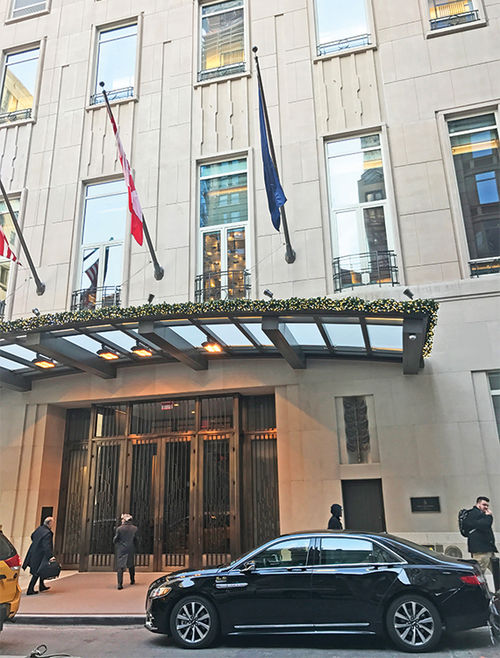
The Four Seasons New York Hotel Downtown debuted in September. Photo Credit: Rebecca Tobin
In late October, Four Seasons debuted a Research and
Discovery Studio at its Toronto headquarters.
There, company managers and designers can test innovations
such as bedding combinations, furniture placement, bathroom fixtures and
restaurant and bar place settings in an effort to better serve its discerning
guests.
"The number of people who have the means to travel and
stay at luxury-type properties continues to grow at a very attractive rate,"
Woodworth said. "The fact that luxury brands like Four Seasons are
focusing on expanding their presence makes sense."