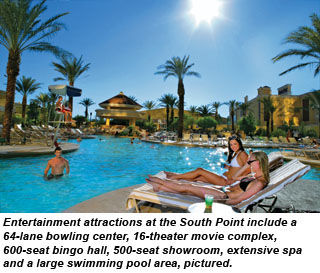
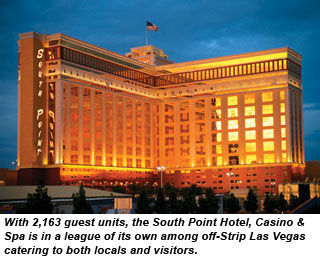
 In a town with larger-than-life casino moguls like the trailblazing Steve Wynn, convention guru Sheldon Adelson and the king of cool, George Maloof, Michael Gaughan cuts a rather low-key figure. Much like the man, his property, the South Point Hotel, Casino and Spa, eschews spectacle. There are no erupting volcanoes, dancing fountains or dueling pirates.
Located midway between the Mandalay Bay and the M Resort in a casino version of a no man's land, South Point's existence is understated by Strip standards.
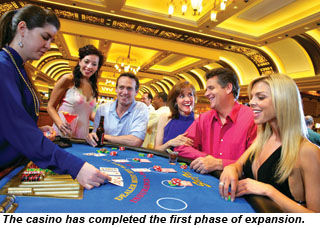
Over the years, Gaughan worked to build the property's popularity among locals and tourists. His latest attempt comes in the form of a $20 million, 55,000-square-foot casino expansion to the former South Coast resort.
That the timing seems odd, given the still-shaky local and national economies, isn't lost on Gaughan.
"Well, cutting back wasn't working," he quipped. He noted the expansion began 2.5 years ago, "when things were good, so it was a matter of continuing to move forward."
The just-completed first phase added 600 slot, video poker and video keno machines; a 22-table poker room; a redesigned, 175-seat race book; and the Grandview Lounge entertainment area.
Slated for the second phase are a Steak 'n Shake restaurant and a Japanese restaurant.
Big expectations
 You could call Gaughan the anti-Steve Wynn, not that he would let you (the two are good friends). In 1979, two years after Wynn bought the Golden Nugget, Gaughan opened the Barbary Coast. Over the next quarter-century, he added the Gold Coast, Suncoast and Orleans hotel-casinos to his Coast Casinos conglomerate and established a reputation as a top-notch gaming operator.
In 2004, Gaughan sold Coast Casinos for $1.3 billion to Boyd Gaming, which was run by another friend, William Boyd.
Expectations were high in 2005 when the South Coast opened five miles south of Mandalay Bay. In addition to capitalizing on the rapid growth of the southwestern portion Las Vegas, the $600 million resort aimed to be the property of choice for inbound motorists from Southern California or Arizona, as it was the first hotel they would see coming off the interstate.
Owners envisioned the 4,400-seat equestrian center becoming a focal point for all types of events.
"South Coast is ideally located to attract a growing locals market as well as a significant number of tourists, given its strategic location to both residential and tourist corridor patrons," Boyd said at the time.
Parting ways
 The Boyd-Coast merger united legendary gaming families: The Boyd empire spans three decades and six states (Nevada, Illinois, Indiana, Louisiana, Mississippi and New Jersey), while Gaughan's father, Jackie, opened El Cortez in 1963 and had stakes in the Gold Spike, Golden Nugget, Las Vegas Club, Plaza and Western in downtown Vegas, the off-Strip Showboat and the Flamingo on the Strip. But the relationship faltered.
"I'm not going to say anything bad about Bill because there's nothing bad to say. We're friends. Our dads were in business together a long time ago," said Gaughan, noting that Boyd didn't feel comfortable in the corporate world.
Gaughan also had a difference of opinion on building Echelon Place, Boyd's $5 billion retail/gaming/entertainment complex. "I thought it was too big a gamble."
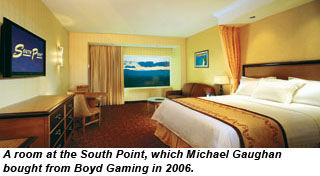
As part of an amicable split, Boyd Gaming sold the South Coast to Gaughan for $560 million in 2006. He renamed the property South Point.
The right mix
 The South Point is "the only property in town where you can ride a horse in the morning, play bingo after lunch, catch a matinee at the theater, eat dinner at a AAA Four Diamond Award-winning restaurant [Michael's], and see a world-renowned act in the showroom and never leave the resort," read the March 12, 2008, press release on the resort's expansion.
The results of Gaughan's efforts to carve a niche for South Point have been mixed. Adding a third tower and 10,000 square feet of conference space as part of a $95 million expansion in 2008 made South Point the city's largest "locals hotel," with 2,250 rooms and 160,000 square feet of meeting and convention space, and enabled it to better compete against megaresorts in the increasingly competitive small and midsize group meetings business.
Conversely, the equestrian center has underperformed. "It breaks even. We'd like to have more events there."
And Michael's restaurant has been unable to re-create the buzz (and crowds) of the original, which opened in 1979 at the Barbary Coast.
"On the Strip, we had dedicated customers," Gaughan said. "Here, the number of customers per night fluctuates. We may have 15 or we may have 95. There's no rhyme or reason to it."
Gaughan's attempt to capitalize on the city's lucrative nightclub scene fell flat. "I had a nightclub, but I didn't get the people I wanted. I got an undesirable crowd. It wasn't our demographic. Our demographic is ... probably people over 40 and blue-collar types. The undesirables chased off my desirables. And I've had a hard time getting all of my desirable customers back."
The casino expansion is another step in that direction. Gaughan hopes the larger venue produces additional revenue to offset 85% occupancy rates (compared with 95% through 2008) and lower room rates.
He said the investment has boosted spirits. "Other places have had layoffs; we haven't laid anyone off. We've had to reduce hours. But with this [expansion], we're able to move people back to full-time. And the morale is still high. Customers don't want to come to a place where the employees aren't happy."
Visit www.southpointcasino.com.
This report appeared in the Aug. 9 issue of Travel Weekly.