 We've all heard the term Web 2.0. It's a term we use to describe the latest generation of Internet technologies. It's software and hardware, but it's also the mindset and milieu that enables enhanced information sharing, collaboration and personal expression in the form of social networking, wikis, blogs and feeds.
But Web 2.0 not only adds sizzle to the desktop experience for the keyboard crowd. Because it coincided with the wireless revolution, it accelerated the migration of Web content and functions to mobile devices that are always with you. It brings the Web to your life. You might say it allows for "Daily Life 2.0."
And that, in turn, suggests that maybe there exists a "Traveler 2.0."
Who would that be?
Two prominent research organizations asked that question recently and decided to seek an answer. In a joint research project, the Ypartnership and PhoCusWright conducted an online survey of 2,559 consumers who were "active and frequent users of the latest entertainment, computer or consumer technology."
The group was generally representative of the U.S. population as a whole, but with a 50/50 gender split and an oversampling of college students, so that the behavior of college students and others could be compared with statistical reliability.
The researchers called them the NextGen travelers.
But don't let the term fool you. NextGen doesn't really refer to the age of the travelers but to the technology they use and the way they use it.
The NextGen group is a 16% slice of the population that cuts across traditional demographics. It includes both high-income and low-income individuals, the single and the married, young and old. What defines these travelers is not their age but their relationship with the digital age.
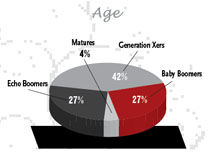
 For example, baby boomers, who are between the ages of 44 and 62, make up 27% of the NextGen group, a bit less than their share of the overall population.
Their children, the echo boomers, are in their 20s. They also account for 27%, a bit more than their share of the population.
People in the so-called Generation X group, between the ages of 30 and 43, account for 42% of NextGen travelers, considerably greater than their 25% share of the population.
Mature travelers, thought to be less technologically inclined, are also represented, though at a low 4%.
A propensity for plugging in
What they have in common is their relatively heavy use of, and reliance on, technology. Nearly 90% use email; 80% download music from the Internet; about 70% own an iPod or MP3 player; 60% download or stream video to a computer or other device.
Various forms of digital entertainment are a big deal with this crowd. On average, they own 3.2 TVs, and 44% of them own a high-definition set. More than 80% play video games on a TV, computer or other device, and that's not counting the college students.
But while NextGen travelers have lots of gadgets to keep them occupied at home, they are also travelers. Two-thirds say they like going to new places and experiencing new things. Three-fourths say they would travel more if they had more money.
That makes them prospects.
But they are not all alike. Within the NextGen group there are predictable variations. Those with higher incomes tend to spend more on gadgets and travel than do those with lower incomes. And, as you might expect, the men in this group are more likely than women to have a PlayStation or other video game console.
Collectively, however, they regard today's technology as essential tools for living. For information about travel, yesterday's travelers might check out the Sunday travel section or pick up a guidebook. For the same task, NextGen travelers would reach for the mouse or the smart phone, because they are comfortable with that technology and empowered by it.
For example, NextGen travelers are similar to ordinary travelers in that they place greater trust in the recommendations of friends and relatives than they do in advertising or other sources of information.
The difference is that they might seek out those recommendations via email or a social networking website rather than in a face-to-face meeting or a phone call. Lorraine Sileo of PhoCusWright says that, for the NextGen traveler, "technology is the enabler."
The survey's authors explain in their executive summary that while technology has become "pervasive in everyday living," the NextGen traveler is "unique in the degree to which that technology is core to his or her lifestyle. For these travelers, technology permeates their social lives."
 More than 70% of NextGen travelers surveyed "agree" or "strongly agree" that technology has improved their ability to keep in touch with friends and family and has improved their ability to learn new things. Nearly 60% say it has improved the way they pursue their hobbies or interests.
In other words, technology doesn't create the NextGen traveler's underlying trust in a personal recommendation, but technology can provide the avenue to that recommendation.
Similarly, people who are inclined to share photographs will do so on the Web if they find the technology enabling. But if they're not into photography or into sharing, they're not likely to share photos on the Web just because it's there.
Reflecting on the survey results, Diane Shuart of PhoCusWright said a traveler's involvement with technology creates "multiple touch points" for marketers.
Travel marketers could infer several things from all this. NextGen travelers, for example, might be particularly receptive to product placement in video games, a burgeoning new advertising medium.
Or they might be more likely to trust the Internet to handle credit card transactions securely or to experiment with alternate forms of electronic payment that do not involve credit cards. The survey wasn't designed to prove those kinds of tendencies one way or the other, but Greg Dunne of the Ypartnership said they might be called "a reasonable inference."
Yet for all their techno-savvy, NextGen travelers in many respects look like pretty normal travelers.
In some ways, not so different
As a group, last year they took 3.4 trips involving overnight accommodations 75 miles or more from home. As it happens, 3.4 annual trips is the same result reported in the National Leisure Travel Monitor, an annual survey conducted by the Ypartnership among a panel of respondents that is deemed to be nationally representative.
Though the authors of the NextGen survey did not make a direct comparison to the Monitor, and while the two surveys were based on different data sets, the results suggest that NextGen travelers do not travel much more, or much less, than others.
Likewise, their reasons for travel seem close to those of mainstream travelers, with "visiting friends and relatives" topping the charts, as it invariably does in most consumer surveys.
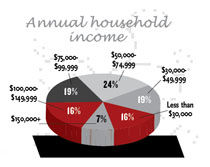 NextGen travelers spend an average of $2,531 a year on travel, but there are some bigger spenders, particularly among big earners. About 7% of NextGen travelers have household incomes of $150,000 or more, and they spend an average of $6,255.
Also, the college crowd is not as far below the $2,531 average as one might suppose. A breakout shows that the average annual spend among college students was $2,426, only about 4% less.
One would expect NextGen travelers to gravitate to the Internet for researching and booking travel, and the survey data confirm that.
Three out of four NextGen travelers have used the Internet to book travel, and they have done so for an average of 2.1 trips. Considering that this group averages about 3.4 trips per year, it would seem that they're booking most of their travel on the Web. Overall, 55% say they rely on online travel sellers such as Expedia, Travelocity or Orbitz, while 39% have used supplier sites.
But they haven't abandoned offline channels altogether. When asked how they book travel, 23% mentioned calling suppliers by phone, and 10% mentioned a traditional travel agent, a figure that rises to 17% among NextGen travelers with annual incomes of $150,000 or more. That finding is consistent with previous research.
Also, in a finding the authors introduced with the word "surprisingly," it appears that NextGen travelers do not spend most of their travel dollars online, as their off-line and online travel expenditures tend to be "fairly equally dispersed."
As for what they want in a travel experience, the results suggest that in some particulars, NextGen travelers are pretty mainstream.
 Like anybody else, they like a bargain, and the top-ranked website feature for NextGen travelers is the ability to check for the lowest fares and rates, cited by 77%.
When asked about hotel amenities, 71% voted for quiet, and 70% cited premium bedding. Free Internet access was cited by 61%.
The top hotel brands preferred by NextGen travelers were Marriott, Hilton and Holiday Inn, the same top three cited by respondents in the Leisure Travel Monitor.
Their top three airline brands were American, Southwest and Delta, also matching the Leisure Travel Monitor.
And, when asked about traveler loyalty programs, 36% said they participated in hotel frequent guest programs, and 43% were in airline frequent flyer plans, percentages that closely track the data reported in the Monitor.
Some other findings about the NextGen traveler:
• Digital media is a big deal for NextGen folks. Only 20% read a print newspaper every day; 17% never do. But 45% read newspapers online.
• About half of NextGen travelers subscribe to satellite, Internet or HD radio.
• Two-thirds have purchased something at an online auction site such as eBay.
• The NextGen mindset has a green tint. A majority (55%) agree or strongly agree that "natural resources must be preserved even if people must do without some luxuries." For college students in the group, however, that number came in lower, at 46%.
• On the same five-point scale, 61% "feel the need to be in control of my life."
• Nearly 40% of NextGen travelers have created or programmed a website.
• Most survey respondents do not write reviews on social networking sites, but among those who do, writing movie reviews is the most popular activity, cited by 23%, followed by music reviews at 18%. Hotel, restaurant and video-game reviews registered a three-way tie at 17%.
• A third would like to orbit the earth, but this question was a gender splitter: it's 23% of the women, and 42% of the men.