Book it: Insight Cuba
• Offers multiple departures on seven people-to-people Cuba itineraries, ranging from a four-day Weekend in Havana from $2,095 to a 12-day Undiscovered Cuba program from $4,495.
• Departures run through June 26.
• Visit www.insightcuba.com.
En route to Cienfuegos ("One Hundred Fires"), a breezy port city on Cuba's south coast about 150 miles southeast of Havana, our tour bus suddenly stopped.
On the road in front of the bus was a line of workmen, each bent over the roadway, scooping up rice granules that were spread out on the asphalt to dry in the sun.
"That's the way we do it in Cuba," said Marlon, our guide and translator. "The rice needs to dry, and the sun provides the heat."
The men scooped up the dried rice, deposited each scoopful in white sacks and then placed each sack on a horse-drawn wagon standing off to the side of the road.
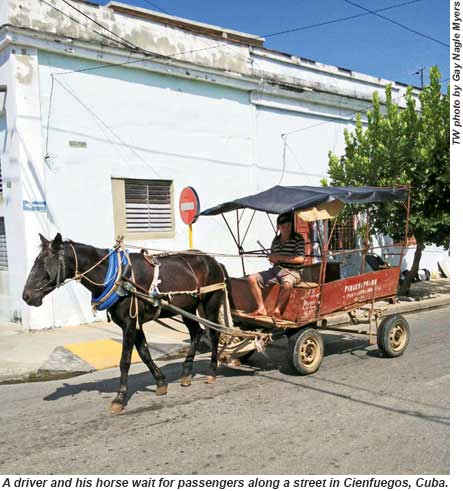 Our driver maneuvered around them and we were off again, but not before handing out chilled bottles of water from our cooler to the rice-gatherers.
It was hot, and they were grateful.
We passed green fields of sugar cane and small plots of farmland, where skinny cows and bony horses grazed.
"We do not kill our animals for meat," Marlon said. "These are work animals."
They looked a bit undernourished to me, but as Marlon explained, "There are no fat animals in Cuba. There is much work to be done."
Cienfuegos, also called La Perla del Sur (pearl of the south), was an intermediate stop on a weeklong Classic Cuba people-to-people itinerary with Insight Cuba, squeezed in between an overnight stop in the town of Trinidad, farther east, and our final destination of Havana.
As with all our daily itineraries, this one packed a lot into a few short hours.
That's the point and the purpose behind the people-to-people programs, after all: to interact with the Cuban people in all walks of life to truly understand the social currents swimming beneath the surface.
Cienfuegos contains a remarkable cluster of neoclassical structures as I saw in my stroll around Marti Park and Town Hall in the town's historical center, named one of nine Unesco World Heritage sites in Cuba in 2005.
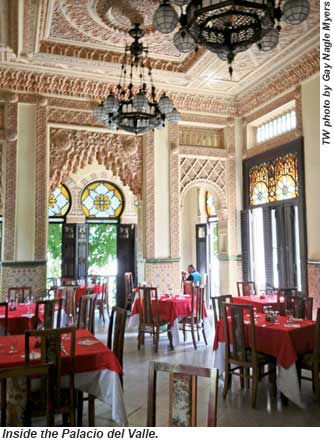 Later, at lunch at the Palacio del Valle, a casino back in Batista's day (pre-1959), in the city's Punta Gorda section, a thin slice of land jutting into the bay, I gaped at some of Cuba's palatial buildings, now restored and still ornate.
I climbed a spiral staircase made of stone with wrought-iron railings to the top of a bell tower for a view of the spectacular Bay of Cienfuegos and the city's Malecon sea wall.
At a stop at a cooperative arts center called Sociedad Grafica de Cienfuegos, or as Alexander the director called it, "art in your hands," artists were using a printmaking technique of cutting designs into sheets of linoleum.
"This is an old method of engraving that we teach our students," Alexander explained. "In the summer, we move our presses into the neighborhoods and give free classes to the kids and neighbors.
"Art is for all people," he said.
Indeed it is in Cuba. The walls of the center were a vibrant collage of engravings and prints, and soon one of the engravers was busy wrapping, rolling and packaging the artwork that we purchased as gifts and souvenirs to bring home.
None of us left empty-handed.
It was a Sunday, and the benches in Marti Park were filling up as churches emptied after services and families gathered in the shade to talk and eat lunches brought with them.
"Sunday is usually a quiet day for families, a time to be together and enjoy each other," said Marlon.
Still another treat awaited our group of nine tourists. We entered a columned building just off the main plaza.
Like many buildings in Cuba, it was somewhat in disrepair but still beautiful, with marble floors, high ceilings and decorative moldings.
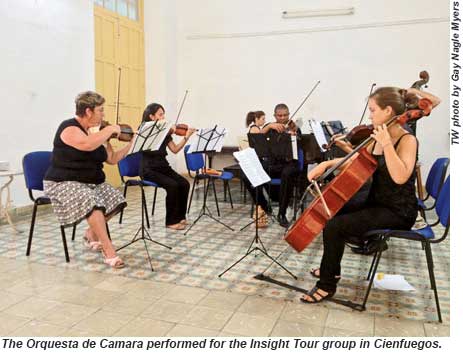 The Orquesta de Camara, a group of seven chamber musicians, was waiting to perform the Concierto Sur (Concert of the South) for us.
Marlon said that the group was founded six years ago.
"Each of the musicians has a university degree," he said. "Training is long. It is seven years for the first level of training, four years for the second level and five years for the university degree."
The training and education, like many other services in Cuba, was free. The musicians performed in Seattle, Phoenix and Miami last year.
The concert, as Marlon later described it, "was music for the soul, a mix of classical and modern."
Before the group began the sixth selection, Marlon told us that the musicians had prepared "a specialty gift for you. You will recognize the song. Most Cubans have no clue what it is. It is folklore Americano."
In fact, it was "Shenandoah," also known as "Across the Wide Missouri," a 19th century folk ballad.
There was not a dry eye in the house when the last note sounded.
After an espresso stop in a state-run cafe, we boarded the bus and headed for Havana, another full day in Cuba to absorb and remember.
Follow Gay Nagle Myers on Twitter @gnmtravelweekly.