Molten lava was a major draw this summer on the southeastern corner of the Big Island of Hawaii, where a new volcanic flow began inspiring all sorts of excitement as early as June.
Emanating from Kilauea's active Pu'u O'o vent, the river of lava traveled downhill near the southeastern boundary of Hawaii Volcanoes National Park, streaming over the Pulama Pali before eventually oozing into the ocean late in July.
A number of operators are offering Big Isle visitors a chance to view the new lava flow's ocean-entry site firsthand, and adventurers can now choose guided tours out to the attraction either over land, through the air or on the water.
Hawaii Forest & Trail has been leading hiking tours out to the flow since July, and Jason Cohn, the company's marketing manager, said business remained strong in the traditionally slower shoulder-season month of September.
"However people do it -- by ground, by boat or by helicopter -- it's one of those things where I think it is a once-in-a-lifetime opportunity," he said of seeing the lava ocean entry firsthand.
Hawaii Forest & Trail's Kilauea Lava Hike is $192, commissionable to agents and offers transportation with stops in Kona and Waikoloa on the island's west coast as well as a pickup in Hilo on the east coast. Lunch is included for travelers joining on the island's west coast as is dinner afterward for everyone, and folks should be ready for an all-day outing no matter where they are picked up.
The tour's hiking component, meanwhile, begins from the county parking area at the end of Highway 130 in Kalapana and travels along an emergency gravel access road about 4½ miles out to the lava ocean entry.
"You definitely want to be in decent shape and ready for a good 8-to-10-mile walk," Cohn explained. "That being said, most of the terrain is gravel and without a lot of big ups and downs."
Guests spend about an hour out at the ocean-entry site, according to Cohn, who said the time passes quickly, in part, because "the lava is really mesmerizing; it kind of puts you into a trance."
"You'll be close enough to smell it," he added. "It's really an assault on a number of senses at once. You smell it. You can feel the heat, and you can see it obviously right there in front of you, [and] you can definitely hear it. You can hear it popping and crackling and then steaming in the ocean."
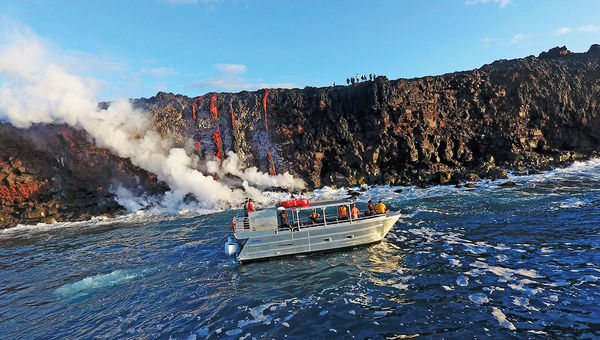
Lava Ocean Tours boat and hikers (on cliff) view Kilauea’s lava flow as it enters the ocean. Photo Credit: Shane Turpin
Business has also been strong for Lava Ocean Tours, which began taking travelers out to the new flow's ocean-entry site by boat in late July.
"We had huge amounts of passengers in August," said owner Shane Turpin. "September's always typically been slow, but we still had a pretty steady bite for this season."
Lava Ocean Tours operates a 42-foot, 49-passenger vessel, which departs from the Isaac Hale Beach Park on Hawaii's east coast. The company's tours start at $180 per person, last around two hours total and feature about 35 minutes at the lava entry.
"We started out with the lava coming over the cliffs, but now the bench is built out quite a ways," Turpin said of the new land created by the flow. "We probably have an acre of new land right there, and at the edge of the bench, there are lava fingers hitting the ocean. The boat safely gets you nice and close but keeps you away from a lot of the hazards, like the gases."
Conceding his own bias, Turpin insisted viewing lava from the ocean is the best way to go.
"It just provides a very unique, facing view of the lava," he said. "From the air, you're looking down on it. From the land, most of the time you're looking at a side view. From the boat, you're floating in front of a cathedral of lava."
Turpin did stress, however, that the boat trip isn't for everyone, warning that the open-ocean route can be jarring and isn't recommended for those with back problems, women who are pregnant or people prone to seasickness.
"You want to make sure that you're someone who'd be comfortable going on a whitewater rafting trip," he said. "It is an ocean-going roller coaster out here."
Prior to this summer's new flow excitement, the best way to see molten red lava on the Big Island was from the air, as many of the eruption sites weren't otherwise accessible. Interest in air tours is also up, however, for Paradise Helicopters, according to Waynette Kwon, the company's director of marketing and sales.
"It's a fairly sizable increase because it's out there in the national news," she said. "And I think a lot of people feel like this might be the only time they'll be able to enjoy this experience."
Kwon noted that all of Paradise Helicopters' Hawaii Island tours feature a flyover of the new lava flow, but for folks really keen to see the molten lava excitement, the company's 45-minute Volcanoes and Waterfalls Extreme product, which is $282 per person and departs from Hilo, might be the best bet. One of the tour's major draws is its doors-off approach.
"With the doors off you can feel the wind, and you can feel the light misty rain that's coming in," Kwon said. "You also get to smell the sulfur of the lava. You smell the ocean. It becomes sensual, and then you become a part of all of it as opposed to just being on a tour. And you do definitely feel the heat of the lava."
Visit paradisecopters.com, lavaocean.com and www.hawaii-forest.com.