
Meagan Drillinger
I always knew Mexico was more than just sun and sand. I had walked the Centro Historico of Puebla, eaten in Polanco in Mexico City and kayaked the waters of Bacalar. But it wasn't until I discovered Chiapas and Oaxaca that I truly understood what "beyond sun and sand" really meant.
This is the last insight column I am writing from my four-month journey through the country. I wanted to travel to colonial cities, see ruins that weren't plastered across travel magazines, and swim on beaches without a Senor Frog's nearby.
The trip started in Merida and Campeche, before I made my way to the states of Chiapas and Oaxaca. These two states alone hit all the notes I was looking for.
First up is a visit to Palenque, a city home to one of the state's most important tourist attractions, just five miles outside the city center. The Palenque archaeological site is shrouded by the jungled Tumble mountains, overlooking the Usumacinta River. The first thing to greet visitors is the largest Mesoamerican step pyramid, the Temple of Inscriptions, which is festooned with Mayan hieroglyphics. The temple is 75 feet high and has one of the only crypts found inside a Mexican pyramid. At its height, Palenque was a religious center that spanned 25 miles, and only a small fraction of that has been excavated today.
Also near the city of Palenque are the Cascadas de Roberto Barrios. The more popular waterfalls in Chiapas are Aqua Azul, but these waterfalls tend to be overrun with sunbathing tourists. Roberto Barrios are lesser known, equally beautiful and incredibly peaceful. Several waterfalls tumble into one another along little paths, stemming from a natural infinity-esque pool at the top. Spend several hours exploring the falls and swimming holes that spill down the mountainside. But because it is such a small village, items like food and drink have to be purchased outside and brought in. The entrance fee to the waterfalls is 20 pesos, but many hotels and hostels in Palenque arrange excursions.
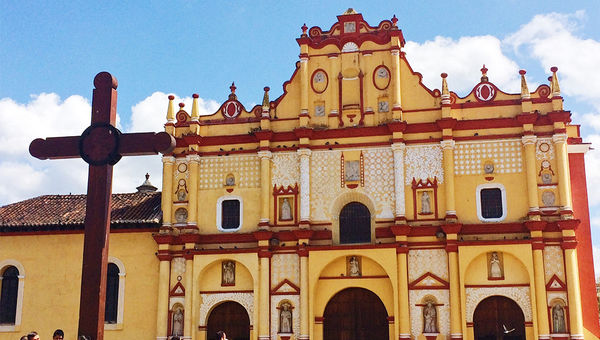
The Cathedral of San Cristobal de las Casas in the state of Chiapas. Photo Credit: Meagan Drillinger
From Palenque I took a bus high up into the hills to San Cristobal de Las Casas. This colonial city sits at 7,200 feet above sea level, surrounded by forested mountains and humming with Mayan heritage. Like most colonial cities in Mexico, San Cristobal is characterized by its low-rise, colorful colonial buildings on either side of cobblestone streets. The main central plaza opens to views of the surrounding valley, with the intimidating yellow-and-red Cathedral de San Cristobal overseeing all. San Cristobal de las Casas is a prime destination for backpackers and spiritual seekers, with Mayan shamans offering yoga and cleansing rituals, vegan and vegetarian eateries, and block after block of budget accommodations. San Cristobal is also a perfect home base from which to explore nearby attractions. The Canon del Sumidero in Sumidero National Park is a massive canyon cut by the Grijalva River, and has walls that climbs as high as 3,200 feet. Consider a boat trip down the center of the canyon to marvel at the looming walls. Another option is to do a day tour to El Chiflon and Lagunas Montibello. El Chiflon is a series of waterfalls that ends at Velo de Novia waterfall, a massive fall that drops nearly 400 feet. Lagunas Montibello is on the border of Guatemala, and consists of a series of lakes that are tucked within pine forests.
Following Chiapas, I hopped the bus (the reliable ADO bus network being my preferred method of travel on this journey) and headed into the neighboring state of Oaxaca. My destination was Puerto Escondido, a sleepy seaside retreat known for its epic surf, laid-back living and lack of mega hotels.
The most famous stretch of beach in Puerto Escondido is Playa Zicatela, home to one of the world's most famous surf pipelines. The crowd in Puerto Zicatela swings entirely surf culture, with small palapa'ed beach bars and restaurants and an inordinate amount of surf shops along the main drag, Avenida del Morro. Small hotels and bungalows start at the beach and creep their way up into the surrounding hills overlooking the crescent-shaped beach. Puerto Escondido also continues to be one of the cheapest destinations in Mexico, and with the dollar as strong as it is, it is possible to vacation like royalty for an extended period of time.
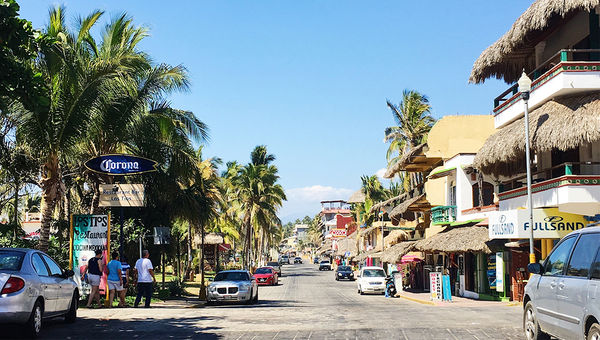
Avenida del Morro, the main street in Puerto Escondido's Playa Zicatela beach town. Photo Credit: Meagan Drillinger
Puerto Escondido is starting to erupt as a foodie destination. The state of Oaxaca is already known for its delicious Mexican fare, with items like the popular tlayudas dominating most street cart menus. Mole is also one of the more popular local dishes to be had throughout the state of Oaxaca. In Puerto Escondido, one restaurant in particular is shaking up traditional Oaxacan cuisine with a modern twist. Almoraduz, in the local Rinconada neighborhood, serves up elegant Oaxacan cuisine from a menu that changes daily. Down on the beach, Costenito Cevicheria serves some of the freshest ceviche to be had, with casual, barefoot elegance in the shape of reclaimed wooden tables underneath a billowing linen tent. The restaurant is upping its mixology game by incorporating high-end mezcal into their cocktails, pulling in a sophisticated crowd. And farther south along the beach, in the even more backpacker/bohemian Punta Zicatela, the Thai restaurant Lychee remains a popular hangout with locals for al fresco dining on some distinctive Thai-style dishes.
My original itinerary had me going north of Oaxaca through Mexico City on my way to the state of Chihuahua and into Copper Canyon, but as is with any backpacking trip, sometimes the plan changes. To really see and experience these hidden gems in Mexico required more time than I had anticipated. From virgin beaches to mountain forests to rugged canyons and colonial cities, to overlook Chiapas and Oaxaca is to overlook Mexico.