For most travelers, Mexico’s Yucatan Peninsula ends at Tulum -- the farthest south that most tourists will go.
But beyond Tulum, deep in the jungles of the state of Quintana Roo, closer to the border of Belize, is a treasure-trove of travel options that will dazzle the minds of outdoor enthusiasts looking to soak in Mexico’s natural beauty.
Heading down Highway 307 from Tulum, travelers will cross into Zona Maya, a collection of small communities in southern Quintana Roo with strong ties to indigenous Mayan cultures. About two-and-a-half hours south of Tulum travelers will hit Bacalar, one of the Magic Towns of Mexico.
The town is named for the lake on which it sits, a multi-colored gem that sparkles underneath the hot, Mexican sun.
Bacalar the lake is known as the Lake of Seven Colors, named for the brilliant shades of blue that swirl across the surface throughout the day. Bacalar is a prime location of kayaking, sailing, swimming, or simply sunbathing on its sugary shores.
If visitors are in pursuit of Mayan ruins in this part of Mexico, chances are they're going to Chichen Itza or Tulum. And while both are spectacular, there are dozens of other Mayan archaeological sites farther south that are just as spectacular, without the crowds. Kohunlich, southwest of Bacalar, is an important Maya city, with the largest number of constructions that are open to the public.
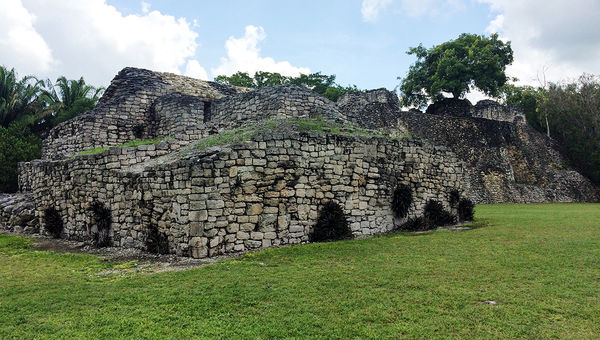
Kohunlich, southwest of Bacalar, is an important Maya city, with the largest number of constructions that are open to the public. Photo Credit: Meagan Drillinger
The city has beautifully preserved buildings and complexes, such as the Temple of Masks and the Stelae Square. The most important sections of Kohunlich are 27 Steps and Pixa’an, which are groups of palaces and residential structures. The entire city rises out of the jungle, so that when visitors climb the Temple of Masks, all they can see is a thick blanket of vast, green wilderness.