 For decades, Las Vegas has been defined by its "Sin City" persona: the clamorous casinos, themed resorts, big-box shows, convention centers and award-winning restaurants that draw millions each year to party, exhibit, gamble and shop along the four miles of Las Vegas Boulevard that constitute the city's legendary Strip.
When visitors did venture beyond the confines of the Strip, it usually meant taking a day tour to the Grand Canyon, Red Rock Canyon or Hoover Dam.
Yet, all the while, there existed another Las Vegas known only to the locals, a hidden place where families were raised and homes were built and kids went to school, a place largely funded by cash flow from the Strip but that existed apart from it. It was a world alien and unknown to the vast majority of visitors.
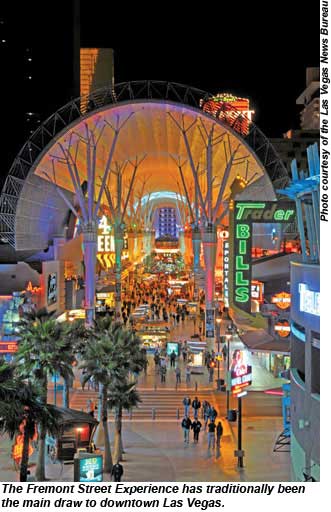
True, the rare, more curious visitor might catch a cab to downtown's Fremont Street Experience, the fully illuminated pedestrian mall that offered a peek into "old Vegas," but if anything, that was an off-the-beaten-path travel morsel consumed in a single bite.
But in recent years, thanks to a major multisource investment in urban renewal, the local community has been reshaping Las Vegas' downtown into a historical and cultural center. And visitors, too, would do well to take notice.
Without sacrificing any of the Strip's glitz, glamour or glory, downtown Las Vegas has been undergoing a revival of its artistic and cultural roots and celebrating the emergence of new creative talent at the community level. Though the Strip will continue to drive much of Las Vegas' economy -- it accounted for $6.1 billion of the city's $9.2 billion in gaming revenue in 2011 -- it is downtown Las Vegas that has seen the most marked change in the last year.
As a result, this "old Vegas" is once again attracting locals eager to plant personal and professional roots in a part of the city that used to drive people away, and in the process, it has started to attract an increasing number of visitors curious about the more innocent side of Sin City.
"The Strip experience is incredibly important, and we're not trying to compete with that," said Seth Schorr, CEO of Fifth Street Gaming, which is overseeing the redevelopment of the Lady Luck hotel and the surrounding neighborhood district, known as Downtown3rd. "We're just trying to give an alternative experience that some people might be interested in. Las Vegas doesn't have to be one-dimensional."
In sum, Schorr said, "We're creating something that every city should have -- that heart and soul that Las Vegas hasn't had in a very, very long time."
Last week the Las Vegas Convention and Visitors Authority (LVCVA) reported that the city drew 39.7 million visitors last year, besting the previous record of 39.2 million set in 2007. The LVCVA has not yet released statistics about downtown visits in 2012, which would reflect traffic to downtown in a year that produced several openings and renovations in the area. Nonetheless, 34% of Vegas visitors (about 13.2 million) visited downtown in 2011, and if the popularity of some of the area's newest attractions and increased foot traffic throughout downtown's streets offer any clues, 2012's numbers were likely much larger.
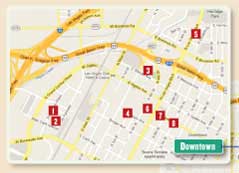 The push to revitalize downtown Las Vegas has largely been the work of locals looking to improve the local community with infusions of large amounts of capital to kick-start new businesses and entrepreneurial ventures. (Click here or on the map, right, for a larger view of the Downtown area.)
Yet much of the downtown growth has visitor appeal, as well, which might make them rethink how they define Las Vegas.
Planting roots
Las Vegas was hit hard during the recession. According to the LVCVA, gaming revenue dropped $2 billion from 2007 to 2009, and the total occupancy rate dropped 10% between 2007 and 2010. Over the same period, the city's unemployment rates were among the nation's worst.
Nonetheless, projects and attractions designed to enhance the downtown area's appeal were brewing in the background, gaining momentum and support.
As Myron Martin, president and CEO of the Smith Center for the Performing Arts, traveled around the country gathering information and compiling ideas on how to design and build the Smith Center, one of downtown's cornerstone attractions, he said he found that a sense of community helped define what such a place should look and feel like.
"Time and time again, the story of the world-class performing arts center in the city was a much broader story," he said. "It was about redevelopment, economic development in general, bringing people to downtown."
 Of course, dreams can only go so far in redefining a city; the other crucial part of the deal is capital investment. Among the community's biggest investors is Tony Hsieh, CEO of the online shoe and clothing shop Zappos.com and a key financial driver behind this movement.
Zappos.com had been "looking to create its own campus," said Kim Schaefer, spokeswoman for the Downtown Project, a community-focused initiative to develop downtown Las Vegas. "Because Tony had already fallen in love with this neighborhood, I think he thought, well, why not turn it inside out and help revitalize the neighborhood as well as build a campus?"
In fall 2011, the Downtown Project was founded, and Hsieh invested $350 million to kick-start it: $100 million in real estate, $100 million in residential development, $50 million in small businesses, $50 million in education and $50 million in tech startups.
"He is investing in small businesses and tech startups, but he isn't doing all of that on his own," Schaefer said.
People who receive funding for their entrepreneurial ventures pursue their own visions for creating a passion-driven, community-based, sustainable business in the downtown area.
"It's really about helping other people to fulfill their dreams," Schaefer said.
Local needs, tourism draws
"Our dream is to have a place where you can live, work and play all in one area," Schaefer said.
The goal of creating a livable, local-friendly neighborhood drives the Downtown Project. A growing number of people are moving to the downtown area, and providing basic needs for these neighborhood citizens is a concern.
Nor is the city blind to the fact that downtown Las Vegas appeals to certain types of visitors, as well. Many travelers seek out those places that attract locals, and they intuit that the local scene is not unfolding in the nightclubs or on the casino floors of Strip resorts.
 Enhancing the appeal, accessibility and safety of downtown -- and striking the delicate balance between the needs of locals and visitors -- has been a joint effort by Las Vegas Mayor Carolyn Goodman and the Las Vegas City Council, the Regional Transportation Commission of Southern Nevada (RTC), the Downtown Project and several other entities that are involved in the revitalization of the area.
Amy Jo Martin is the founder and CEO of Digital Royalty, an established company in which Hsieh invested before it moved downtown last June.
"There's a unique dynamic between the tourists and locals within the area," she said. "It's not uncommon to be standing on the corner of Las Vegas Boulevard and Fremont Street next to someone in an Elvis costume who's headed to work, Tony Hsieh and tourists from the Midwest who are sporting a large open container filled with a Las Vegas beverage. There's no judgment in our community; we all co-exist."
Certainly some of things that locals desire downtown -- a grocery store, dry cleaners and nail salons, for example -- hold little interest for most visitors, but other things, such as more green space and a farmers market, do.
"It's a critical balance between the tourists and the locals, but I believe tourists will want to go where the locals go," Schorr said.
In the past year, several downtown hotels have undergone renovations and rebranding, opening their doors to travelers interested in staying in accommodations off the Strip:
- The former Fitzgeralds underwent a face-lift and is now known as the D, with a flashy new casino floor and bar, sleek and modern rooms and a couple of new restaurants.
- The Golden Gate, Las Vegas' first casino hotel, retained its vintage Vegas charm but also added 16 suites and penthouses, a high-roller lounge and a new lobby.
- The Plaza recently invested $35 million in renovations, which included updating more than 1,000 guestrooms and the casino floor.
- In late 2013, the Downtown Grand, formerly the Lady Luck, will reopen for business after a complete renovation.
"We've seen an uptick in terms of room occupancy as well as gaming because the hotels and their remodeling efforts have made it so attractive to be down here," Goodman said.
 New and improved attractions have also drawn visitors to downtown Las Vegas.
The Mob Museum, which opened Feb. 14, 2012, in the former federal courthouse and U.S. Post Office on Stewart Avenue, offers a comprehensive look at Las Vegas' mob history as well as organized crime around the world through hundreds of artifacts and interactive exhibits. In its first year, the museum attracted more than 200,000 visitors from all 50 states and nearly 35 countries.
The Smith Center, which opened about a month later, has drawn thousands of locals and tourists alike. Though originally built with locals in mind, the Smith Center has attracted visitors, as well.
"When 'Wicked' was here [at the Smith Center], there were a number of people from out of town who came to see the show," Martin said, adding that those people "will come back to Las Vegas to see shows because it was such an extraordinary experience. As great as this season was, I think next season will be even more exciting in terms of the quantity and quality of the artists that we're able to attract to Las Vegas."
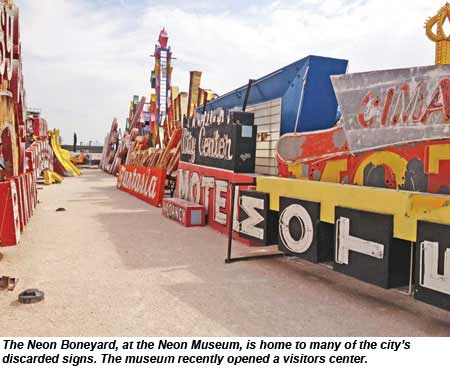
Though it has been open for a number of years, the Neon Museum is enticing travelers with a new visitors center made from the old La Concha Motel lobby and more cohesive tour offerings. Also known as the Neon Boneyard, this is where many of the city's discarded signs have been put on display.
"People who visit Las Vegas want to see that art form," Goodman said.
Dangling light bulbs and rusty pieces of wire on signs from closed hotels, wedding chapels and diners tell a story of the city's history, and the new tour makes the experience much more accessible and understandable. Though visitors could wander through the Neon Museum in the past, tours had to be booked online prior to arrival. Reservations are still recommended, but the visitors center opening has made it possible for people to simply drop by, as well. (Read more about the Neon Museum in related article, "Neon Museum illuminates Las Vegas’ past.")
Fremont Street Experience, which has been the primary draw to downtown Las Vegas for several years, continues to entertain visitors with its open doors to casino gaming, street performers and artists, and kitschy knickknack shops. A temporary zipline, which ran down the spine of Fremont Street Experience, is being replaced with a permanent one called Slotzilla, which will open this year.
Neonopolis, another entertainment complex located on the eastern end of Fremont Street Experience, is also gaining popularity. Site of the famed Heart Attack Grill (a hospital-themed restaurant where anyone weighing more than 350 pounds eats free), Neonopolis also houses the Las Vegas Toy Shack, a shop owned by Johnny Jimenez, the "toy guy" from the History Channel show "Pawn Stars," and the soon-to-open Krave Massive, the world's largest gay nightclub and the country's only LGBT movie theater.
Though locals aren't likely to zip down the heart of Fremont Street Experience or frequent the Mob Museum on a daily basis, other attractions do have cross appeal.
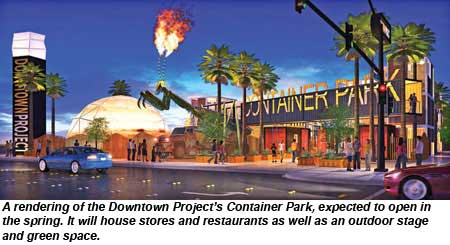 The Downtown Project's Container Park, which will house several local stores and restaurants as well as an outdoor stage and green space, is expected to open later this spring. Downtown3rd is also designed for a mixed audience. Several restaurants and bars, all with indoor and outdoor space to mingle and sit, have already opened in the area, and more will be added in the coming months along with retail shops and meetings space.
"It's a true pedestrian district," Schorr said.
One of the keys to managing an area like this is providing the infrastructure to handle an influx of people.
David Swallow, director of engineering services for the RTC, said, "We see downtown as having a very large potential for growth and creating a suburban hub for the Las Vegas Valley that historically we just haven't had. We're trying to make sure that as far as transportation is concerned, we can facilitate that growth."
Usage of the RTC's public transportation services has increased significantly across the valley, and downtown is certainly no exception. Though those staying on the Strip can use taxi services to get downtown, many use the Strip & Downtown Express bus service, which quickly moves tourists between the city's two main areas of visitation.
The city of Las Vegas and the RTC have implemented (and will continue to introduce) a number of facilities and amenities in the downtown area to provide safe, accessible access to walkers, cyclists and public transportation users. New green bicycle lanes and signage on busy downtown streets will create an easily navigable network of transportation routes, and the RTC's new transit hub, the Bonneville Transit Center, includes the valley's first commuter bike center. The RTC is expected to introduce a local bike share program in 2013, which will offer more transportation options to people living and working in, as well as visiting, downtown.
The new face of Las Vegas
One of the most powerful indicators of downtown Las Vegas' success is simply the fact that those who are interested in developing the space are actively participating in what it has to offer.
Hsieh is moving the Zappos headquarters to downtown this fall, which will add almost 1,500 people to the neighborhood on a daily basis. Many of these employees will likely support other local businesses in the area, and some might even move downtown.
"What we have as a community is a really great opportunity to define who we are as a city," Schaefer said. "There really is a spirit of community here, and I don't think people expect that at all."
Vintage Vegas is still right beneath the surface of downtown Las Vegas, but the new coat of paint across the area has added a different shade to the city.
"The draw to this area is the character of the people and the legacy of the environment," Martin said. "This is old Vegas, and what's happening here with the blend of tourism and community development is rare."