For years, the domestic river cruise industry has paddled
along, riding the ups and downs of just a few, sometimes volatile players
operating old-fashioned paddlewheelers on the Mississippi and a few other
select waterways.
And while growth has been steady in recent years, at least
one player -- and the largest one at that -- recently predicted that the
domestic industry is on the verge of both major change and major expansion.
Viking, the largest European river cruise operator, has been
threatening for years to enter the U.S. market. As a result, American Cruise
Lines (ACL), the longest active player in the domestic river industry and by
far the biggest, with five vessels and counting, has been positioning itself to
get a leg up before newer players gain ground.
ACL can leverage one major advantage: Owner and CEO Charles
Robertson also owns Chesapeake Shipyard, giving the cruise line a place to
build new ships that meet federal laws requiring that all U.S.-flagged vessels
be built in the U.S. and staffed by Americans.
Last year, ACL introduced the country's first modern river
ship, the American Song, built in the style of modern European luxury ships,
only bigger. Some suites are as large as 800 and 900 square feet, and the
cabins also have balconies, lots of glass and scores of other modern luxury
amenities that have been missing on U.S. rivers long dominated by renovated
paddlewheelers and replica paddlewheelers.
The new ships are also much more eco-friendly, an
increasingly important consideration among travelers young and old.
ACL's modern ships mark a new generation of vessel design
for domestic river cruising, which Robertson said he believes has barely begun
to tap its full potential.
"People are more interested in staying home and
discovering America," he said. "And our modern boats have struck a
very receptive chord."
Robertson said ACL has a very loyal following among older
customers, primarily baby boomers, but the "median and average age is
coming down a bit. It's still 50-plus, although we're seeing a lot of
multigenerational families."
Indeed, travel advisor Pete Larson of Jolly Mon Vacations
and River Cruise Guru in Grand Forks, N.D., said he has found domestic cruising
to be an "amazing product." But he said he has had a hard time
selling U.S. itineraries, mostly because of the price point. That is in part
due to laws requiring that domestic river cruise lines hire only American
crews, while European and Asian cruise lines can tap into much lower-cost labor
markets.
"Cruises here are higher priced than their European
rivals," he said. "They are considered luxury cruises, but most of
the ships are older paddlewheelers or steamboats. They certainly have an old-world
charm but are far from the luxury ships of Europe."
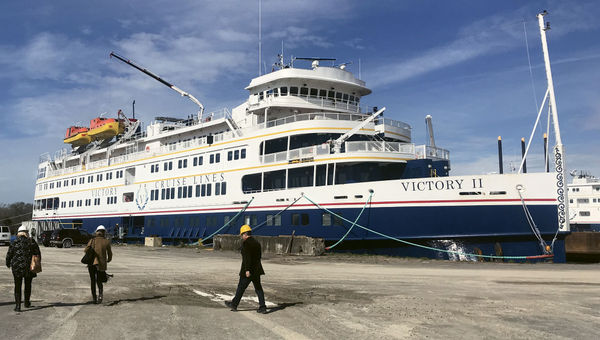
The Victory II, one of two ships acquired by American Queen Steamboat Co. when it bought Victory Cruise Lines, sails the Great Lakes in the summer and the Eastern Seaboard in the winter.
ACL, however, is planning to build five of the large, modern
ships, giving cruisers the option to book luxury products with lots of room and
extras like private balconies and room service.
Its first such ship, the American Song, launched last fall
on the Mississippi with sold-out sailings. This year, it has been repositioned
in the Northwest, while the company's second modern ship, the American Harmony,
is set to launch this summer on the Mississippi. A third is schedule to debut
next year.
Launch dates have not been announced for the final two.
ACL's strategy differs from that of the American Queen
Steamboat Co. (AQSC). CEO John Waggoner said in February that after the company
completes renovating its fourth paddlewheeler, the American Duchess, he will be
shifting his focus, at least temporarily, to ocean cruising, focusing on
coastal and adventure itineraries.
AQSC recently bought Victory Cruise Lines, which sails two
ships on the Great Lakes and the Eastern Seaboard and has an expedition ship
for Alaska being delivered next year.
Although demand for domestic river cruising is high,
Waggoner said he wants to build upon, rather than cannibalize, the company's
customer base.
Coastal and adventure cruising, he said, "attract a
younger demographic. If we can start getting people in their 40s and 50s and
then keep them through the Great Lakes and our riverboats -- the American
Empress, the American Queen -- and have customers for 30, 40 years, for us that's
huge, because then you've built a sustainable market."
ACL, however, sees room for both types of cruising, and it
is using the modern ships to attract new river cruisers. In addition to what
will this year be six river ships, it operates five coastal ships.
And with Ritz-Carlton, Ponant and others now competing in
the Great Lakes and coastal markets and Viking eyeing the U.S. river market,
Robertson seems intent on staying ahead.
"I think there will be a lot more competition," he
said. "Our market certainly is changing."
ACL joined the river cruise market in 2000 with sailings on
the Hudson. It has been adding itineraries and growing slowly but steadily ever
since.
Its competition has been much more volatile. AQSC's
predecessor was Majestic American Line, which went under in 2008, leaving ACL
sailing virtually unchallenged on the Mississippi. In 2012, AQSC bought
Majestic American, with much fanfare about the return of more paddlewheelers on
popular Mississippi routes between places like Memphis and New Orleans and to
towns made famous by Mark Twain.
Today, both ACL and AQSC sail the Mississippi and the Snake
and Columbia rivers in the Northwest, among other waterways.
Robertson said he also sees opportunities on other domestic
rivers, although given the highly competitive and copycat nature of the
industry, he declined to name what other waterways he might be eyeing.
While both ACL and AQSC say demand is strong, travel
advisors haven't seen nearly as much demand for domestic routes as they have
for European cruises. One reason for the difference is that both companies have
strong repeat customer bases and aggressive direct-to-consumer marketing and
sales programs.
"I have met people while onboard and probed them with
questions," Larson said. "Many had booked direct with the cruise
line. One couple told me that since they weren't leaving the country, they
weren't really scared to book things themselves."