In separate letters late last month, a U.S. senator and
the Business Travel Coalition (BTC) called for a federal investigation into
airline surcharges that are deeply cutting into the value of frequent-flyer
rewards miles.
Both are accusing airlines of continuing to levy fuel
surcharges in violation of a 2012 Department of Transportation (DOT) regulation
on the matter, even as the price of oil has plummeted from a high of $147 per
barrel in 2008 to approximately $30 per barrel today.
Sen. Richard Blumenthal (D-Conn.) has asked the DOT to
take particular notice of the impact such surcharges have on the value of
frequent-flyer programs.
“It is an unfair and deceptive practice when airlines
convince consumers they are earning thousands of miles to use with award
programs only to be surprised by hundreds of dollars in hidden fees at the
checkout page,” Blumenthal wrote in a Feb. 22 letter to Transportation Secretary
Anthony Foxx.
In its 2012 regulation, the DOT stated that airlines’
surcharges must be based upon a reasonable estimate of the per-passenger fuel
expenses incurred by a carrier above a baseline fuel cost.
Blumenthal accused carriers of responding to those rules
by renaming their fuel surcharges with vague titles such as “carrier-imposed
charges” or “international/domestic surcharges.”
Simple ticket searches on carriers’ websites reveal how
significant surcharges can be on international flights. For example, a total
ticket cost of $1,412 for an April roundtrip on Delta between Atlanta and
London Heathrow included a $458 “carrier-imposed international surcharge”
alongside a $729 base fare. Taxes and fees accounted for the remaining $226.
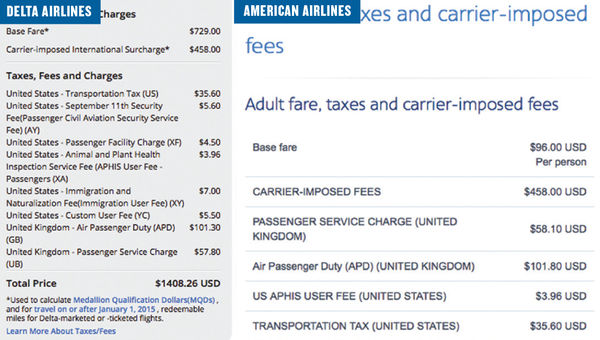
Delta and American add "carrier-imposed fees" to international flights.
Similarly, an American Airlines flight on the same April
dates between New York and Heathrow had an economy-ticket cost of $966. Of that
total, the base fare accounted for only $285, while “carrier-imposed fees” were
$458. Taxes and government fees made up the remaining $223.
United, on the other hand, didn’t include a surcharge in
a $1,162 ticket it was selling for the same dates between its Chicago O’Hare
hub and London. Instead, United charged a base fare of $940 plus taxes and
government fees of $222.
Airlines for America (A4A), the trade organization that
represents major U.S. carriers other than Delta, declined a phone interview
request for this report. However, A4A spokesman Vaughn Jennings provided
emailed statements in which he said that Blumenthal’s assertion about domestic
surcharges was incorrect because surcharges are permitted only on tickets for
international travel.
“In general, surcharges on international tickets reflect
a variety of factors and market forces that vary from market to market,”
Jennings wrote. He did not respond directly to the allegations of Blumenthal
and the BTC that some carriers have simply changed the name of their fuel
surcharge to steer clear of the 2012 regulation.
Jennings said that Blumenthal’s assertions did not stand
up to the facts. Domestic airfares, he said, fell to their lowest level since
2010 during the third quarter of last year.
“It would be difficult to find an industry that is more
transparent than airlines in their pricing,” he wrote.
In his complaint to the DOT, Blumenthal made specific
note of the impact surcharges have on frequent-flyer ticket redemption.
“That carrier-imposed surcharges sometimes only surface
when a consumer attempts to redeem an award ticket through an airline loyalty
program seems to further confirm the deceptive nature of these surcharges,” he
wrote.
But because carriers have begun awarding loyalty miles
based upon how much customers spend in fares, rather than on how far they fly,
the surcharges also impact reward accrual, said airline industry analyst Bob
Mann of R.W. Mann and Co.
A Travel Weekly search for a reward ticket from Miami to
Barcelona from May 24 to June 2 through American’s AAdvantage program yielded
an economy fare that cost 60,000 miles plus $439 in taxes and fees, including
$280 in carrier-imposed fees. Flights were operated by American and by its
partner British Airways.
Blumenthal singled out Delta in his letter, writing that
the carrier’s “voluminous rules and conditions web page” contains only a
passing mention that an international-award ticket could contain up to $600 in
taxes, fees and carrier-imposed surcharges. Delta also asserts that it reserves
the right to change or add fees without notice.
Such disclaimers are neither new nor unusual, Mann said.
“The bottom line is that carriers have always reserved
the right to change the terms of these programs with or without notice,” he
said. Mann added that courts have ruled that such policies are legal.
In an email, the DOT acknowledged that it had received
Blumenthal’s letter and was working on a response. The agency also said that it
had previously investigated British Airway and Air France respectively for
noncompliant and mislabeled fuel charges. In 2012, the DOT fined Air France
$85,000 for failing to disclose the full price of frequent flyer tickets and
for describing a carrier-imposed surcharge as a tax.