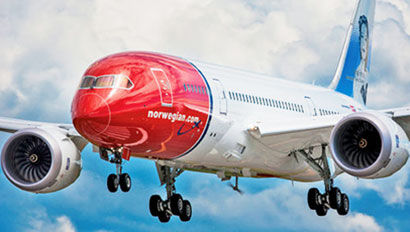
 In an aviation version of David vs. Goliath, Norwegian Air, the third-largest European low-cost carrier, has won a license from the Irish Aviation Authority that will enable it to move the headquarters of its long-haul subsidiary to Ireland, adding yet another victory in its war with an airline establishment determined to halt its advance.
While Norwegian denies that the Ireland move was made to enable it to lower its labor costs, it clearly plans to expand its transatlantic service and bring substantially lower fares to the highest-margin market that U.S. carriers fly.
Norwegian, which had already won European Union approval to expand under the 2007 Open Skies accord (extended by the U.S. and E.U. in 2011), now faces just one more hurdle: approval for an operator’s license from the U.S. Transportation Department (DOT).
So it is at the DOT that the major U.S. carriers and the Air Line Pilots Association (ALPA) are making their last stand in a furious battle to stop the low-cost carrier from throwing pricing uncertainty into the lucrative transatlantic market.
Norwegian is moving ahead aggressively nonetheless, acting as if the DOT approval was a foregone conclusion.
Immediately after winning Ireland’s approval, it ordered four more Boeing 787 Dreamliners. It had previously announced that it would be adding new gateways in the U.S., including Los Angeles, San Francisco and Orlando, and that it would begin flying from New York to London Gatwick beginning in July.
It said it plans to introduce Gatwick service to Los Angeles and Fort Lauderdale later in the year.
An expanding international presence
An established European carrier, Norwegian Air Shuttle, which flies commercially as Norwegian, began transatlantic services last May. It currently flies out of New York Kennedy and Fort Lauderdale on routes limited to Oslo, Norway; Stockholm, Sweden; and Copenhagen, Denmark.
It also flies routes throughout Europe and to the Middle East and Africa, enabling customers to connect beyond the carrier’s European gateways.
In their petition to the DOT, American Airlines, Delta Air Lines, United Airlines and ALPA argued that Norwegian was able to offer fares as low as $297 from Los Angeles to London only because by headquartering in Ireland, it was dodging higher labor costs by establishing “flags of convenience” a la the shipping and cruise industries.
In a joint filing with the DOT in December, the carriers and union said that Norwegian was creating a “shell company” in Ireland as a way to avoid Norway’s labor laws and use imported labor. Ireland is a member of the European Union, Norway is not.
The major airlines and ALPA also pointed out that while Norwegian will maintain its headquarters in Ireland, it will not fly there, even though Ireland will ultimately be responsible for monitoring the carrier’s compliance with safety issues.
That charge triggered immediate protests from Irish aviation officials, who say it casts aspersions on the country’s regulation of airline safety.
Source of savings: The Dreamliner
Norwegian denies that cutting labor costs is the reason it can offer rock-bottom fares. The carrier says its ability to cut prices is directly attributable to its use on long-haul routes of the Boeing 787 Dreamliner, which Norwegian said is far more efficient than the older aircraft U.S. carriers are using for transatlantic flights.
The Dreamliner savings alone, Norwegian said, account for why it can offer an August roundtrip fare from New York to London of $922, compared with fares of just over $1,400 on American and Delta.
As for its employment practices, Norwegian said it is basing crews in several markets, including the U.S., Europe and Thailand, which it notes is a long-established practice.
“This is something that other airlines have been doing for decades,” said Lasse Sandaker-Nielsen, communications manager for Norwegian. “They’re just trying to make it look like it’s something new.”
He said that Norwegian, like all airlines, complies with local labor regulations for its crews. The carrier is establishing flight crew bases in major markets such as New York and Fort Lauderdale and is hiring 300 U.S.-based cabin crew members, he said.
Sandaker-Nielsen said that Norwegian’s compensation plans have to be competitive to attract crew. He claimed the airline had received 5,500 applications for the positions for which it is recruiting and had recruited crew members away from major carriers, including American, United and British Airways.
Sandaker-Nielsen said Norwegian’s recently obtained Irish operating license simply gave it the E.U. presence it needs to expand into Asia and has nothing to do with its transatlantic service, which is covered by the 2007 Open Skies agreement.
“U.S. carriers are obviously afraid of competition and have been dominating the transatlantic market way too long, and fares are way too high,” Sandaker-Nielsen said.
Besides benefiting from the Dreamliner’s lower operating costs, Norwegian is operating its aircraft from 16 to 18 hours a day instead of the 10 to 12 hours a day other airlines operate their planes.
Norwegian has ordered a total of 14 Dreamliners. Three are in service now, and by May it will have seven in service.
Where’s the threat?
Aviation consultant Mike Miller dismissed the suggestion that Norwegian is a threat to large airlines.
“They are David facing Goliath across the Atlantic,” he said.
He also pooh-poohed the idea that a carrier with a few long-haul planes could pose a threat to “super-large, immunized alliances.”
“American, BA, Delta, KLM and Air France have huge economies of scale that Norwegian doesn’t have,” Miller said.
Norwegian might be a competitive threat on individual routes but not beyond that, he said.
While Miller acknowledged that Norwegian did have lower labor costs, he asserted that it was due to employing a younger workforce.
Norwegian flies more than 20 million passengers per year on a route network that stretches across Europe, North Africa and the Middle East. It has long-haul flights to Southeast Asia as well as the U.S.
When asked when the DOT might hand down its decision, a department spokesman would say only, “We are in the midst of a contested proceeding, and we are not in a position to address timing issues at this time.”
Follow Kate Rice on Twitter @krtravelweekly.