FLORIANOPOLIS, Brazil -- Members of the world's most exclusive travel club, the World Travel and Tourism Council, gathered here this month to discuss strategies for dealing with global economic malaise, health-related threats and apparent governmental indifference to industry concerns.
In the end, more problems were described than solutions prescribed, but the summit concluded with an unprecedented oral agreement between the WTTC and the United Nations World Tourism Organization to coordinate lobbying efforts on the issues of trade and jobs.
The partnership reflects the blunt recognition that the impact of the dramatic issues of the day, particularly the global recession and H1N1 flu, are being critically influenced by a patchwork of reactive public policy.
The audience and speakers also reflected the interdependence among public and private organizations, with attendees including the CEOs of Carlson, Travelport, Starwood and other global travel conglomerates as well as the president of Brazil, the regional executive director of the International Monetary Fund and tourism ministers from around the world.
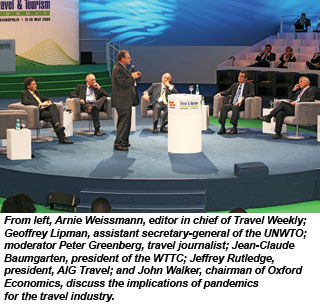 In the opening panel, focusing on the flu, John Walker, chairman of Oxford Economics, presented a study commissioned by the WTTC to analyze the possible outcome of a virulent worldwide pandemic. The predictions were dramatic.
In reaction to the current H1N1 outbreak, travelers are booking to destinations they believe are safe. In a global pandemic, however, he said there would be no perceived havens, and the resulting disruptions could result in GDP losses of nearly $2.2 trillion to the global tourism economy.
"Traffic would not be redirected," Walker said. "People will stop [leisure] travel, perhaps even within countries. Business and governments will cut back, as well, on discretionary travel. Nondiscretionary spending will be affected, regardless of what the media may say."
(Editor's note: The author of this article was a participant on this panel. At this point in the presentation, co-panelist Geoffrey Lipman, assistant secretary-general of the UNWTO, leaned over and whispered, "That makes sense. When your kids are dying, you don't want to go anywhere.")
Asked what, if anything, could be done to mitigate such a crisis, Walker said those in the room should "encourage governments to be better prepared. Governments need to look at contingency plans."
On a panel focusing on the global economic recession, Paulo Nogueira Batista Jr., an executive director of the IMF who represents eight regional countries, including Brazil, noted that the U.S. and some European nations were taking measures without considering what effect they would have on neighboring and other countries. Emphasizing that his comments were his own and not made on behalf of the IMF, Nogueira Batista characterized some of these measures as "desperate" and "perverse."
He cited as an example how a rise in taxes on airline tickets in Britain had significantly raised the cost of a leisure trip to the Caribbean; as a result, poorer Caribbean countries had to lower their hotel taxes to attract British vacationers. The net result is that money is moving from the treasuries of developing countries to developed ones.
Nogueira Batista admitted that the IMF had been reluctant to recognize that deregulation of the financial industry had gone "too far," and he asserted that underregulation caused tremendous damage to the world economy, "much more than Osama bin Laden."
The moderator of the session, Charles Petruccelli, president of global travel services for American Express, which is primarily involved in financial services, countered, "But hasn't it created millions of jobs and wealth?"
Nogueira Batista replied: "This oversized financial sector has been destroying a lot of prosperity. The new trend to globalization will be smaller, less ambitious and more regulated. During this crisis, the short-term [goal] is to revive credit flows, so you don't want to be too restrictive. But the financial lobbies that have enormous influence on governments are fighting a rear-guard action."
A call for some regulation was endorsed by Fernando Pinto, CEO of TAP Portugal airline. "We lost billions of dollars because of speculation on the price of fuel," he said. "Bring back some regulation to this crazy marketplace."
The question of how to influence governments on behalf of travel and tourism was raised by Carlson CEO Hubert Joly, who said, "It's key for governments to see that we're talking about jobs, millions of entry-level jobs. Maids, receptionists, stewardesses, taxi drivers. With a Democrat in the White House, making that appeal is key."
Sebastian Escarrer, vice chairman of Spanish hospitality giant Sol Melia, said, "The main point is that tourists do not vote. And if they do not vote, they are not on the agenda of the political leaders."
The rise of protectionist measures as a result of the economic crisis concerned Petruccelli. He said 47 protectionist measures were enacted over the past two months. "This actually eliminates jobs," he said.
Escarrer agreed, pointing out that Croatia, which is "90% dependent on international visitors," is calling for its own citizens to vacation at home, as is Spain. "We [all] depend on tourism from others. We have to think: If everyone did this, how would it affect us?"
Saying that tourism had been helpful in bringing about reform when Spain was under the dictatorial rule of Francisco Franco, Escarrer said he also wanted to see U.S. travel restrictions to Cuba lifted. "It is an anachronism in a global economy, especially since the Cold War has ended," he said. He called the recent measures making it easier for Cuban-Americans to visit relatives on the island "very timid reform" and asked the Obama administration to "move forward."
Arthur de Haast, CEO of Jones Lang LaSalle Hotels, a global consulting and investment firm focusing on hospitality, observed that when governments failed to work in a coordinated fashion, there were "interesting consequences."
"In some countries, incentives are given to invest in hotels, including tax breaks," de Haast said. "But if you're importing anything to make the hotel functional, there's a 300% import tax, which makes the project unviable."
Toward the end of the discussion about industry problems and governmental policy, an audience member who described himself as "a young entrepreneur from Portugal" criticized the group for expecting government to provide assistance for industry problems. "I've seen nothing but bad vibes here," he said. "This is an industry of good vibes. I need optimism."
Petruccelli responded: "If we had waited for support and help, we would not be here. We are extremely vibrant. All of us know when we come out of [the recession], we will be stronger and more creative." But, he added, "The fact is that some help from some of the institutions and some understanding of the role we play as creators of jobs and wealth would definitely help us accelerate and be a stronger stimulus to the economy."
Toward that goal of communicating effectively to governments, a spontaneous agreement was reached between the WTTC and the UNWTO during the final panel, which featured the newly elected secretary-general of the UNWTO, Taleb Rifai. Rifai and WTTC President Jean-Claude Baumgarten agreed for the first time to work together to lobby governments to support travel and tourism. Their first action will be to travel to Mexico and make a joint statement urging the resumption of travel to that country.
The oral agreement, which the WTTC insisted had not been planned, seemed to underscore a comment made by Petruccelli in an earlier panel. He noted that a survey conducted by the Association of Corporate Travel Executives reported that 60% of its members would avoid a trip to an exotic destination even if it were cheaper than going to a more mundane locale.
"But why are we in Florianopolis?" Petruccelli asked. "We could have had a conference call. But sometimes it's important for all of us to get together."