Although Airbnb and other short-term-rental upstarts have now been a part of the hospitality landscape for more than a decade, an accurate measure of the impact the segment has had on traditional hotels remains elusive.
Frustration over this fact took center stage during last month's Americas Lodging Investment Summit, held Jan. 27 to 29 in Los Angeles, with executives expressing heightened concern over the short-term-rental category's relentless expansion.
"The playing field has changed quite a bit," said panelist Raul Leal, CEO of Virgin Hotels. "I think that for the hotel business, it has got to be tough to say, 'I'm going to build a full-service [hotel] somewhere,' with the challenge of all these different accommodations. It would be interesting to have [STR] layer in Airbnb and everything else and see what the net loss really has been."
STR, for its part, is trying to do just that. The hotel data firm is running a pilot program in Nashville, collecting data from the market's short-term-rental operators. So far, results indicate that the segment is giving traditional hotels a run for their money.
STR president Amanda Hite said,"We actually see that the [short-term-rental] rates are higher than the hotels' because they have a higher number of guests in the property. You've got families, bachelorette parties, where you have a lot of people staying in one unit. So, in some cases, the rates are running a little higher."
Likewise, STR's research suggests that short-term rentals are a likely culprit when it comes to the hotel industry's sluggish average daily rate, or ADR, growth. According to Hite, the U.S. hotel market had 140 fewer compression nights, defined as nights when occupancy is 95% or higher, in 2019 versus the year prior.
"We've got a lot more flexible supply in lodging today, and we see it in the compression nights," Hite said. "If you don't have those highly compressed nights where you're able to drive the rate, then that certainly has an impact on overall business."
David Kong, president and CEO of Best Western Hotels & Resorts, echoed Hite's sentiments, while also warning that the recent emergence of new, hybrid upstarts could pose an even larger threat in the coming years.
"Alternative lodging accounts for over 10% of total supply, and this year it's forecast to go up to 12%," Kong said, citing data from a recent CBRE report on the maturing short-term-rental market.
"Any way you think about it, alternative lodging has had a negative impact on our RevPAR," Kong added. "What's making it even worse is you have these branded apartment/hotel owners, like Stay Alfred or Sonder, that are building a brand in alternative lodging. That's even more worrisome."
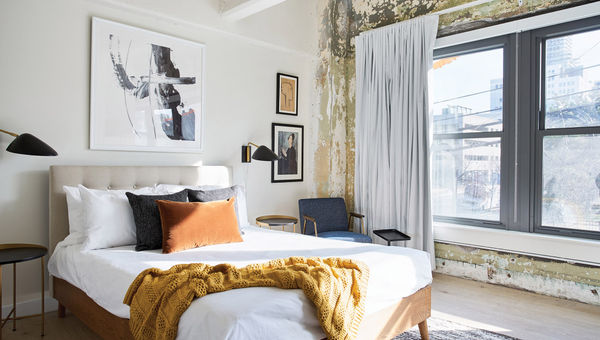
A bedroom at a property available through Sonder, a hybrid accommodations provider that rents out residential units and also operates 11 hotels.
Hybrid hospitality companies
This burgeoning breed of apartment/hotel operators typically specializes in leasing residential units and renting them out as short-term accommodations, while also promising various tech-enabled services and amenities. Among one of the fastest-growing players in this space is San Francisco-based Sonder, which has raised more than $400 million in investor funding and is enjoying early success on the brand-building front.
Brett Stewart, head of hotel real estate for Sonder, said, "Up until this point, we haven't really done any major consumer marketing. But despite that, we actually drive a lot of our business via Sonder.com, north of 25%. Once guests have stayed with us, they're booking direct."
Sonder currently has 5,000 individual units across 28 cities; some of the company's biggest markets are New York, New Orleans, Chicago, London, Philadelphia and San Diego.
Not all of Sonder's inventory is short-term rentals, however. In mid-2018, the company made its move into traditional hospitality, opening its first Sonder Hotel in a nine-unit property in the Hayes Valley neighborhood of San Francisco. Today, Sonder has 11 hotels, with 30 more under lease. The company recently inked a deal for its first resort property, located in a yet-to-be-disclosed Southern California destination.
"Essentially, we're partnering with the owners, just like any other traditional hotel brand," explained Stewart. "We're taking over all the units, and we're operating them to our brand standards, both in the physical sense and on the service side of things."
As Sonder and other short-term-rental players encroach further into the traditional hospitality space, it's likely to make things even murkier for hoteliers looking to take stock of the competition.
But, according to Cindy Estis Green, CEO and cofounder of hospitality data analytics firm Kalibri Labs, Sonder's latest move is simply a sign of things to come.
"There are going to be more hybrid models," she predicted. "And I think, eventually, it's going to be part of the normal supply. It's just a new kind of supply. It's not an interloper, but the evolution of the hotel industry."