At least four lifestyle hotel chainlets will debut in the
San Francisco Bay Area by year's end as new entrants enter a lucrative market
largely vacated two years ago by longtime boutique hotelier Kimpton Hotels
& Restaurants.
Among the new entries: Richard Branson's Virgin Hotels and
celebrity chef Nobu Matsuhisa's hotel brand.
The 131-room San Francisco Proper, the first of the
fledgling Proper lifestyle brand headed by former Viceroy Hotels chief Brad
Korzen, opened in the city's Mid-Market district last week. The 196-room Virgin
San Francisco is slated to open in the city's SoMa (South of Market) district
by the end of the year, as is a 203-room Yotel in Mid-Market.
Some of that churn has extended farther south into Silicon
Valley, where Nobu Hospitality, which is led by Matsuhisa and includes actor
Robert De Niro as an investor, will debut hotel operations in the Bay Area by
reflagging Palo Alto's 83-room Epiphany Hotel. That property, which is owned by
Oracle co-founder Larry Ellison, opened in 2014 and is run by Bay Area
boutique hotel stalwart Joie de Vivre.
Additionally, former Starwood Hotels chief Barry Sternlicht
is redeveloping a Sheraton near Google's Mountain View headquarters into the
first Bay Area hotel under the 1 Hotels ecoluxe brand, though that property isn't
scheduled to open until late 2019.
San Francisco has long been fertile ground for independent,
small-chain operators because its geographic constraints -- the city is 49
square miles and bordered by water on three sides -- limited the ability to
build new, larger hotels, forcing builders to redevelop existing buildings,
known in developers' parlance as "adaptive reuse."
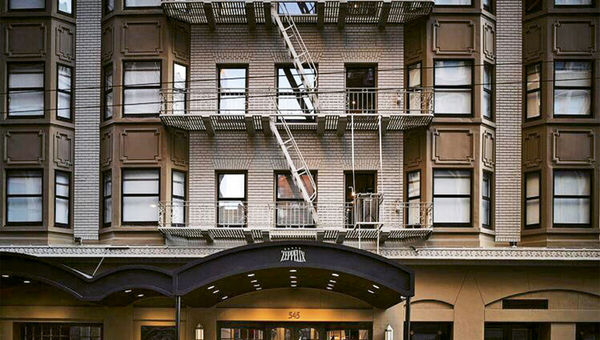
The Hotel Zeppelin near San Francisco's Union Square opened last year in what was formerly Kimpton's Prescott Hotel.
Kimpton was founded in San Francisco in 1981, while Joie de
Vivre Hotels, which is now owned by Two Roads Hospitality, was born six years
later.
"The adaptive reuse opportunities lend themselves to
more independent operators," said Julie Purnell, San Francisco-based
managing director at consultancy CBRE
Hotels. She added that it's also more difficult to get redeveloped buildings to
conform to larger brands' standards. "San Francisco has always been an
attractive market for boutique and independent hotels."
Still, the churn of such hotel operators appears to have
accelerated since 2015, when Kimpton was acquired by InterContinental Hotels
Group (IHG). Faced with the prospect of having its hotel staff unionize because
of the labor status of other IHG hotels in San Francisco, the owners of seven
of Kimpton's nine properties in the city almost immediately deflagged them, and
many of those hotels were subsequently remodeled.
Notably, Pebblebrook Hotel Trust last year reopened Kimpton's
old Prescott Hotel near Union Square under Viceroy Hotels and Resorts
management, naming it the Hotel Zeppelin. Earlier this year, the company opened
the Hotel Zoe at the Fisherman's Wharf site that housed Kimpton's Tuscan.
So while IHG and other larger hoteliers are likely to fall
under labor-union rules, the new breed is not.
Hotel consultant Rick Swig, whose family owned the city's
Fairmont from 1945 to 1998, said that while nonunion hotels are likely to pay
wages similar to those of union properties in order to attract quality staff,
such hotels can still operate more efficiently than union properties because they
can be more flexible with staffing in terms of shift hours and position
deployment.
"You can't get a good-quality employee for less than
what the unions are paying," Swig said. "But the union contracts are
very specific by categories and what the work days are. And all of those
nickels and dimes add up to quarters and dollars really fast."
Freed from such constraints, the new brands and their
developer partners have been lured by a market where room demand has been
consistently high in recent years, driven by high tourism numbers and a
continually expanding tech industry.
Through June, San Francisco-San Mateo's average nightly room
rate of $225 trailed only New York's $233 and Oahu's $229, though revenue per
available room was down 5.1% from a year earlier, largely because most of the
Moscone Center convention complex closed in April for an expansion.
That's not to say traditional brands are avoiding the local
market. Lured by the development of the $4.5 billion Transbay Transit Center in
SoMa, which is being billed as the "Grand Central Station of the West,"
the Langham Place San Francisco luxury hotel is slated to open in 2020, while
the city's first Waldorf Astoria is scheduled to debut the following year. A
250-room Marriott will open next year in the Mission Bay district near AT&T
Park, home of the Giants baseball team.
That said, with new-economy companies like Google, Twitter,
Uber and Salesforce either establishing or expanding their presence in the
Mid-Market district, whose gritty history -- the area was once part of the
Tenderloin -- shares an uneasy existence with younger tech workers, the newer
chainlets represent the most prominent trend in a local lodging sector in flux.
"Those workers want to stay where their businesses are
taking them," Swig said. "The millennials who work across the street
are populating the area because they're the new, hip places to go."