BETHLEHEM, West Bank -- Tony Blair, destination pitchman?
A voice message seemed to indicate that might be the case.
"I work with Tony Blair in the Quartet," said a man who identified himself as Ian Smith, "and we sent a letter to you a couple of weeks ago urging you to attend an event in Bethlehem. It's a special event where we're showcasing Palestinian tourism, and my colleague Tony Blair, who was the prime minister of Great Britain, sent a follow-up letter. Just want to check that you got the invitation, and I'd like to encourage you to accept it."
I searched my inbox and, sure enough, 25 days earlier, I had received an email (still unopened) with the subject "Mr. Blair letter," a subject not unlike that on a number of unopened emails I assume originate in Nigeria.
Attached to the email was a PDF file bearing Blair's letterhead, personalized with my name and ending with a facsimile signature in blue ink, explaining that he had been working for three years "to improve security and the economy [of Palestine] with a particular focus on the tourism sector."
I was invited to tour sites on the West Bank and then attend a Palestinian investment conference where both Blair and Palestinian Authority President Mahmoud Abbas would be in attendance.
The program, hosted by the Palestinian Authority's Ministry of Tourism and Antiquity, was underwritten in part by the U.S. Agency for International Development, a government organization that channels aid to developing countries.
"I would wholeheartedly encourage you to accept the invitation to visit the Holy Land to see for [yourself] the incredible tourism opportunities available," the letter concluded.
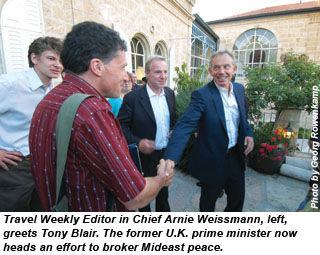 I knew Blair had been appointed to lead the Quartet (so called because its sponsors are the U.S., the European Union, Russia and the United Nations) in the Promethean challenge of enabling peace in the Middle East, but I had not kept up on his activities, and I certainly was unaware that tourism had become prominent in his strategies.
From what I knew of the state of tourism -- and politics -- in the tangled relationship between the West Bank and Israel, I wondered if even someone of Blair's stature could make meaningful progress.
West Bank story
The West Bank had experienced a dramatic rise in tourism investment from 1994 to 2000; more than $700 million was spent in those years, five times what had been invested in the previous 30 years.
But tourism evaporated after the Intifada of 2000-2005. Potential visitors were frightened away by the violence, which included a siege of the Church of the Nativity in Bethlehem in 2002.
When the turbulence subsided, the Israeli government, in the name of security, instituted measures that by their very nature were tourist-unfriendly. Abundant checkpoints made movement painfully slow and unpredictable.
Tour operators could never know with certainty how long it would take to get through any given checkpoint, nor even know the degree of scrutiny their guests would undergo before being permitted -- when permitted at all -- to get from point A to point B in the West Bank.
Additionally, Israel built a 25-foot concrete wall that not only separates Israel from Palestine but in many instances separates one part of Palestine from another. Israel says it is for security; Palestinians say it is an effort to institute "apartheid" in the Holy Land.
Some pilgrims were willing to put up with a certain degree of inconvenience and unpredictability to visit Christianity's holiest sites, especially Bethlehem's Church of the Nativity, built over the site believed to be Jesus' birthplace.
But other West Bank attractions, including ruins in Sebastia and Jericho, and even Old Testament sites like Jacob's Well in Nabulus or Abraham's Tomb in Hebron, disappeared from the itineraries of tour operators.
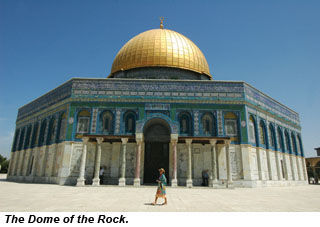 The Quartet plays a crucial role because the Israeli government and the Palestinian Authority are not officially speaking to one another. The Quartet's work typically involves shuttle diplomacy, outside regular diplomatic channels. Its mission is to work "from the bottom up," Blair told me, preparing a healthy society for Palestine in anticipation of a broader peace agreement.
The Quartet is also active in areas other than tourism, most notably Gaza's infrastructure, East Jerusalem housing and education.
Blair coordinates his efforts with President Obama's special envoy to the Middle East, George Mitchell, whose focus is to work out the broader "final stage" issues such as borders, the status of Jerusalem and refugees.
The Quartet has spent a lot of its energy working with Israel to ease mobility on the West Bank, and that's where the group can point to concrete results. Tim Williams, a New Zealander who holds the title "movement and access adviser" for the Quartet, said that facilitating the ability of people to get around the West Bank was his primary short-term goal.
Four years ago, a visit to the West Bank beyond Bethlehem was unsafe, he said. Security is no longer of concern for most tourists today, but the West Bank is still dotted with 580 manned checkpoints and unmanned roadblocks, often just mounds of earth that appear suddenly on roads, though he noted that the number has dropped by several hundred over the past few years. Key access points have been opened, and the intensity of inconvenience has been eased.
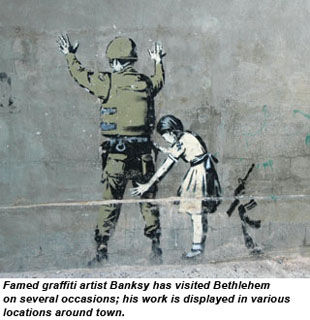 "A tourist who came here just two years ago and returned today would notice the improvement," Williams said. "Some of it is due to the Israelis' willingness to make adjustments; some is due to our engagement. The improved access to Bethlehem is definitely linked to our efforts. The improvements in Jalame [near Jenin] is definitely related to us, though its opening is still unreliable."
Williams understands that reliability is the key to getting tour operators to engage with the West Bank beyond Bethlehem. "Regularity is improving, but it takes awhile for tour operators to trust it," he said.
A key step toward expanding tourism in Palestine came when the Israelis, at the urging of the Quartet, provided greater access and facilitated improvements along Road 60, also known as the Road of the Patriarchs for those focused on the Old Testament and the Samarian Road by those oriented to the New Testament.
The road runs north-south almost the entire length of the eastern Holy Land, from Nazareth in Israel through the West Bank cities of Jenin, Sebastia, Nabulus, Ramallah, Jerusalem, Bethlehem and Hebron.
Our group went up the road from Bethlehem as far north as Sebastia, and except for a section that was still being improved between Nabulus and Sebastia, the trip went smoothly. We breezed through a checkpoint in Hawara that, according to Stefan Szepesi, a private development coordinator for the Quartet, used to be closed to vehicular traffic. "You would have to get out of your bus or car, walk across the border, and continue on by taxi," he said.
Traffic in and out of Nabulus, a center of resistance during the Intifadas, was particularly slow. "What used to take an hour now takes two minutes," Szepesi said. "Vehicle checks are much less intensive. The difference is night and day. Still not perfect -- occasionally, they'll inspect every vehicle -- but much more predictable."
Ian Smith, the Quartet's point person for tourism development, said the Quartet had asked the Israeli government for "unambiguous" assurances that checkpoints would be open, and the Israelis agreed. "But no one's going to be putting [Nabulus and Sebastia] into brochures until it has been tested."
As it happened, we were traveling Road 60 the same day that the Turkish flotilla had been stopped en route to Gaza by Israeli Defense Forces, with deadly consequences. As we set out that morning, Smith wondered aloud if the incident would lead to delays resulting from heightened security.
But Israeli soldiers who boarded our coach at the checkpoint connecting Bethlehem to the road to Jerusalem simply entered through the front door, walked the length of the aisle and exited through the back door, all in less than 60 seconds.
European tour operators in our group (no American tour operators had accepted the invitation to join), all of whom specialize in the Holy Land, were impressed with the ease of movement, and a few said they would be sending "pilot" tours to test the reliability of the new route.
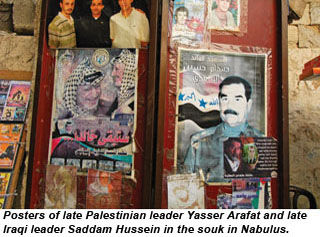 Referring to Road 60, Carlo Munns, a coordinator for Opera Romana Pellegrinaggi, a tour operator affiliated with the Vatican, said "I'm very pleased to go the way Christ went. I'm preparing a trip for September to see how it goes."
Of immediate concern to Georg Rowenkamp, managing director of Biblische Reisen, a German tour operator focused on the Holy Land, were rules defining which guides can work where. Israeli guides cannot work in the West Bank because Israel says it can't guarantee their safety in Palestine. So whenever one of Rowenkamp's motorcoaches crosses into the West Bank from Israel, an Israeli guide is replaced by a Palestinian guide.
"The passengers don't like it when the guide changes," he said. "Technically speaking, Palestinian guides are permitted to work in Israel, but they can have difficulty getting permits to do so."
Nevertheless, Rowenkamp was glad to see Road 60 open. "Right now, we use the Jordan Valley road, but it's not as interesting," he said.
USAID is also involved in tourism development on the West Bank, with about 30% of the money going to help businesses in the West Bank with tourism-related projects. A representative of the group said the level of funding is reflective of the opportunity and willingness of both the government and the private sector to come together and agree on a plan going forward. "They got serious," he said.
The Palestinian Riviera?
 In 2008, at the first Palestinian Investment Conference, tourism was relegated to one breakout session, which, according to Elisa Moed of the Christian social network and travel booking site Travelujah, was unproductive.
But during the second conference, held June 2 and 3 this year in the large, modern Bethlehem Convention Center, travel was one of three primary points of focus.
Among the hundreds in attendance were Blair; Abbas; Mitchell; diplomats and businesspeople from several European countries and the U.S.; prominent Palestinian politicians; and business leaders, regional investors and journalists.
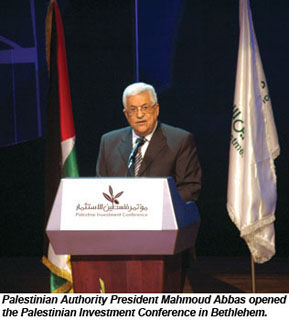
Abbas opened the conference with a fiery, hour-long political speech that began with a denunciation of the Israeli blockade of Gaza and Israeli actions against the flotilla. He articulated a lengthy list of grievances, called for national reconciliation and insisted on international help.
He made one reference to tourism: "All the Christians and Muslims in the world come here and pray here and get blessings here. Tourism can be the cornerstone of our Palestinian economy. But [Israel doesn't] want us to do this. ... People do not want to come here because they fear being stopped at a checkpoint and being humiliated by Israeli soldiers and kept waiting for hours."
That afternoon, however, a general session panel that focused exclusively on tourism was much more upbeat. Khouloud Daibes, Palestinian minister of tourism and antiquities, said her ministry was "close to announcing a Palestinian Promotion Board," a new public-private enterprise.
Familiarization tours would be offered to travel agents and tour operators. Daibes acknowledged that there were still challenges involving freedom of movement but, in a nod to Blair, said, "We are trying to solve it."
Blair spoke with exuberance, calling Palestine "the greatest tourist opportunity on Earth," and he pointed to recent increases in the number of tourists and hotel occupancy. He called on the audience to invest in tourism.
Zaki Khouri, a prominent Palestinian businessman who is chairman of the Palestinian Tourism and Investment Co. as well as a board member with other investment and holding companies, was sitting on Blair's left. He said that about 22% of his investments are in tourism-related projects, including Bethlehem's Jacir Palace InterContinental Hotel, and that his tourism investments would be increasing.
He said he was encouraged by Hilton's recent interest in expanding its presence in the Middle East, adding that he has invited Jumeirah, the luxury hotel company owned by Dubai's government, to "take a look" at opening a hotel in Palestine.
"Don't forget we have a Riviera in Gaza, with 200 chalets on the beach," he said. "We could build the best boutique hotels in the Middle East."
He acknowledged that employee-to-guest ratios in Palestine are far below international standards but said that this could be overcome. "The Swiss are not smarter than the Palestinians," he said.
Khouri challenged Blair to "tear down the wall and put in a 1,000-room hotel at Rachel's Tomb" in East Jerusalem. "Let's do it, even if we have an Israeli partner with us. But tear down the wall."
 Basil Eleiwa, chairman of Cactus, a large investment group in Gaza that focuses exclusively on hospitality (he also heads Gaza's hotel association), was optimistic about tourism.
"We have the location, central among three continents," he said. "We have a moderate climate and a hospitable nature. Political stability is the backbone of tourism development, but regardless of the siege, we have managed to build projects that are success stories."
He said that "despite the situation and suffering," he recently added rooms and expanded meetings space in one of his hotels. "And local people are investing their own money."
One of his properties had been destroyed at the beginning of the Intifada, he said, but his response was to build another.
"We understand the difficulties caused by the siege and closures," Eleiwa said. "But we're working on that."
As the conference came to an end, a tangible result was announced: Italy, France and the U.S. pledged $655 million to invest in Palestine's private sector for "information and communication technology, housing and tourism."
If barriers to traveling the region continue to be literally knocked down and the Palestinian economy and society are concurrently built up, tour operators can begin to approach Holy Land tourism as they would any other destination: logically, rather than politically, and with an eye on operations rather than on current events.
In the end, the best measure of Blair's progress in the Middle East might be the ability of a tour operator to practice business as usual in Palestine.
This report appeared in the June 21 issue of Travel Weekly.