A word to the wise: Do not lump Raleigh and Durham together
when speaking with the locals.
Talk to a booster of Raleigh, the North Carolina state
capital, and they’ll sing the praises of a local economy fueled in part by the
state government and medical industry, complemented by institutions such as the
free North Carolina Museums of Natural Science, Art and History and, as of this
summer, the world’s largest beer garden.
Drive 25 minutes northwest to Durham and you’ll find a
downtown area reinventing itself from its tobacco- and textile-industry past to
develop a thriving culinary, arts and entertainment scene fueled in part by
dozens of local startups.
Yet, with Raleigh-Durham Airport getting both more capacity
(Terminal 1 completed its renovation in April 2014) and kudos (it was named the
country’s ninth-best in a Conde Nast poll), the two cities’ hotel sectors have
been running parallel by steadily boosting inventory in recent years.
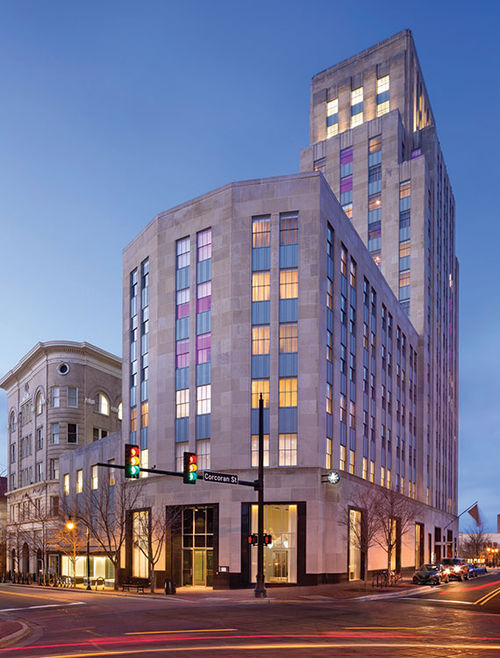
Downtown Durham’s new hotels include the 21c Museum Hotel, which opened in a 1930s Art Deco tower in March.
For Durham, it’s been a mix of boutique and chain hotels.
Chainlet 21c Museum Hotels, which specializes in including art galleries within
its upscale properties, added a 125-room hotel downtown in March. Meanwhile, in
July, both the independent Durham Hotel and the 147-room Residence Inn Durham
McPherson/Duke University Medical Center Area opened.
Raleigh, with more than 14 million annual visitors compared
with just 9 million for Durham, is apparently a safer bet for the larger
chains. Since last July, Raleigh has added four hotels totaling 535 rooms,
including properties under Marriott’s Spring-hill Suites, Residence Inn and
Courtyard brands as well as a Hilton Garden Inn.
The rapid expansion of Starwood Hotels & Resorts’ Aloft
boutique brand is perhaps the best reflection of the pull of what’s commonly
known as Research Triangle for its three superior research universities: North
Carolina State in Raleigh, Duke in Durham and, 15 miles southwest, the
University of North Carolina in Chapel Hill.
Starwood, which already had an Aloft property in Chapel
Hill, last month opened the 134-room Aloft Durham Downtown and opened the
135-room Aloft Raleigh earlier this month. The Aloft Raleigh-Durham Airport
Brier Creek is scheduled to open in March.
“We saw the need in the marketplace to expand in North
Carolina,” said Brian McGuinness, global brand leader of Starwood. “We know
it’s an aggressive footprint, but the demand is there, and the time is right.”
The area is home to about 28,000 hotel rooms, which puts it
on par with markets such as Cincinnati and Jacksonville, Fla., and about 10% fewer
than Charlotte and another buzzy student mecca, Austin, Texas, according to
STR.
Rates in the area remain relatively inexpensive. Factor out
the largest (and generally most expensive) 25 U.S. markets, and the average
hotel room price in the remaining U.S. markets through September was still
about 10% more than Raleigh-Durham-Chapel Hill’s $96 average, according to STR.
Still, the demand numbers bear out the strategies of
Starwood and its competitors. Raleigh-Durham’s revenue per available room
(RevPAR) through September was up 7.2% from a year earlier. And last year’s
RevPAR advanced 11%, which outpaced the 8.3% increase for the country and was
up 34% from recession-era lows of 2009.
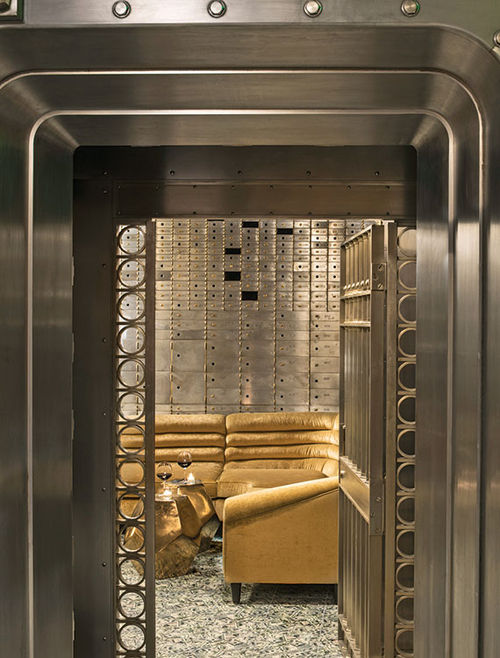
The 21c Museum Hotel's lounge was built out of the building’s old bank vault.
The combination of that increased demand and inventory of
older buildings drew Louisville, Ky.-based 21c Museum Hotels to open a property
in the area, its fourth nationwide. Redeveloped out of a 78-year-old Art Deco
building that was designed by Empire State Building architects Shreve Lamb
& Harmon, it originally housed a Home Savings Bank office on its ground
floor (the hotel’s lounge area was built out of the building’s old bank vault).
“It was a combination of what was already happening around
downtown Durham and the growth we saw that’s continuing to happen,” said 21c President
Craig Greenberg. “We were also really attracted to restoring a historic
property.”
History or not, the area’s growth as a technology hub
suggests a region with an eye fixed steadily on the future, say both Greater
Raleigh Convention and Visitors Bureau spokesman Ryan Smith and Durham
Convention and Visitors Bureau spokesman Sam Poley.
Poley said that, along with cities such as San Francisco,
Minneapolis and Austin, the Raleigh-Durham area is one of eight U.S. “tech
hubs” that are part of the Google for Entrepreneurs network of cities receiving
startup investment funding from the search-engine giant.
“There are startups everywhere,” he said.