In the Hot Seat
Yeti Holidays' managing director, Daman Pradhan, spoke with Travel Weekly's Johanna
Jainchill last week about repatriating 200 visitors on Yeti tours in Nepal and
helping get aid to stricken villages, as well as about the future of Nepali
tourism. Read More
I left Nepal just one month ago, bidding the small Himalayan
country one last “Namaste.” The universally recognized word, expressing both
hello and goodbye, is spoken and/or expressed in the graceful gesture of folded
hands.
Today, the country reels from the magnitude 7.8 earthquake
that struck on April 25 in both the center of the country and the heart of
every traveler lucky enough to have experienced its beauty.
So far, there are no definitive assessments of the extent of
damage to Nepal’s tourism infrastructure, but it is clearly extensive,
threatening a huge and lasting financial loss, given the crucial role tourism
plays in the country’s economy, just as it faces years of rebuilding.
One of the poorest countries in Asia, the tiny
Wisconsin-sized nation has suffered a long string of setbacks. It is still
struggling to overcome the legacy of a disabling 10-year Maoist insurrection
that ended in 2006, and since becoming a republic in 2008, a fractious Nepali
government has been unable to ratify a new constitution.
“The only thing holding the country together, it often
seems, is the strength, humor and tenacity of the Nepali people themselves,”
said Jeff Greenwald, the California-based journalist and author of “Shopping
for Buddhas: An Adventure in Nepal,” one of his three books set in the country.
While I had seen just a glimpse of Nepal and its hospitable
people during my too-brief, one-week visit, Greenwald has considered it a
second home for 30 years.
“This disaster tears at the roots of their society and will
be very challenging to overcome,” Greenwald said.
The staggering numbers that describe the toll, complemented
by graphic photos, have filled international media in much the same way as
other natural disasters that have rocked our planet in the recent past.
As of late last week, Nepal officials estimated that the
earthquake had claimed more than 5,000 lives, and that number is expected to
double as cleanup and triage operations continue. It also destroyed 70,000
homes, left more than 10,000 people injured and 200,000 homeless. It left 1
million children in need of critical care and triggered an avalanche that
killed 19 people (14 of them Sherpas) on Mount Everest.
Best estimates suggest that some 8 million of the country’s
29 million population have been affected.
“Aside from the human tragedy,” Greenwald reminded me last
week, “there’s a cultural disaster to contend with, as well.”
Nepal, specifically Kathmandu and the Kathmandu Valley, have
one of the world’s highest concentrations of Unesco World Heritage Sites.
Kathmandu, Patan and Bhaktapur are each anchored by a Durbar (Royal) Square at
their heart, studded with centuries-old palaces and multi-tiered temples, many
of which are now in rubble. There is still no word about whether or when any of
those treasures can be rebuilt.
On top of that, there is a constant threat of looting.
In the best of times, arriving at the Kathmandu Tribhuvan
Airport after an interminable flight from the other side of the world can feel
a lot like time travel. Today, the images coming out of the country suggest it
is chaotic and log-jammed, with tons of relief and medical supplies arriving
from all over the world, with China and India jockeying for favorite-neighbor status.
The supplies are urgently needed in remote and isolated
villages, many of which have been flattened and whose access roads, where any
survived, have been blocked by landslides. Special-strength tents will be
needed to shelter displaced victims from the monsoon season, just a few weeks
away.
In stark contrast, we had stayed in luxurious surroundings,
guests of the well-known Dwarika’s Hotel, eschewing the western ambience of the
city’s Hyatt Regency or Crowne Plaza for a self-contained world that exuded
local character.
An enclave of traditional architecture, the award-winning
boutique hotel was the passion of visionary Dwarika Das Shrestha. I was
relieved to hear that it had escaped serious earthquake damage, as had its new
sister property in the nearby hills outside of town.
Dwarika’s daughter, Sangita Einhaus, and her staff made sure
the hotel’s foreign guests sleeping in the open courtyardwere safe and
comfortable and were treated and cared for as if family.
Outside of town, the country club-like Gokarna Forest
Resort, where we had lodged just weeks before, now serves as a refuge for
hundreds of displaced families. Most sleep under tarps along the roadside, in
open lots or on the city’s parade grounds.
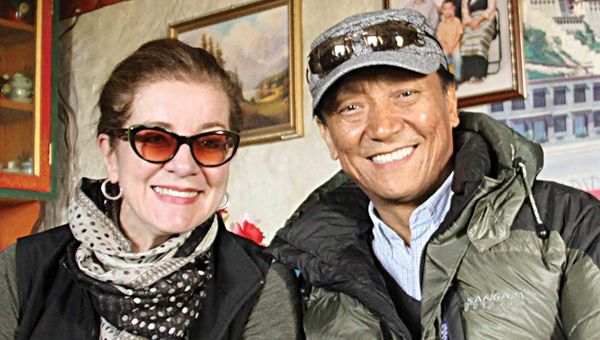
Author Patricia Schultz with the Crown Prince of Lo Manthang on her recent visit to Nepal. Photo Credit: Mollie Fitzgerald/Frontiers Travel
We had been introduced to the religious rite of cremation at
Pashupatinath, the gilded-roofed temple to Shiva and the country’s holiest
Hindu site. The temple, which also escaped earthquake damage, has long been a
major pilgrimage destination, with pyres along the banks of the sacred Bagmati
River, a tributary of the Ganges. The place was busy with cremations the day we
visited; now it is said they are taking place around the clock as well as en
masse across Kathmandu.
More of the spirituality woven into this small mountain
nation is on view at the Boudhanath Stupa, possibly the largest in Asia and
partially damaged by the earthquake, and the epicenter for the large Tibetan
Buddhist refugee community in Nepal, a group of people who now risk being
displaced twice in their lifetimes.
It is a swirling world of monks and devotees performing
their ritual perambulation (walking clockwise) around the white-washed stupa
wreathed with rainbow-hued prayer flags, turning prayer wheels on their way. It
was one of many times we were touched by the country’s deep attachment to
time-tested religious ways, something that will be sorely needed in the months
and years ahead.
We had come as a small fam trip for American Virtuoso and
Signature travel agents (accompanied by one token travel writer). The
destination management company that hosted our trip, Mumbai-based Ventours
International, had long been aware of Nepal’s exceptional attractions and had
created a once-in-a-lifetime itinerary that whisked us around by helicopter to
14,000-foot peaks for an alfresco breakfast overlooking Everest, then over
staggeringly beautiful landscapes to the little-visited ancient kingdom of Mustang.
Situated on the Chinese border with Tibet and until recently
ruled by the same family, whose members can trace their lineage to the 14th
century, Mustang is said to be even more Tibetan than Tibet itself.
Nepal’s tourism industry is the engine of its economy: One
of every nine Nepali is involved. Some 585,000 international visitors arrived
by air in 2014.
Those who come for trekking and mountaineering (the
Annapurna area near the lakeside town of Pokhara, Nepal’s trekking hub, was
relatively undamaged) will likely be the first to return when the
post-earthquake dust settles. Four hundred climbers arrive annually to attempt
reaching Everest’s summit, paying tens of thousands of dollars.
The larger issue is going to be long-term recovery efforts,
which by some accounts will take three to five years. So how can you help? A
good place to start is with any reputable international charity such as Unicef,
Nepal Red Cross Society, Doctors Without Borders, Oxfam International, Habitat
for Humanity and — Greenwald’s preference — Mercy Corps. Each of those groups
has people already on the ground in Nepal.
“Yes, the short-term tourism will clearly suffer badly,”
said Dr. Antonia Neubauer, founder of Myths and Mountains, who has been
offering trips to Nepal since 1988. “But come the fall, returning will be very
important to the people.”
Neil D’Souza, the co-founder of Ventours International,
agreed, predicting that “Kathmandu will
pick itself up, clean up its infrastructure and create a good administration.”
___
Travel Weekly Contributing Editor Patricia Schultz is the
author of the New York Times best-seller “1,000 Places to See Before You Die.”