The English explorer James Cook first landed in the Hawaiian Islands in 1779, and during that visit he stopped at Kealakekua Bay on the Big Island of Hawaii, meeting the island’s chief, Kalaniopuu.
During their encounter, the Hawaiian leader took off his ahu ula, or feathered cloak, and his mahiole, feathered helmet, and gifted them to the English explorer in a demonstration of goodwill. The cultural treasures were later taken aboard Cook’s ship and back to England, where they passed through the hands of various collectors and museums until 1912, when they were donated to the Dominion Museum in New Zealand, a predecessor of today’s Museum of New Zealand Te Papa Tongarewa in Wellington.
This March, Kalaniopuu’s ahu ulu and mahiole were returned to the Hawaiian Islands 237 years after leaving the Big Island through an exhibition exchange partnership between Te Papa Tongarewa, the Bernice Pauahi Bishop Museum in Honolulu, and the Office of Hawaiian Affairs.
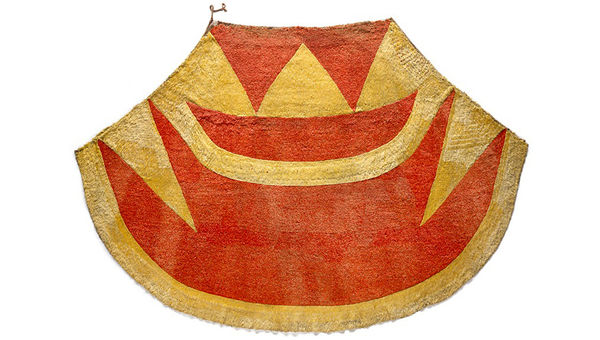
Kalaniopuu’s ahu ulu (feathered cloak) and mahiole (helmet) will be on display at the museum as part of a long-term loan. Photo Credit: Courtesy of Te Papa Tongarewa
“I’m grateful to witness the return of these cultural heirlooms,” Kamanaopono Crabbe, the CEO for the Office of Hawaiian Affairs, said in a March statement. “The return of the ahu ula and mahiole to Hawaii is a cause for celebration, and it will be a source of inspiration, reflection and discussion amongst Native Hawaiians, Hawaii residents and visitors alike.”
Today, Oahu visitors can enjoy an up-close look at the feathered cape and helmet at the Bishop Museum, where the objects are scheduled to remain on long-term loan.
“The exhibit space at Bishop Museum will be called He Nae Akea: Bound Together,” Blair Collis, the Bishop Museum’s former president and CEO, said in a statement this spring. “This reflects the connection of Kalaniopuu to his land and people, the connection between the peoples, nations, and cultures throughout the centuries who have cared for these treasures, as well as the connection between the three institutions directly involved in this loan.”
Ahu ula, mahiole and all other feather work were traditionally reserved exclusively for Hawaiian alii, or royalty, “symbolizing their chiefly divinity, rank and power,” according to museum officials. Creation of the feather cape and helmet was also extraordinarily labor-intensive and performed by talented artisans. The ahu ula alone features feathers from about 20,000 birds.
Museum officials noted that collecting the prized red and yellow feathers was work traditionally performed by “skilled trappers [who] caught the birds by employing various techniques, such as snaring their prey midair with nets, or using decoy birds to lure them onto branches coated with a sticky substance. They often harvested only a few feathers from each bird before releasing them back into the wild.”
Honolulu’s Bishop Museum is open every day from 9 a.m. to 5 p.m. Admission is $22.95 for adults and $14.95 for children 4 to 12. Visit www.bishopmuseum.org.