Mpumalanga, also known as "the land of the rising sun," is home to the iconic Kruger National Park and is undoubtedly one of the most popular provinces in South Africa. Take the time to explore it, and you'll find the region has much to offer beyond the park.
Undoubtedly on the bucket list of every wildlife lover in the world, Kruger is of course not to be missed when visiting Mpumalanga. Home to thousands of animals, from giraffes to buffalos to elusive big cats, the park boasts 16 different ecosystems and along with the much sought-after Big 5, there are 147 species of animals and 507 species of birds.
There's no shortage of accommodation options in the region, from luxurious and award-winning five-star, private lodges to simple and rustic accommodations within the camp.
The private game lodges in Sabi Sand Private Game Reserve adjoining Kruger are renowned for their luxury offering throughout the world. Lodges like Sabi Sabi, Singita and Lion Sands all offer travelers individual attention, privacy, outstanding cuisine and the most lavish accommodations. Most of the guides at these lodges know every inch of the area and will be able to help you experience rare leopard sightings or direct you to hiding places of wild dog pups.
Although the experience in a private lodge is unparalleled, the more affordable and rustic options at the Kruger National Park also have their unique appeal. There's nothing more "real" or "authentic" than having a braai (barbecue) in front of the campfire or hearing the roar of the lion while sleeping in a safari tent at the Lower Sabie Restcamp.
Beyond Kruger, however, visitors will find breathtaking views, plunging waterfalls, high-adrenaline eco-activities and a rich history ... that's just for starters.
The best scenic views in the province can be seen while traveling along the Panorama Route. Travelers will love the Blyde River Canyon, which is dotted with breathtaking sites such as the Three Rondavels and Bourke's Luck Pothole. And no description or brochure can prepare you for the spectacular view from the aptly named God's Window, known as one of the most scenic vantage points in South Africa. Majestic cliffs plunge down more than 2,000 feet from the viewpoint and, on a clear day, you'll be able to see over Kruger toward the Lebombo Mountains on South Africa's border with Mozambique.
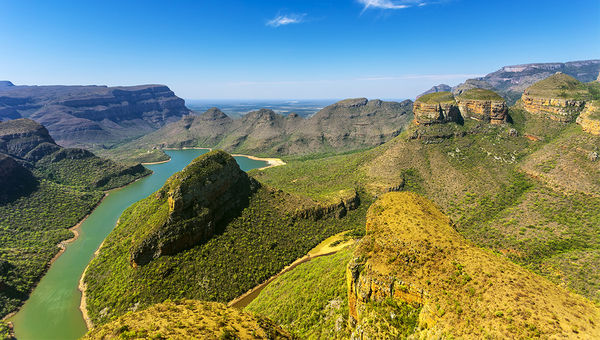
Along the Panorama Route, visitors will take in the sites such as the Blyde River Canyon and the Three Rondavels. Photo Credit: Shutterstock/WitR
Also on the Panorama Route are some of South Africa's most beautiful waterfalls, Lisbon Falls being the most dramatic. Berlin Falls and Mac Mac Falls are also sure to wow travelers as the water plunges down rugged cliffs in beautiful natural surroundings. The waterfalls owe their names to the European miners who came to try their luck in the area in the heady days of the gold rush in the 1800s. They named the falls after towns and places in their home countries.
To learn more about the province's rich gold-mining history, a visit to the quaint little village of Pilgrim's Rest, a settlement lost in time, is a must. Here you'll be able to walk in the footsteps of early gold prospectors, visit the Alanglade House, once the mine manager's home, and drink in a legendary bar. To make the historical stay complete, book a night in the Royal Hotel, which was built in 1894. Expect to sleep in brass bedsteads and relax in ball-and-claw baths.
For the more adventurous travelers, Mpumalanga offers a wide range of eco-adventures. Visitors can choose to abseil down Mpumalanga's beautiful mountain peaks and cliffs with trained guides at their side. For those who want to go down a tad faster, the Big Swing is the highest cable Gorge Swing in South Africa and will give you the experience of a 220-foot freefall in under three seconds.
Travelers can take a more leisurely approach to eco-adventure with a whitewater paddling experience on the Sabie River. They'll be able to take in the scenery as well as test their skills on the gentler rapids, go for a swim and even bum-slide down the river.
Caving enthusiasts will be able to explore the biggest and most well-known cave system in South Africa, the Sudwala Caves. In the early 1900s, during the Second Boer War, Sudwala Caves were used to store ammunition. According to adventure tour operator Dirty Boots, legend has it that the caves may be the hiding place of the famous Kruger Millions, the large freight of gold bullion that disappeared somewhere between Waterval Onder and Nelspruit.
Mpumalanga travel tips:
Best time to visit: Late winter (August to October) is the best time for game-spotting in the Kruger National Park, as the grass is low and animals are dependent on waterholes.
The best time for hiking is during autumn (from March to May) and spring (September to November).
Summer tends to be very hot but scenically very beautiful, and there are lots of baby animals to see.
Getting around: It's best to hire your own vehicle to navigate the area at your own pace. If you want to explore Kruger National Park on a self-drive, it's advised to rent a minivan because you'll sit high up and have a better chance to spot game.
How long to stay: A weekend will suffice for a quick look around but plan to stay at least a week to do justice to the region and visit the Kruger National Park.
Documentation: U.S. citizens don't need a visa for travel to South Africa. However, remember that when traveling with children, travelers will need to be able to present an unabridged birth certificate, which contains details of both parents.
Health requirements: Protection against malaria is essential if you're planning to travel northern and northeastern Mpumalanga, notably Kruger. The highest risk is during the hot, rainy months from November to April. The risk is reduced during the cooler, drier months from May to October. Your doctor will advise which kind of anti-malarial tablets to take.
The best protection against malaria is to avoid getting bitten by mosquitos. Malaria-carrying mosquitoes are active between dusk and dawn, so cover yourself well during this time. Sleep under a mosquito net when possible and wear long sleeves and pants.