DENVER — The lobby at the Brown Palace Hotel and Spa here
includes an exhibit displaying the long list of U.S. presidents who have stayed
at the property, a small shrine of sorts to the history of the iconic hotel.
A
10-minute drive away, the Bud+Breakfast at the Adagio’s lobby features a shrine
of a different kind: a case of glass bongs, including the epic, enormous Big
Bertha, which guests can use to smoke marijuana.
That is the yin and yang of this city’s lodging market,
where the more recent additions blend tradition with progressive social change.
Like many U.S. metropolitan areas, the Mile High City has
seen a resurgence in its downtown and surrounding neighborhoods over the past
decade as locals and visitors explore by foot, rediscovering the city’s
historical gems.
This rebirth is well-represented by a trio of historical
properties that line downtown Denver’s 17th Street plus a fourth inn nearby,
all of which have either opened or have been substantially tweaked within the
past couple of years.

The Renaissance Denver Downtown City Center was redeveloped out of the old Colorado National Bank Building and uses its old vaults for meeting rooms. Photo Credit: Danny King
With the downtown’s diagonal stretch of 17th Street, bookended
by Union Station on the northwest and the Brown Palace on the southeast, a
natural place to start is at the train station and its Crawford Hotel. Named
for local preservationist and developer Dana Crawford, the 112-room hotel
opened in July 2014 as part of the $54 million face-lift to the 135-year-old
railway station.
Cleverly integrated around the station’s light-filled and
bustling Great Hall, restaurants and retail outlets, the hotel features three
types of rooms, with many offering views of the arriving and departing trains:
the Classic offers a slightly Victorian bent; the Pullman combines the train
theme with nods to art deco design and the Loft rooms are located in the
station’s former attic and feature funky, slanted ceilings mixed with the building’s
original massive, exposed wood timbers.
More importantly, the hotel offers guests easy access to
Union Station restaurants such as Mercantile Dining & Provision and local
outposts of the Snooze breakfast spot, the Pigtrain Coffee Co. and the Milkbox
Ice Creamery. The station’s Great Hall doubles as the hotel’s lobby.
The Renaissance Denver Downtown City Center, about eight
blocks up the street, also opened in 2014, and while the Marriott-branded hotel
doesn’t match the scale of Union Station, its lobby area is just as stunning
and its history no less significant. The former Colorado National Bank building
first opened in 1915 and played a key role in the development of downtown
Denver. It was reconfigured two years ago as a 230-room hotel whose multilevel
lobby spans the city block and features 16 giant, restored murals originally
painted in 1925, depicting Native American life on the plains.
Upstairs, the rooms reflect a departure of sorts, as the
design and amenities lean to the more modern, with splashier artwork,
headboards that have a midcentury feel and the internet connectivity of a
newbuild property.
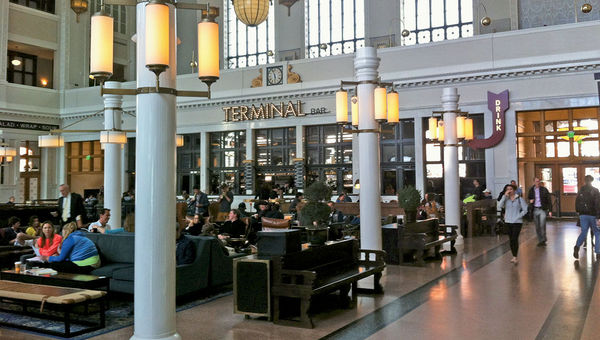
The Crawford opened in July 2014 as part of Union Station’s $54 million renovation and redevelopment. Photo Credit: Danny King
Where it most deviates from the conventional is with its
meetings rooms, three of which were built out of the former bank’s vaults,
complete with steel doors that are 3 feet thick. Weighing 60,000 pounds each,
it is not surprising that they remain open at all times.
Following a more traditional route is the sandstone-clad
Brown Palace, which later this year will celebrate its 125th anniversary. Opened
in 1892, the Brown is Denver’s oldest continually operating hotel (the Oxford
opened a year earlier but has been closed at times). Having joined Marriott’s
Autograph Collection soft brand in 2012, the Brown Palace completed a
three-year, $10 million renovation project last year. Most of the rooms were
updated to feature tasteful, somewhat conservative decor, although the top
floor’s 33 units, also known as the Top of the Brown, retain a 1930s-era, art
deco charm that’s slightly funkier.
The real star of the property, though, is the central
atrium, where guests can enjoy afternoon tea and sandwiches, listen to live
piano music and gaze up at multiple levels of ornate wrought-iron terraces and
stained glass.
The downtown properties help form the heart of Denver’s
lodging market, whose approximately 44,000 hotel rooms put it on par with
metropolitan areas such as Philadelphia, San Antonio and Tampa/St. Petersburg.
Area hotels have benefited from tourism numbers that set an annual record in
2013 and beat that mark by 10% in 2014, the most recent year tracked: Denver’s
revenue per available room (RevPAR) has risen 25% since 2012, outpacing the
country’s 21% RevPAR growth rate.
How much of that surge is attributable to Colorado in
late 2012 becoming the first state to legalize recreational marijuana use is
open to debate. Talk to Jayne Buck, the vice president of tourism at Visit
Denver, the city’s convention and tourism board, and she’ll tell you that
factors such as the city’s art museum, its botanical gardens and the influx of
highly regarded restaurants has made Denver more of a regional leisure draw to
feeder markets such as Houston, Dallas and Chicago.
And on the business front, conventions for the health
care, energy and technology sectors have more than made up for any shortfall
from the oil market.
Buck adds that there’s been no data proving that
marijuana legalization has had either a positive or negative impact on visitor
numbers.
“It may make us look a little progressive,” she said.
“But we’re not using that as a draw for the city.”
Still, a stroll through parts of the city will reveal a
plethora of “no smoking” signs on establishments and at least one cheeky
billboard referencing a cannabis food-snack, not to mention the occasional
cloud of herb.
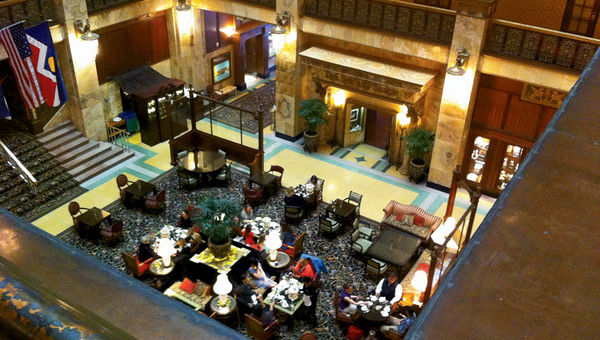
The Brown Palace, which opened with its iconic atrium in 1892. Photo Credit: Danny King
Which brings us to Bud+Breakfast at the Adagio. Long a
Victorian fixture in the historical Cheesman Park neighborhood about two miles
southeast of downtown, the former Adagio Bed and Breakfast was taken over by
the owners of the fledgling Bud+Breakfast brand in April 2014 for what is
regarded as Denver’s first cannabis-themed inn. The brand also has two other
Colorado properties, with a fourth slated to open this summer.
Granted, the classical music-themed rooms, named for composers such as Vivaldi,
Handel and Copland, aren’t out of the ordinary for anyone who has visited a bed
and breakfast; they sport a warm, comfortable, lived-in feel.
Where things depart from the ordinary is that guests are
welcome to smoke pot in the inn’s lobby area and back patio, which features an
all-hours hot tub, and they can even borrow Big Bertha. In-room imbibing is
also allowed, but only if the guests use one of the inn’s vaporizers.
In addition, there’s a massage room, where guests can
order a rubdown that include cannabis oil for pain relief, producing, in the
words of one of the innkeepers, a “body high.”