NEW YORK -- At first glance, my spacious Premier King Room at the Equinox Hotel New York looked like a textbook example of modern luxury hospitality.
The sleek aesthetic, sophisticated neutral palette and floor-to-ceiling windows all delivered exactly what I'd expected from the Hudson Yards property, which opened in 2019 as the first hotel from fitness brand Equinox.
But a tour of the space with general manager Jeff Rednour quickly revealed that this was no ordinary luxury room.
It was one of four Premier Kings the Equinox has transformed into The Sleep Lab, an experience developed in collaboration with sleep neuroscientist Matthew Walker, founder and director of the Center for Human Sleep Science at the University of California, Berkeley.
A Sleep Lab stay starts at $1,700 per night, about a $350 nightly premium over standard Premier Kings. (Not yet available through the GDS, commissionable rates are available by contacting the hotel directly.)
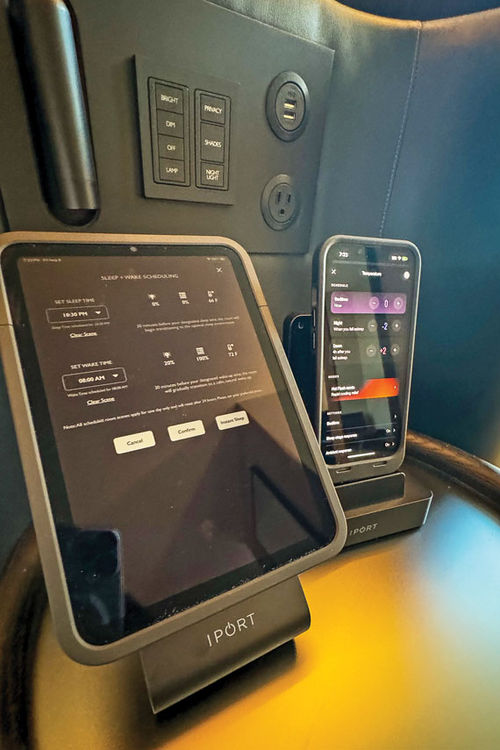
A pair of bedside digital devices allow guests to adjust their mattress topper and room sleep settings before winding down for the night. Photo Credit: Christina Jelski
The concept, which was launched last month, builds on what Rednour calls Equinox Hotels' ethos to create optimal "dark, quiet and cool" sleep environments across all its guestrooms, thanks to signature amenities like heavy-duty window blinds with side zippers; enhanced sound insulation; and breathable Coco-Mat mattresses. The hotel takes light elimination so seriously, it has special permission from safety officials to disable the LED indicators on in-room smoke detectors, committing to frequent inspections as part of the agreement.
The Sleep Lab program layers on top of this already sleep-friendly foundation, sometimes literally. Central to the experience is a high-tech mattress topper, which turns each side of the bed into a personalized climate zone and tracks sleep performance, offering an official "sleep report" the following morning. The topper, from a company called Eight Sleep, uses AI-powered sensors to monitor heart rate, breath rate and more while guests sleep.
Using a bedside device, Rednour helped me customize the topper with Walker-recommended settings designed to mimic natural temperature patterns. The system would begin cooling at bedtime, drop further during deep sleep, then gradually warm toward morning. As a final touch, the topper gently vibrates at wake time.
The whole process is enhanced by the room's built-in "sleep and wake" features: guests use the in-room iPad to set a bedtime, before which the AC kicks into high gear, the lights gradually dim to darkness and the motorized blinds descend. Come morning, the process reverses. A half hour before waking, the room warms, the lights brighten and, once it's time to get up, the blinds open automatically.
One of the Sleep Lab's most unique features isn't in the bedroom; it's in the bathroom. The room's shower has a pair of hydrotherapy features: a 20-minute hot steam option, with a lavender- and frankincense-infused aromatherapy oil, and a cold shower function that delivers 40 seconds of ice-cold water at the push of a blue button.
Getting ready for bed
After this comprehensive tour, I was ready to put Walker's theories to the test.
Around an hour before my 10:30 bedtime, I took the steam shower for a spin, wrapped myself in a robe and headed to the room's expansive minibar, stocked with not only snacks and beverages but wellness supplements, self-care products and fitness offerings.
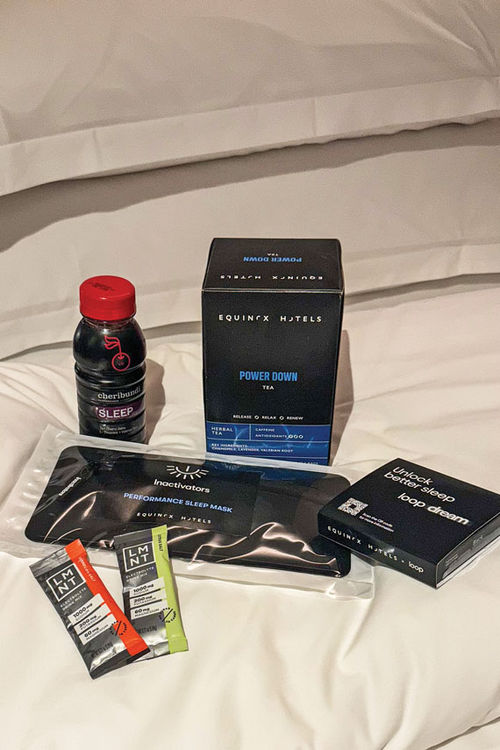
Select minibar items are included as part of The Sleep Lab experience. Photo Credit: Christina Jelski
Select items are complimentary as part of the Sleep Lab experience, including a bottle of tart cherry juice, said to be a sleep-inducing food, and a "Power Down" herbal tea, with chamomile, lavender and valerian root.
I limited myself to half the juice and, a bit later, a half cup of tea, wary of the fact that a too-full bladder can derail even the most optimized sleep experience.
Post-teatime, I noticed the room cooling, so I crawled into bed. Just as Rednour promised, the lights dimmed and the blinds closed. Despite my typical night owl nature, I fell asleep relatively quickly.
Morning was ushered in with the mattress topper's vibration and gradually brightening lights. Soothing, ambient music filled the room as the blinds rose. I ended my Sleep Lab experience with the cold shower -- not quite the full, freezing 40 seconds but a brief blast that left me remarkably alert.
Based on my "good" sleep quality score of 94, I apparently passed the Sleep Lab with flying colors. At $1,700 per night, the experience doesn't come cheap, but then again, as any chronically tired traveler will tell you, getting a full night's rest can feel pretty darn priceless.