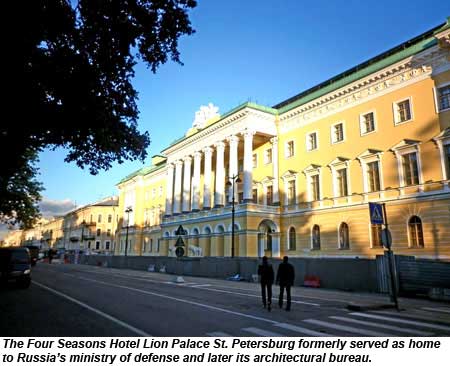
 In 1833, Russian author Alexander Pushkin used the poem "The Bronze Horseman" to reference the pair of lion sculptures at the entrance of the one-time St. Petersburg home to Russian Princess Cleopatra Lobavona-Rostovskaya.
"Two sentry lions stood at guard like living things, and kept their ward with paw uplifted," Pushkin wrote.
As of July, guests can get a different kind of royal treatment at what's now the Four Seasons Hotel Lion Palace St. Petersburg by way of spa treatments, gilded-edge mirrors, and caviar at a place called the Xander Bar. And they'll get some WiFi to boot.
That combination of old-school opulence and new-school extravagance is becoming slightly more commonplace, as there has been a mini-trend of luxury hotels popping up around Europe converted from centuries-old buildings.
Most recently, a handful of European buildings that once served as palaces, libraries, banks, government administrative buildings or upper-crust homes have either been reopened or are being repurposed as luxury hotels within the central districts of some of the world's most visited cities. (View a slideshow of some of the properties here or by clicking on any of the images.)
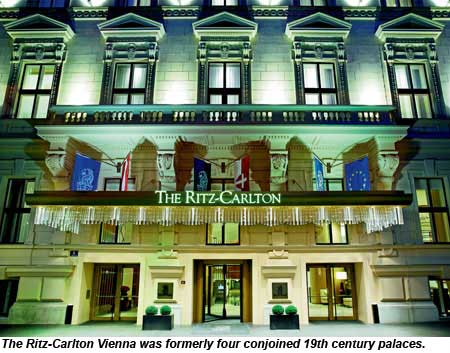
Last August, the Ritz-Carlton Vienna reopened in what had formerly been four conjoining palaces built between 1865 and 1871. They had subsequently been used as a bank. That hotel, Austria's first under the Marriott International luxury brand, has 202 rooms and a 3,300-square-foot ballroom as well as a rooftop bar.
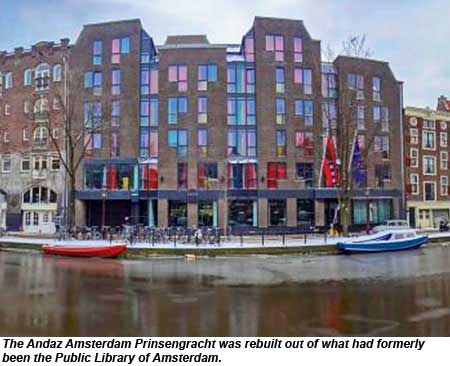
Two months later, Hyatt's Andaz luxury boutique brand entered continental Europe with the Andaz Amsterdam Prinsengracht, a 122-room hotel rebuilt out of what had formerly been the Public Library of Amsterdam. It includes a rear facade dating to 1897.
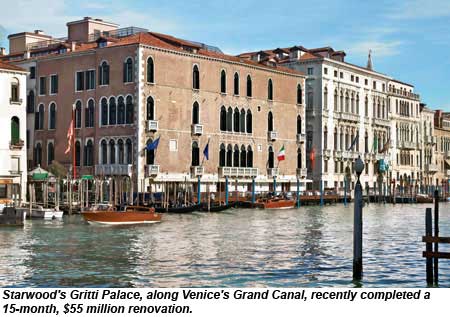
In Venice, Starwood Hotels & Resorts' Gritti Palace features sections along the city's Grand Canal that were once private residences and date to the 14th century. The 82-room property had operated as a formal hotel since the late 1900s, but it was reconfigured for its most recent incarnation and reopened in February after a 15-month, $55 million renovation that included both aesthetic and structural improvements.
 Meanwhile, the aforementioned Four Seasons Hotel Lion Palace St. Petersburg, Four Seasons' first in Russia, welcomed guests this summer to its 177 rooms, reconfigured from a building that had served as home to Russia's ministry of defense and later (and appropriately) its architectural bureau. The building was first constructed in 1817 next to the city's St. Isaac's Cathedral for Princess Cleopatra.
And Amsterdam's first hotel under Hilton's Waldorf Astoria luxury badge will see the light of day in 2014 after its transformation from a half-dozen canal houses built in the 17th and 18th centuries. Those houses, which were eventually converted to a bank headquarters building, will house 94 well-appointed rooms when the hotel opens next March.
The recent spate of conversions reflect a marriage of convenience of sorts. Unlike the adaptive reuse trend in the U.S. in which many urban hotels are emerging from former office buildings and department stores that were built in the early 20th century, many of the European buildings are a century older than that, and some are owned by European governments.
And while these entities look for ways to boost income by selling well-located government buildings, hotel developers are looking to snap up that rare, center-city piece of real estate with the belief that the eventual room rates will be high enough to cover the exorbitant costs of redevelopment.
A flexible tenant
"Many European governments are on austerity plans, need to cut budgets and are looking to increase their coffers, so some of these iconic buildings are being sold to developers," said Elizabeth Winkle, London-based managing director for STR Global. "A hotel is flexible enough as a tenant or owner that they won't destroy the fabric of the building."
Granted, this trend isn't limited to continental Western Europe. In Washington, D.C., the Trump Organization has entered into a long-term lease for the federal government-owned Old Post Office Pavilion and will redevelop the site into a luxury hotel. That property, which will receive about $200 million in funds, will have more than 270 rooms and is slated to open by the end of 2015.
In Istanbul, the 115-room Pera Palace, which originally opened in 1892 as a luxury rooming house for travelers arriving on the Orient Express, reopened in 2010 after an extensive renovation and was taken over last year by Dubai-based luxury hotelier Jumeirah.
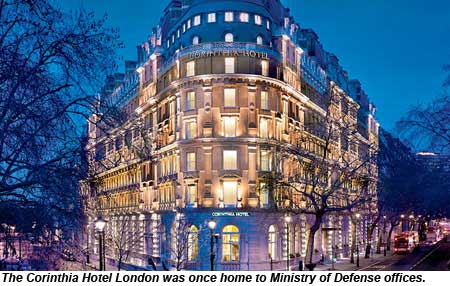 In Britain, the 294-room Corinthia Hotel London first opened as a hotel in 1885 but was subsequently converted to offices for the U.K.'s Ministry of Defense. It reopened in 2011 following an estimated $495 million upgrade.
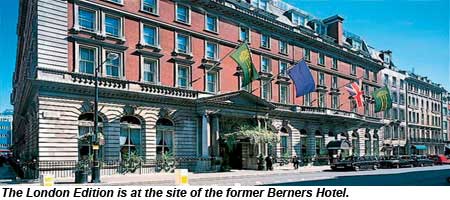
Even the uber-chic Ian Schrager has gotten into the act. The boutique hotelier, who's partnering with Marriott International on expanding the much-talked-about but largely delayed Edition brand, this month opened that brand's first London hotel in a Fitzrovia-district building that started life in 1835 as a group of townhouses before being transformed into the former Berners Hotel in 1908.
Still, many of these conversions are taking place within Western Europe, a region that remains a primary destination for wealthier global travelers. For the first six months of 2013, international tourist arrivals to and within Europe were up 5% from a year earlier, as the draw of the cities continued to outweigh the effects of a lagging economy throughout the southern part of the Continent, according to the United Nations World Tourism Organization (UNWTO).
And while Asian countries such as Thailand, India and South Korea are experiencing some of the world's fastest growth rates when it comes to international tourism spending, Western European countries like Spain, France, Italy and the U.K. remain among the top 10 countries with the highest international tourism receipts, according to UNWTO data.
That cities like Amsterdam, Vienna and Venice remain such a strong draw for luxury travelers is a good thing, because renovating such historical structures is not a cheap proposition. In addition to the expensive prospect of either updating or replacing long-outdated mechanical and operational building systems, development costs spike further on factors such as narrow city roads and hemmed-in properties that restrict construction access.
 Additionally, the developers in many cases are obligated to work with city governments and cultural entities to ensure that a certain degree of architectural integrity is maintained.
Then there are the site-specific issues that arise only when dealing with centuries-old buildings. In addition to aesthetically tying together what originally had been three buildings that became the Gritti Palace while working with the Venice Fine Arts Committee on design mandates, Starwood was faced with the challenge of the city's frequent flooding, which inundated the hotel's ground floor. And the problem is only going to grow worse, since scientists say Venice is sinking by as much as two millimeters a year.
To keep the bottom of the hotel dry, Starwood surrounded the building with a concrete barrier that went 10 feet into the foundation and rose 28 inches above ground. Chuck Chewning, creative director at Donghia Associates, which was responsible for the interior redesign of the hotel, likened that construction effort to building an underground swimming pool.
As a result, Starwood spent $55 million on the upgrades, or more than $670,000 per room, in an effort to structurally upgrade the property while maintaining and restoring centuries-old touches such as casings, wood-beamed ceilings and even some of the original terrazzo floors.
A sense of place
"A lot of money went into that reconstruction and waterproofing of the property," Chewning said. "A lot of the work was bringing in 21st century amenities to the property while still making sure it had a sense of place."
It's that sense of place that appears to permeate each of the recently converted hotels. In addition to the aforementioned marble lions, the Four Seasons St. Petersburg features Corinthian columns and the original stone staircase at its facade, vaulted ceilings in the lobby and mahogany in-room fixtures.
True to the brand's reputation, the Ritz-Carlton Vienna includes the building's original marble staircase as well as original wood carvings and paneling throughout the building. The hotel also pays homage to the city's classic design by way of the golden ceiling frescoes in the hotel's lobby lounge and the half-million crystals covering the hotel's Crystal Ballroom.
The traditional references at the Andaz Amsterdam Prinsengracht, which is located between the Prinsengracht and Keizersgracht canals, reflect a structure with a more checkered history, as the two buildings that make up the property were essentially rebuilt in 1977 when the property became a library. Still, the hotel's late-19th century rear facade has been restored, while the hotel includes a library with a crystal chandelier and Dutch-styled, hand-painted numbers on the room entrances.
 Nearby, the Waldorf Astoria Amsterdam is ensured of maintaining at least the external architectural integrity of its former buildings because of its location within the Amsterdam Canal District, which in 2010 was declared a Unesco World Heritage site for its layout and well-preserved architecture. The property will also feature a grand staircase built by 17th and 18th century French architect Daniel Marot.
While costs associated with such reconstruction efforts dwarf what a developer would likely spend building a brand new hotel of the same size, guests appear to be willing to pay for such irreplaceable touches, judging by the hotels' room rates. With rates in Europe averaging almost $136 a night in July, the most recent month tracked by STR Global, rooms at such reconstructed hotels sell for a multiple of that amount.
Weekend rates in mid-October for rooms at both the Ritz-Carlton Vienna and Four Seasons St. Petersburg start at about $500 a night and work their way up to more than double that amount for larger suites.
Gritti Palace rates are even pricier, with rooms on the Grand Canal starting at about $2,000 a night and the hotel's Presidential Suite priced at more than $12,000 a night.
While the Waldorf Amsterdam hasn't started taking reservations, rates at the Andaz Amsterdam start at about $400 a night and top out at about $1,000.
Tradition seasoned with modernity
Despite the architectural pedigree, these hotels' guests won't be paying for just museum pieces. The Andaz Amsterdam appears to be the most forward-leaning of the bunch, featuring touches such as 40 pieces of video art spread throughout the hotel, a cat-themed hologram along the wall that connects the two buildings and modern concrete bathroom furnishings.
Meanwhile, Amsterdam's Waldorf Astoria will have a 5,500-square-foot health club and spa as well as a bar built into the building's old bank vault.
Modern luxury-hotel mainstays such as a rooftop bar with city views and an indoor swimming pool are part of the Ritz-Carlton Vienna experience.
While St. Petersburg's Four Seasons promotes the buildings' history extensively, the hotel also includes built-in flat-screen TVs in its bathrooms, top-floor guestrooms whose terraces have heated floors, and a lounge called Xander Bar that features dozens of vodkas and caviars.
 And as part of the Gritti Palace renovation, 10 rooms were removed in order to ensure proper-sized guestrooms and bathrooms, while especially flush guests can reserve a two-level suite that includes a 2,700-square-foot terrace with a pool and Jacuzzi.
The hotel also goes cross-historical with one suite designed with furniture inspired by 1970s-era Donghia designs and a "Peggy Guggenheim Patron Grand Canal Suite" with furnishings and art reflecting the modernist tastes of that noted art collector.
"The general philosophy of the work was to maintain the romance and the ambience of the old Gritti, but at the same time it was important to make it attractive and interesting to a younger clientele," said Donghia's Chewning.
That said, the hotels' locales and price points will likely ensure that their recent face-lifts will appeal to a clientele familiar with their own nips and tucks.
"These hoteliers are investing in technology and an atmosphere that appeals across all generations," said STR Global's Winkle. "But I imagine that if you spoke to the development teams, the younger generation is not likely to be their target market."
Follow Danny King on Twitter @dktravelweekly.